From idea to patient: the whole journey
📍 Where we are: Stop 1 of 21 · the very beginning — a map of the whole trip before we set out.
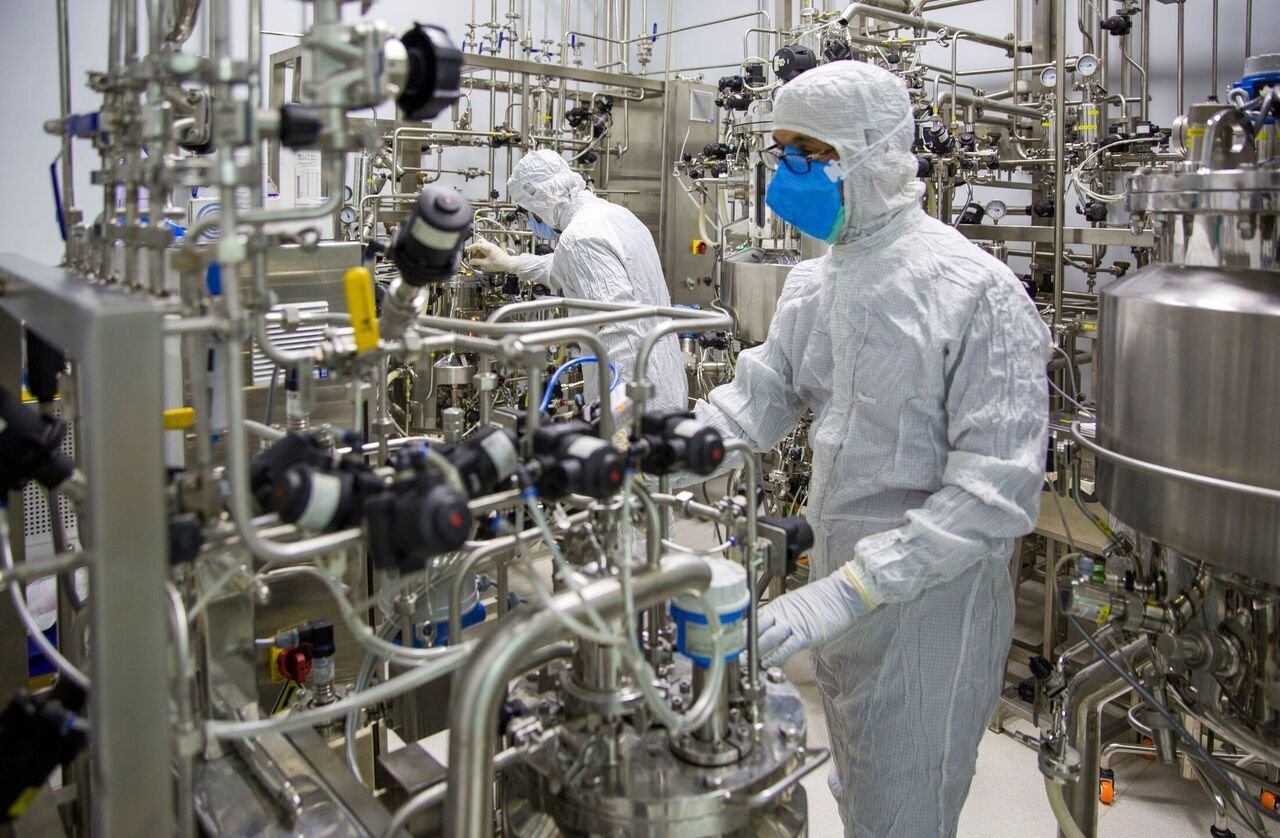 Inside a GMP biomanufacturing suite: gowned operators tend the stainless-steel vessels and piping where a biologic drug is grown. This whole book is the story of how a medicine reaches a room like this — and everything that happens after.
Biopharmaceutical production suite. Image by Tehran Times, CC BY 4.0, via Wikimedia Commons.
Inside a GMP biomanufacturing suite: gowned operators tend the stainless-steel vessels and piping where a biologic drug is grown. This whole book is the story of how a medicine reaches a room like this — and everything that happens after.
Biopharmaceutical production suite. Image by Tehran Times, CC BY 4.0, via Wikimedia Commons.
Welcome. This guide explains how one kind of modern medicine is made, from the first spark of an idea all the way to a vial that helps a real patient. You need zero background. If you are curious and fifteen-ish at heart, you are exactly the right reader.
The medicines we are talking about are not invented in a lab dish and forgotten. They are household names. If you or someone you love has taken Humira for arthritis, Keytruda for cancer, Rituxan for lymphoma, Remicade for Crohn's disease, or Avastin for a tumor, you have already met this kind of medicine [1]. Every one of them is a monoclonal antibody — and every one of them is grown by living cells in a tank, not mixed in a beaker. This guide is the story of how that happens.
The big idea to hold onto: this medicine is not mixed together like a recipe in a bowl. It is grown by living cells, then carefully cleaned up and packaged. Think of it as farming followed by refining, not cooking.
Imagine you need a tiny, perfect key that fits one specific lock in the body. You cannot carve this key by hand — it is far too small and intricate. So instead you train tiny living "factories" (cells) to make the key for you, by the billions. Then you wash away everything that is not the key, pour the keys into clean little bottles, and ship them to people who need them. That is this whole guide, start to finish.
What this chapter covers
This is the map you look at before the road trip. We will name the kind of medicine we are making and how it differs from an ordinary pill. We will lay out the four big acts of the journey, with one guardian — Quality and Regulatory oversight — wrapped around all of them. Then we will untangle the single most confusing thing for newcomers: that there are really two clocks running, a slow one-time clock to invent and approve the medicine, and a fast repeating clock to make each new batch.
We will meet the two ways factories actually run — the standard fed-batch method and the modern continuous one. We will ground all of it in real companies, real equipment, and the real rulebooks that govern every step. And finally we will zoom in on the single document that ties a run together — the batch record — and the everyday ways it catches things going wrong. By the end you will have the whole shape of the journey in your head, ready to walk it chapter by chapter.
New term? Keep the glossary open in another tab as you read — every bolded word lands there.
What kind of medicine is this?
The star of this guide is a biologic — a medicine made by living things rather than by pure chemistry. The most common type is a monoclonal antibody (mAb): a single, identical kind of protein (a large molecule your body uses as a tool) that sticks to one exact target, like that perfect key in a lock. "Monoclonal" simply means every copy is identical, all descended from one original cell. "Antibody" is the natural shape your immune system already uses to recognize invaders; here we borrow that shape and aim it at a target of our choosing.
That is different from a small molecule drug like aspirin, which is built atom by atom in a chemical reaction and is small enough to draw on a napkin. A monoclonal antibody is enormous by comparison — a folded chain of roughly 1,300 amino-acid building blocks (amino acids are the small molecules every protein is strung from), hundreds of times larger than aspirin and far more delicate. You cannot synthesize something that big and intricate reliably in a chemical plant. So it has to be grown, by cells, the way nature grows proteins. Want the full story of what an antibody is? See what is a biologic.
This single fact — grown, not built — drives everything else in this guide, and it leads straight to the most important principle in the whole field: the process is the product [2]. For a small-molecule pill, you can test the final tablet and know exactly what you have. For a biologic, the molecule is so large and the cells that make it so sensitive that the only way to guarantee what comes out is to control, measure, and document how it was made at every step. Change the recipe even slightly — a different temperature, a different feed schedule — and you can change the medicine itself. There is no separating the antibody from its manufacturing journey. That is why this guide spends so much time on the journey, not just the destination.
The four big acts of the journey
The whole trip breaks into four acts, with one watchful guardian wrapped around all of them.
- Discover and Develop — choose what to attack in the body, find the right antibody, build the cells that make it, and perfect the recipe.
- Upstream — grow those living cells in warm tanks called bioreactors so they pump out the antibody. This is the "make it" half.
- Downstream — separate the antibody from everything else and purify it until it is clean enough for a human body, which also means proving that any virus a mammalian cell line could harbor has been removed. This is the "clean it" half.
- Fill-Finish and Deliver — put the purified medicine into vials, label them, test them, and ship them cold to patients.
That virus-removal promise in act 3 is worth a closer look, because it shapes how the whole downstream half is designed. "Clean" means two things at once: stripping away impurities, and proving virus removal through several independent orthogonal steps — each removing virus by a different physical mechanism (acid that inactivates it, a filter that sieves it out), so a virus that slips past one step is caught by the next. Their virus-killing power is summed in log-reduction value (LRV) units, where each log means a tenfold cut (3 logs is 1,000x fewer), and international rules (ICH Q5A) expect the orthogonal steps to add up to a large safety margin — for example two robust steps of about 4 logs each combining to roughly 8 logs of overall clearance, the kind of headroom regulators look for.
Wrapping all four acts is Quality and Regulatory oversight: a constant set of rules, checks, and records that proves every batch is safe and identical. This is not paperwork bolted on at the end — it is the spine that runs through every act. Its formal name is cGMP, current Good Manufacturing Practice: the body of regulations (in the United States, codified in the Code of Federal Regulations as 21 CFR Parts 210 and 211) that defines how a medicine must be made, documented, and controlled. The "current" matters — it means the standard rises as technology improves, so yesterday's best practice is not allowed to become tomorrow's excuse. Nothing reaches a patient without it. More on that in the bigger picture.
The whole journey at a glance

Read that diagram left to right, wrapping down to the second row: each box is roughly one chapter of this guide, and the arrow into the next box is the hand-off where one team's careful work becomes the next team's starting material. The sidebar mirrors this exactly, so you can always see how far you have come.
How long does all this take?
Here is the part that trips up almost everyone. Two very different clocks run in biologic manufacturing, and confusing them is the single most common beginner mistake. Keep them separate and the whole field suddenly makes sense.
The slow clock — inventing and approving a brand-new biologic — runs about ten years or more. That is not ten years of building tanks; it is ten-plus calendar years of mostly waiting and proving, because you cannot rush biology or safety. The path looks roughly like this:
| Stage | Time | Who / how many | What it answers |
|---|---|---|---|
| Discovery and preclinical | ~2–3 yr | lab models and animals | Is it plausibly safe and worth trying in people? (ends with an IND) [3] |
| Phase 1 | ~1–2 yr | 20–100 healthy volunteers or patients | What dose can people tolerate? (safety) [3] |
| Phase 2 | ~2–3 yr | 100–500 patients | Does it actually work, and at what dose? |
| Phase 3 | ~2–3 yr | 1,000 or more patients | Is the benefit real and the side effects acceptable? (confirmation) [3] |
| Regulatory review | ~1–3 yr | FDA/EMA reviewers | Should it be approved? (BLA/MAA decision) |
Reading down the table, you can see the cohort grow from a handful of people in Phase 1 to a thousand or more in Phase 3. A few terms above are worth spelling out: an IND (Investigational New Drug application) is the regulatory permission slip that lets human testing begin; Phase 2 is where many promising drugs quietly fail; and at the end the company submits a BLA (Biologics License Application) in the United States or an MAA (Marketing Authorisation Application) in Europe, and the agency (the FDA in the US, the EMA in Europe) decides whether to approve.
Because these phases overlap, can stop and restart, and many candidates never finish, the full road from first idea to approved medicine commonly lands around a decade and costs on the order of a billion-plus dollars when you account for all the failures along the way [4]. This long clock runs once per medicine.
The fast clock — making one finished batch of an already-approved medicine — runs a few weeks, not years. And here is the second subtlety: "a few weeks" means the total cycle time — growing a small starter culture up to full scale (the seed train), running the production tank, purifying, filling vials, and waiting for quality tests — not just the time the cells spend in the big tank. The production tank itself typically runs about 10–14 days; the surrounding steps and final quality testing stretch the whole cycle to roughly 2–4 weeks per lot. This short clock runs every single time a new batch is made, for as long as the medicine is on the market.
So the journey in this guide is really two journeys stacked together: the long one-time road to a working, approved product, and the repeatable few-week road that runs again and again. The diagram below shows them as two loops, one slow and one fast, both wrapped in the same quality framework.
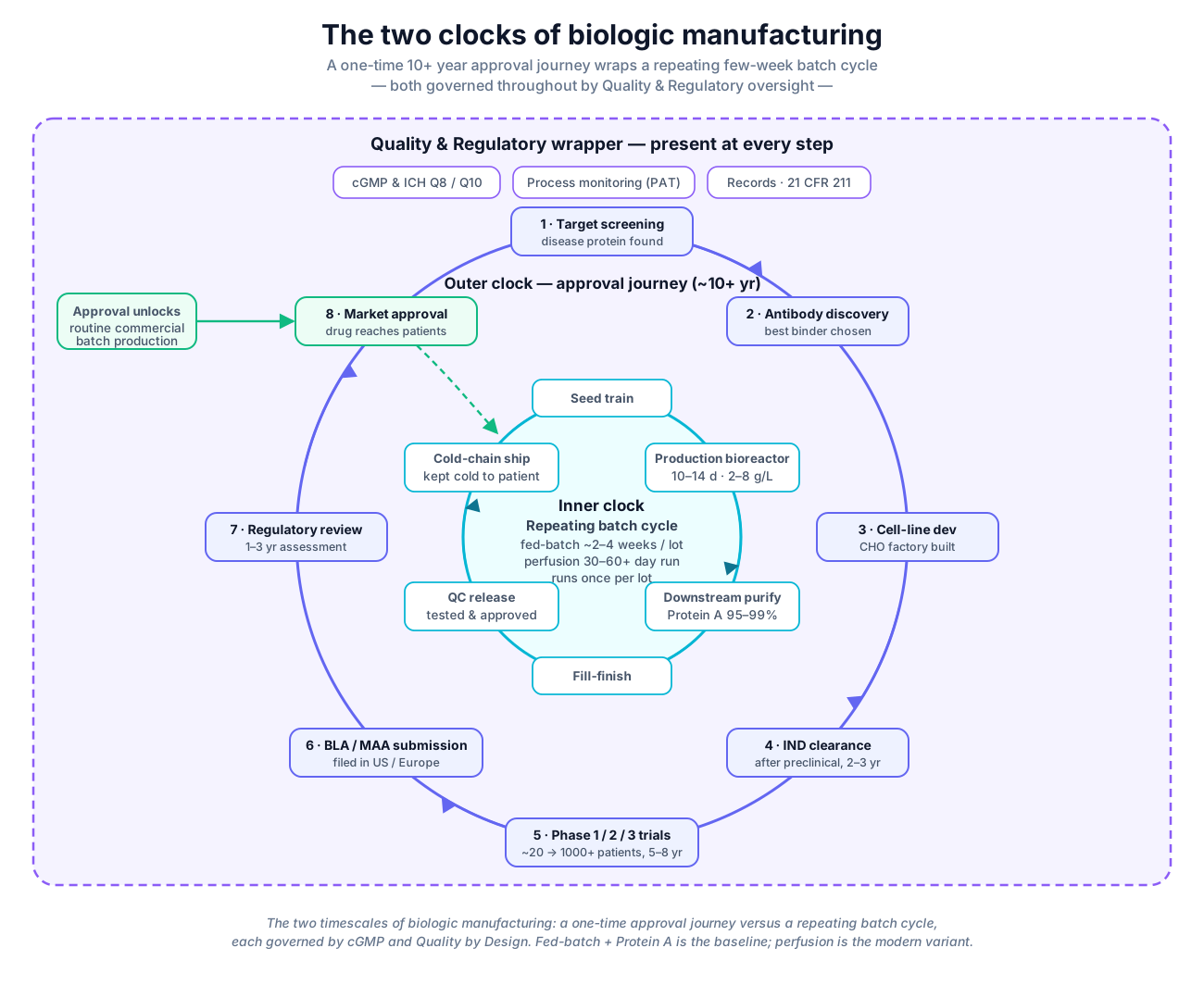 The two timescales of biologic manufacturing: one-time approval journey versus repeating batch cycle, each governed by cGMP and Quality by Design.
Original diagram by the authors, created with AI assistance.
The two timescales of biologic manufacturing: one-time approval journey versus repeating batch cycle, each governed by cGMP and Quality by Design.
Original diagram by the authors, created with AI assistance.
Two worlds of manufacturing
There are two ways to actually run the factory, and you will meet both in later chapters. They are not "old versus new" so much as "the proven workhorse versus the rising challenger."
Standard (fed-batch). This is the method behind roughly 95% of approved monoclonal antibodies today — the proven default [1]. Cells (almost always CHO cells, from Chinese hamster ovary tissue, the industry's reliable production host) grow in a large tank. You periodically feed them concentrated nutrients to keep them productive — that is what "fed" means — and then, after about 10–14 days, you harvest everything at once. A modern, well-tuned fed-batch process produces a titer (the concentration of antibody in the harvested broth) in the range of about 2–8 grams per liter, with high-performing platforms reaching ~10 g/L. Commercial production tanks span an enormous range, from around 500 liters for a rare-disease medicine up to 20,000 liters for a blockbuster used by millions. To feel what those numbers mean: at 3 g/L in a 20,000 L tank, a single run yields roughly 60 kg of antibody before purification losses — which is exactly why every percent of downstream yield matters. Purification then leans on a single trusted first step: Protein A affinity capture, which we explain next.
Modern (continuous and intensified). This is the emerging direction, not yet the norm. Instead of filling one tank and harvesting once, the cells are kept producing nonstop while fresh medium flows in and product-laden fluid flows out continuously — a perfusion bioreactor. If a fed-batch tank is a pond you stock once and drain once, a perfusion bioreactor is a flowing stream — fresh water in, waste out, fish harvested continuously. Keeping conditions fresh lets the culture reach much higher cell densities (often 50–100 million cells per milliliter, versus roughly 5–20 million in fed-batch) and keep producing for 30–60 days or more instead of two weeks [5]. That is what "intensified" means in plain terms: more product squeezed out of smaller equipment over a longer run. On the purification side, a single Protein A column is replaced by a multi-column or periodic counter-current arrangement that runs continuously, lifting throughput several-fold. We will dwell on this world later; for now, just know it exists and is growing, but fed-batch still dominates the medicines on pharmacy shelves.
Side by side, the two worlds line up like this:
| Standard — fed-batch | Modern — continuous / intensified | |
|---|---|---|
| Share of approved mAbs today | ~95% — the proven default | Emerging; not yet the norm |
| Host cells | CHO (Chinese hamster ovary) | CHO |
| How the tank runs | Fill, periodically feed, harvest all at once | Fresh medium in, product out, nonstop (perfusion) |
| Run length | ~10–14 days, then harvest | 30–60 days or more |
| Peak cell density | ~5–20 million cells/mL | ~50–100 million cells/mL |
| Harvest titer | ~2–8 g/L (high platforms ~10 g/L) | Lower harvest (permeate) titer (~0.5–2 g/L) but higher volumetric productivity over the run |
| Capture step | One Protein A column | Multi-column / periodic counter-current Protein A (roughly two- to three-fold throughput) |
Volumetric productivity in that last row means total grams harvested per litre of tank over the whole run: because perfusion harvests every day for 30–60 days, its modest daily titer adds up to more total product per litre of equipment than a single 10–14 day fed-batch drain — which is why a lower instantaneous titer can still win overall.
We will lean on the standard fed-batch process to learn the basics, and point out where the continuous world does it differently. So, in one line: fed-batch is the safe default you will learn the fundamentals on; continuous is the higher-yield future you will see flagged along the way.
The one purification step worth knowing now: Protein A
If you remember only one piece of equipment from this whole map, make it Protein A capture. Almost every monoclonal antibody on the market is purified using it — for standard antibodies, that is; a few engineered formats (certain bispecifics and Fc-deficient fragments — antibody variants that lack the normal tail end, the Fc, that Protein A grabs) bind Protein A poorly or not at all and need different capture chemistry. That near-universal fit is what makes a platform process possible — one well-understood recipe that works for antibody after antibody [1].
The trick is beautifully simple. Protein A is a natural molecule that grabs antibodies — and almost nothing else — by their tail end. So you pack it onto tiny beads (a resin) inside a column, pour your messy harvested broth through, and the antibodies stick while all the cell junk washes straight past. Then you change conditions to release the now-purified antibody — in practice a brief drop to about pH 3–3.5 (strongly acidic — low pH means acidic) that loosens the grip, which conveniently doubles as a virus-killing low-pH hold: the acid disrupts the fatty outer coat many viruses need to infect, inactivating them. Because that same acid also unfolds antibodies slightly so they stick together and clump (forming aggregates), the released pool is neutralized back toward pH 5–7 almost immediately. In one step, this captures roughly 95–99% of the target antibody and discards most impurities [1]. The resins themselves come from a handful of specialist vendors — names like Cytiva, Repligen/Purolite, and Thermo Fisher (POROS) — and choosing and running them is its own craft, covered in capture chromatography. In the continuous world, the same chemistry is run across several small columns in rotation, raising resin productivity roughly two- to three-fold.
Why it matters
Holding both clocks and both worlds in your head at once is what lets the rest of this guide click into place. The slow clock explains why these medicines are expensive and why a manufacturer cannot simply "tweak" an approved process — every meaningful change can re-open the approval question. The fast clock explains why factories obsess over every hour and every degree: a batch worth millions of dollars can be lost to one bad shift. And the "process is the product" principle explains the mountain of measurement and paperwork you will see at every step. It is not bureaucracy for its own sake; it is the only way to guarantee that the dose a patient receives next year is identical to the one tested in the trial that proved it works. Get the process right and document it faithfully, and you get a safe, consistent medicine; cut a corner, and you risk a recall, a shortage, or worse.
In the real world
This whole journey is governed by a small shelf of rulebooks you will meet again and again. You do not need to memorize them now — just learn to recognize the names, so they feel familiar when each later chapter opens one up.
The legally binding layer comes first. In the United States, 21 CFR Part 211, Subpart J spells out the batch record requirement — the legally mandated, contemporaneous document that captures exactly how each lot was made, by whom, and with what materials, so any batch can be reconstructed years later [6].
Sitting above the day-to-day rules are international guidelines from the ICH (the International Council for Harmonisation). ICH Q8(R2) introduced Quality by Design (QbD) — the discipline of defining a medicine's Critical Quality Attributes (CQAs) and mapping each to the Critical Process Parameters (CPPs) you must hold steady to achieve it. The one-line rule that keeps the two straight: a CQA is a property of the molecule that must be right for safety or efficacy; a CPP is a knob on the process you hold to get there. Many of an antibody's CQAs trace straight back to the fact that it is grown by living cells: the impurity attributes that drive downstream design are leftovers from the cells themselves and slightly-different copies of the same antibody the cells produce. Laid out as the two buckets the rule names:
| Critical Quality Attributes (properties of the molecule) | Critical Process Parameters (knobs on the process) |
|---|---|
| Purity above ~95% | Bioreactor temperature within about ±1 °C |
| Potency within roughly ±20% of target | Dissolved oxygen held in a target band such as 40–100% of saturation — how much oxygen is dissolved in the broth, as a percentage of the most the liquid can hold; the living cells consume it as they breathe, so too little starves them |
| Endotoxin below about 1 EU/mg (a toxin from certain bacteria; EU/mg is endotoxin units per milligram of antibody) | Feed rate within a few percent |
| Aggregate level (antibody molecules clumped together, the high-molecular-weight species, often released below ~1–2%) | |
| Host-cell protein (leftover proteins from the CHO cells, frequently held under ~100 ppm — parts per million) | |
| Residual host-cell DNA (leftover DNA from those same cells) | |
| Charge variants and glycan variants (slightly different versions of the same antibody, which can change how it behaves) |
These limits and setpoints are exactly the kind tracked across a real process [7].
ICH Q10 extends this into a Pharmaceutical Quality System that governs the medicine across its entire lifecycle, from development through every commercial batch [8]. And the FDA's 2004 Process Analytical Technology (PAT) guidance crystallized the mindset behind all of it: build quality into the process by measuring it as it runs, rather than testing it in afterward [9]. That live, in-process measurement is also the doorway to prediction: once a probe reads the broth every minute, a trained model — a soft sensor — can estimate the titer and the cells' nutrient levels in real time, between the slow lab samples, and even nudge the feed to keep them on target. That is where machine learning has earned its first genuine foothold in this field, the subject of the ML companion's production bioreactor chapter. If you want to see how this is documented for a real antibody, the industry's landmark teaching example is the A-Mab case study, which walks through QbD and a Protein A platform process end to end [2].
Anatomy of a batch record
This last section is a sneak peek at material the upstream and quality chapters unpack in full — skim it now and it will click later. Everything above — the recipe, the locked setpoints, the feed schedule, the genealogy — converges into a single document that is the legal and physical spine of a lot: the batch record. It is not a loose label or a number; it is an identity card for one complete run. Modern plants structure it the way the international automation standard ISA-88 (the ISA's standard for how recipe-driven batch processes are organized, which is why it shapes the record that documents them) structures any recipe-driven batch: a named batch that follows an approved recipe, runs on a specific unit, and unfolds as an ordered sequence of phases.
A typical 14-day fed-batch CHO run breaks into four phases — Inoculate (about 12 hours, seeding in cells grown up through the seed train), Growth (about 7 days, cells multiplying), Production (about 4.5 days, antibody accumulating), and Harvest (about half a day, draining the broth) — each holding the same locked critical parameters: temperature 37 °C, pH 7.0, dissolved oxygen in a 40–100% band, with concentrated feed added on a fixed schedule. Do not try to make those phase lengths add to exactly 14: real growth and production phases overlap rather than running as tidy back-to-back blocks, so the phase boundary is an operational marker, not a hard clock.
 One batch record as an ISA-88 batch entry: a recipe link, a unit, four locked-setpoint phases, and typed edges to the seed-train genealogy and the QC release decision.
Original diagram by the authors, created with AI assistance.
One batch record as an ISA-88 batch entry: a recipe link, a unit, four locked-setpoint phases, and typed edges to the seed-train genealogy and the QC release decision.
Original diagram by the authors, created with AI assistance.
This single record is where the physical run becomes data — the exact moment a measurement on the floor is born as a stored data point. The same batch_id that names the lot on the factory floor becomes the key that every measurement, signature, and result hangs from — and the labeled links between records (a phase runs on a unit, a lot descends from a seed train) are what later let the data world reconstruct any run. Those labeled links are not just convenient pointers: each one is a typed relationship — a named edge with a fixed meaning, the same runs-on and descends-from kind of relationship a formal ontology (a shared, machine-readable vocabulary of the things in a domain and how they relate) uses to record lineage, explored in relations and genealogy and grouped into kinds — a batch is-a recipe-driven run, a unit is-a bioreactor — in classes and taxonomy. It is a thread we follow into the data world in the data shadow, and trace point by point in the lifecycle of a data point. When that record is finally implemented as concrete rows in a real system, it looks like the upstream bioreactor model in the open-source companion's upstream bioreactor chapter, and the whole spine is stitched together end to end in its capstone.
Common batch failures
The batch record is also the place where things go wrong — and where the proof of what went wrong (or did not) is supposed to live. The three patterns below are classic deviations: departures from the documented process that a plant must formally log, investigate, and correct. Each recurs in regulatory inspection findings, and each maps directly to a piece of the identity card above.
- A misread excursion. Early in the run, a pH excursion can masquerade as a low–dissolved-oxygen problem, because a stressed culture shifts both at once. If an operator chases the wrong setpoint, the locked-parameter window is silently breached and the record no longer reflects what the cells actually experienced. The defense is the contemporaneous, signed reading at each phase — contemporaneous meaning written down as it happens, not reconstructed from memory afterward — exactly what 21 CFR Part 211, Subpart J demands [6]. That word is the "C" in ALCOA+, the data-integrity checklist regulators apply to every record: each entry must be Attributable, Legible, Contemporaneous, Original, and Accurate (the "+" adds complete, consistent, enduring, and available). A reading that fails any one of those — an unsigned value, one back-filled an hour later — is treated as no record at all.
- A clock reset. A control system restarted mid-run can reset the phase timer, so a culture is harvested early — at, say, day 12 logged as day 14 — cutting the Production phase short and lowering titer. The mismatch only surfaces if the record's timestamps are trustworthy and reviewed; production-record review is itself a mandated step [10].
- A genealogy gap. A contamination event traced backward through the seed-train lineage stalls when a vial-to-seed-train link is missing — the "descends from" edge on the card is broken — so the affected lots cannot be bounded. Incomplete records and broken traceability of this kind are among the most common Subpart J non-compliances cited in FDA and EMA batch-record inspections [11].
None of these are exotic. They are ordinary lapses that the batch record exists to catch — which is why the "process is the product" principle treats faithful documentation as part of the medicine itself. How a plant formally logs, investigates, and corrects a deviation like these is the subject of the bigger picture.
Key terms
- Biologic — a medicine made by living cells rather than by pure chemistry.
- Monoclonal antibody (mAb) — one identical kind of protein, all copies descended from a single cell, that sticks to one exact target in the body.
- Small molecule — a tiny, chemically built drug like aspirin; the opposite of a biologic.
- cGMP — current Good Manufacturing Practice; the regulations defining how a medicine must be made, documented, and controlled.
- Upstream — the "make it" half: growing cells so they produce the medicine.
- Downstream — the "clean it" half: purifying the medicine until it is safe.
- Fill-finish — putting the finished medicine into vials and sealing them.
- Batch / lot — one complete run of manufacturing that makes a set amount of product.
- Batch record — the legally mandated, contemporaneous document that captures exactly how one lot was made: recipe, unit, setpoints, phases, signatures, and genealogy.
- ISA-88 phase — one ordered step of a recipe-driven batch (Inoculate, Growth, Production, Harvest), the standard way a run is structured.
- Fed-batch — the standard method: grow, periodically feed, then harvest all at once at the end.
- Continuous / intensified — the modern method: keep producing and purifying nonstop, using perfusion and multi-column capture.
- Quality and Regulatory — the rules and records that prove every batch is safe and identical.
- Titer — the concentration of antibody in the harvested broth, typically 2–8 g/L in modern fed-batch.
- IND / BLA / MAA — the regulatory gateways: an Investigational New Drug application opens human testing; a Biologics License Application (US) or Marketing Authorisation Application (EU) seeks approval to market.
- CQA / CPP — a Critical Quality Attribute is a property of the molecule that must be right for safety or efficacy; a Critical Process Parameter is a process knob you hold steady to achieve it.
- CHO cells — Chinese hamster ovary cells, the industry's standard production host.
- Protein A capture — the affinity step that grabs antibodies onto resin beads, capturing ~95–99% of the target in one pass.
- Quality by Design (QbD) — designing quality into the process by linking Critical Quality Attributes to Critical Process Parameters.
- ALCOA+ — the data-integrity checklist every record must meet: Attributable, Legible, Contemporaneous, Original, Accurate, plus complete, consistent, enduring, and available.
- Soft sensor — a trained model that estimates a hard-to-measure quantity (like titer) in real time from an easy in-process signal, between slow lab samples.
- The process is the product — the founding principle that for a biologic, how it is made defines what it is.
Where this leads
You now have the whole map in your head: four acts, two clocks, two worlds, one guardian. Every chapter from here fills in one piece of it. The next chapter, what is a biologic, zooms all the way in on the medicine itself — what an antibody actually is, what it is made of, and why something this large and delicate can only be grown by living cells. That is the foundation everything else is built on, so let us start there.