Measuring quality and keeping the protein stable
📍 Where we are: Stop 8 of 21 · Discovery & Development — before we build the factory, we learn how to measure whether the antibody is right and how to keep that fragile protein safe in the vial.
By now we have a cell that makes our antibody (a Y-shaped protein the immune system uses to grab onto specific targets). But two big questions remain: How do we prove it is the right, working medicine? And how do we keep that delicate protein from falling apart between the factory and the patient? This chapter is about those two inseparable jobs — and they run in parallel, because you can only keep stable what you can measure.
Think of a packaged food. It needs a nutrition label so you can check exactly what is inside — and it needs the right preservatives and packaging so it stays fresh and safe until someone eats it. Analytical development writes the label and the tests behind it. Formulation development keeps the medicine fresh. Get either one wrong and the product on the shelf is not the product you designed.
What this chapter covers
We will walk through the two halves of this work. First, analytical development: the toolbox of tests — the chromatography systems, the mass spectrometers, the cell-based potency assays — that prove an antibody's identity, purity, potency, and fine structure, and the standards (ICH, USP) that say how rigorous those tests must be. Then formulation development: the buffer, the named excipients and their real concentrations, and the choice between a ready-to-use liquid and a freeze-dried cake. We will meet the exact stability conditions regulators expect, see how every quality attribute traces to a release test under cGMP, and learn why protein clumps are not a cosmetic nuisance but a genuine safety risk. Throughout, real instrument names, numeric limits, and the guidelines that govern them.
What actually happens
These two jobs run side by side from early development onward. They are also two converging pathways: analytical development builds toward a release-test specification, while formulation development builds toward a justified shelf-life claim, and both pathways meet at a single cGMP release decision.

Let's take them one at a time.
Job 1: Analytical development (writing the tests)
There is a saying in this work: you cannot improve what you cannot measure. So scientists build a toolbox of assays (laboratory tests) that answer four core analytical questions about the antibody.
The four analytical questions: identity, purity, potency, and structure
These four questions are the spine of the whole assay toolbox; every method below exists to answer one of them.
-
Identity — is this actually the right antibody, and not something else? A peptide map (chop the protein into fragments and read them by LC-MS — liquid chromatography paired with mass spectrometry, the workhorse instrument detailed below) and capillary electrophoresis (CE) confirm the molecule is what the label says.
-
Purity — how clean is it? In particular, how much has clumped into aggregates (proteins stuck together) or drifted into charge variants? Size-exclusion chromatography (SEC-HPLC) sizes the molecules and counts aggregates; ion-exchange (IEX) and modern imaged capillary isoelectric focusing (icIEF) sort charge variants. A charge variant is the same antibody carrying a tiny chemical change on its surface that shifts its overall electrical charge as the protein ages or is modified; because ion-exchange separates molecules by charge, an IEX trace resolves these into a fingerprint of peaks — the acidic variants (examples of such changes include deamidation, sialylation, glycation, N-terminal pyroglutamate) and basic variants (such as an extra C-terminal lysine or succinimide). The exact names matter less than the idea that a small surface change moves a molecule to a separable peak. CE-SDS (run both reduced and non-reduced — reducing breaks the disulfide bonds that hold the antibody's chains together, so the two conditions report the whole molecule versus its separated chains) is the workhorse for fragmentation and the heavy/light-chain assembly check, catching covalent clips (places where the protein backbone has broken) that native-condition SEC reports differently.
Purity also means process-related impurities: there are three universal mAb release tests every reader should know — residual host-cell protein (HCP), residual host-cell DNA, and leached Protein A (a trace of the Protein A capture material — the resin, a packed chromatography column, used in an early purification step to grab the antibody out of the broth — that sheds into the product). Each is a clean analyte / method / unit triple:
| Process-related impurity | How it's measured | Reported as |
|---|---|---|
| Residual host-cell protein (HCP) | ELISA (an antibody-based detection test) | ppm (parts per million) |
| Residual host-cell DNA | qPCR (a DNA-copying assay) | nanograms per dose |
| Leached Protein A | trace of the capture resin | trace level, must be cleared |
-
Potency — does it actually work? A cell-based bioassay or an ELISA checks that the antibody still binds its target the way the medicine is supposed to. Potency is reported as relative potency — a percentage of a reference standard — and because cell-based assays are inherently high-variability, the acceptance window starts wide (commonly a 70–130% type range) and tightens as the method matures over the product lifecycle [2].
-
Structure — the fine details, including glycans: tiny sugar chains attached to the antibody. It is tempting to picture glycans as the trim on a car — but that analogy undersells them. Glycan variation (changes in fucosylation, sialylation, and galactosylation) directly alters how strongly the antibody recruits immune killing — that is, how well it flags a target cell so the body's own defenses destroy it — through ADCC (antibody-dependent cellular cytotoxicity, where the antibody summons immune cells to kill the flagged cell) and CDC (complement-dependent cytotoxicity, where it triggers a cascade of blood proteins that punch holes in the target), and it changes how fast the body clears the drug. So glycans are a genuine CQA (see the glossary for the running CQA/CPP/PAT terms), not decoration — and teams profile them by mass spectrometry or hydrophilic-interaction chromatography and hold the variation to roughly ±10% relative from the target profile [1].
Concretely: as the antibody is built, the CHO cell (the Chinese-hamster ovary cell line used to grow most antibodies, met in earlier chapters) decorates it with these sugar chains, and the common patterns get short codes for how many galactose sugars the chain carries — G0F, G1F, and G2F (zero, one, or two galactose units, all bearing a core fucose), the dominant and expected baseline. Afucosylation — leaving off that core fucose sugar — lets the antibody grip immune (NK) cells more tightly, which is why it is the lever that strongly increases ADCC (the basis of glycoengineered antibodies). High-mannose (Man5) forms are watched because they make the body clear the drug faster (a clearance / PK — pharmacokinetic — liability). The three glycan facts to hold in mind:
| Glycan form | Why it matters |
|---|---|
| G0F, G1F, G2F | The dominant CHO glycoforms — the expected baseline |
| High-mannose (Man5) | Watched as a clearance / PK (pharmacokinetic) liability |
| Afucosylation | Leaving off the core fucose sugar — strongly increases ADCC |
| Teams set a target afucosylation/high-mannose window in development precisely because these drift with cell-culture conditions (media, ammonia, pH, manganese) — which is exactly why glycans are a CPP-sensitive CQA linking this chapter back to process development. (A useful one-line rule: a CQA is a product property that must stay in spec, while a CPP is a process setting you control to keep that CQA in spec — a CPP-to-CQA link the ontology book represents as a single queryable edge in relations and genealogy.) |
Workhorse instruments: HPLC, LC-MS, capillary electrophoresis, and biophysical tools
To make these measurements, scientists reach for a few workhorse instruments. HPLC (high-performance liquid chromatography) separates a mixture so each piece can be counted; the same hardware runs in size-exclusion (SEC), ion-exchange (IEX), and reverse-phase (RP) modes depending on what you want to sort. Common commercial systems include the Agilent 1260 Infinity, the Waters Acquity (UPLC, often with a C18 reverse-phase column (a common separation column whose surface is coated with 18-carbon chains) or a dedicated protein column), and the Shimadzu Prominence. LC-MS (liquid chromatography paired with mass spectrometry) weighs molecules so precisely it can confirm the exact mass of the intact antibody and its fragments — a high-resolution quadrupole time-of-flight (Q-TOF) instrument can pin the mass to within a few parts per million (an error of only a few units in a million — precise enough to tell the right molecule from one carrying a single small chemical change). Alongside these, capillary electrophoresis separates by size or charge in a thin capillary, and biophysical sizing tools like dynamic light scattering (DLS) or mass photometry catch aggregates and oligomers that chromatography can miss [1]. Every one of these instruments is also a data source: each injection emits a chromatogram, a spectrum, or a reading that becomes a measured value in a record — the companion data book traces how that signal is born and travels in instruments and sensors.
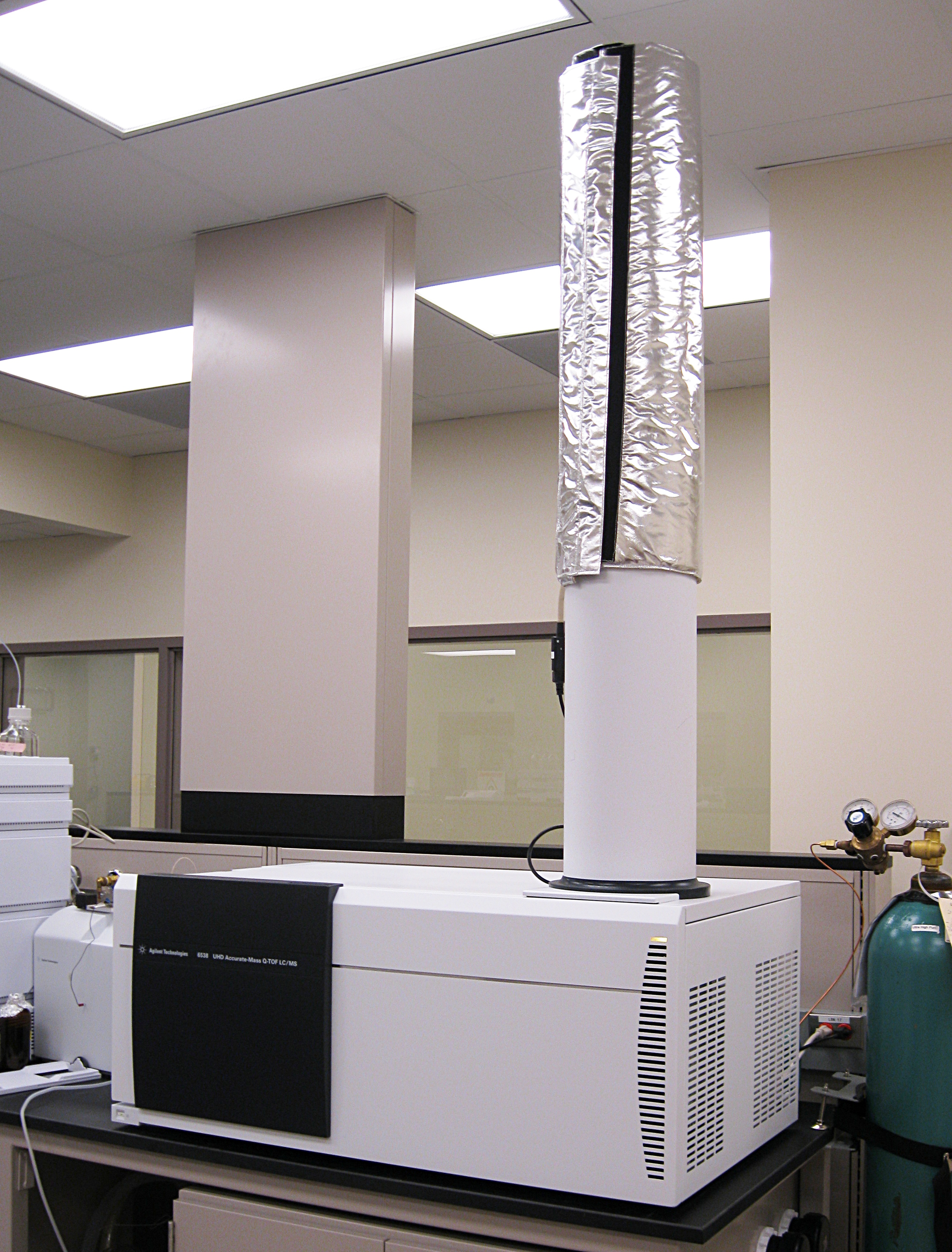 A high-resolution quadrupole time-of-flight (Q-TOF) mass spectrometer — the kind of instrument used to confirm the exact mass and structure of a therapeutic antibody.
Q-TOF LC/MS mass spectrometer. Image by Michael Pereckas, CC BY 2.0, via Wikimedia Commons.
A high-resolution quadrupole time-of-flight (Q-TOF) mass spectrometer — the kind of instrument used to confirm the exact mass and structure of a therapeutic antibody.
Q-TOF LC/MS mass spectrometer. Image by Michael Pereckas, CC BY 2.0, via Wikimedia Commons.
Critical Quality Attributes (CQAs) and the ICH Q6B specification framework
The properties that truly matter for safety and effectiveness — and that must be kept inside set limits — are named the Critical Quality Attributes (CQAs). The CQA list becomes the medicine's definition of "good." International guidance shapes exactly how these attributes are specified: ICH Q6B lays out the framework for biologic specifications — test procedures and acceptance criteria across identity, purity, potency, quantity, and glycan profiling [2]. A typical purity specification, for instance, holds aggregates below 5% by SEC (per USP expectations — the USP, U.S. Pharmacopeia, is the official compendium of legally recognized drug standards; its European counterpart is the Ph.Eur., European Pharmacopoeia, and a "compendial" method or limit is simply one written into one of these official books), with tighter limits common for high-risk products.
A test is only trustworthy if the method itself has been proven. Two more guidelines govern that. ICH Q14 (Analytical Procedure Development, adopted in 2023) brings a risk-based, lifecycle approach to designing and qualifying assays — defining what the method must achieve, identifying the parameters that affect its robustness, and managing the method from early development through routine manufacturing [3]. And USP General Chapter <1225> (Validation of Compendial Procedures) sets the bar for validation rigor: accuracy, precision, specificity, linearity, and range must all be demonstrated before a method can be used to release product, with Ph.Eur. Chapter 2.3.1 giving parallel expectations for protein-therapeutic monographs [6]. A validated method also needs qualified equipment to run on: before the Agilent 1260 or the Q-TOF can generate release data, the instrument and its software are put through IQ/OQ/PQ — Installation Qualification (proving the unit is installed and connected as specified), Operational Qualification (proving it performs across its operating range), and Performance Qualification (proving it gives the right answer on the actual assay) — so the box itself is documented as fit for purpose. This same three-stage logic scales up to whole production trains when the process is transferred to the plant, covered in From the lab bench to the factory floor.
Anatomy of a CQA specification
It helps to look at one CQA the way the quality system actually stores it: not as a loose number, but as a structured specification record — the control-point definition. Take "aggregates by SEC." The spec names the attribute (high-molecular-weight species — the formal spec name for the aggregates introduced above), the method (SEC-HPLC, size-exclusion mode), the instrument (e.g. an Agilent 1260 Infinity with a SEC column), the unit (% relative peak area), the acceptance range (spec_low 0% to spec_high 5%), the source standard it traces to (ICH Q6B; USP and Ph.Eur. 2.3.1), and the release test that measures it. This record is deliberately distinct from the measured result: the specification says what "good" must be, while the certificate of analysis at quality control and release records the value an actual batch returned against this window.
 One Critical Quality Attribute stored as a specification record — the field-by-field definition of the control point, distinct from any measured result.
Original diagram by the authors, created with AI assistance.
One Critical Quality Attribute stored as a specification record — the field-by-field definition of the control point, distinct from any measured result.
Original diagram by the authors, created with AI assistance.
That same record is where the physical-to-digital thread begins. The spec window defined here becomes, downstream, a single verified row in the laboratory information system — a lab.result carrying a value and a PASS/FAIL status checked against exactly this spec_low/spec_high pair — the first tagged data point in the batch's growing data shadow (the complete digital record that accumulates alongside the physical product), introduced in the data book's the data shadow. For that PASS/FAIL to count as legal evidence, the LIMS that stores it must itself be validated and the record must be ALCOA+ — Attributable, Legible, Contemporaneous, Original, Accurate, plus complete, consistent, enduring, and available — which is why the modern, risk-based move from exhaustive validation (CSV) to computer software assurance (CSA) matters here too; the data book unpacks both in data integrity and ALCOA+ and from CSV to CSA. The open-source code book shows that row and its check in the analytical lab, LIMS, and ELN. And the relationships this record traces to — attribute to method to source standard — are exactly what the ontology book formalizes as a queryable graph in relations and genealogy.
So Job 1 hands the factory a list of CQAs and the validated tests that measure them. But a perfect test list is useless if the protein degrades before it reaches the patient — which is the whole point of Job 2.
Job 2: Formulation development (keeping it stable)
Formulation design: buffer, excipients, and concentration for stability
A protein is delicate. Heat, shaking, freezing, light, or the wrong liquid can make it unfold (lose its three-dimensional shape) or aggregate (clump together). A clumped antibody does not work — and, as we will see, can be unsafe. So formulators design the protein's chemical home:

First they pick a gentle buffer — a liquid that holds the acidity steady. For mAbs this is very often a histidine buffer in the pH 5.0–7.0 range, where antibodies tend to be most stable — histidine wins because its pKa near 6 (the pH at which a buffer resists acidity changes most strongly, so a buffer works best near its own pKa) buffers right in that mAb-stable zone and it is low-toxicity for injection. Then they add excipients, stabilizing ingredients that each do a specific job [9]:
- Surfactants — polysorbate 20 or polysorbate 80 at 0.01–0.1%. These soap-like molecules coat the air–water and container surfaces so the protein cannot unfold and clump where liquid meets air, glass, or plastic (interfacial aggregation, the kind that shaking causes).
- Sugars / lyoprotectants — sucrose or trehalose at 5–10% w/v (weight per volume — grams of sugar per 100 mL of solution), used especially in freeze-dried products. During lyophilization they physically replace the water structure around the protein, holding its shape when the water is gone.
- Osmolytes / aggregation suppressors — arginine at 100–500 mM (millimolar, a measure of how many molecules are dissolved per litre), which suppresses hydrophobic interactions between protein molecules and helps keep highly concentrated solutions from gelling or clumping.
| Recipe component | Typical choice | Typical amount | What it does |
|---|---|---|---|
| Buffer | Histidine | pH 5.0–7.0 | Holds acidity steady where mAbs are most stable |
| Surfactant | Polysorbate 20 or 80 | 0.01–0.1 % | Coats air and container surfaces so the protein can't unfold and clump there |
| Sugar / lyoprotectant | Sucrose or trehalose | 5–10 % w/v | Replaces the water structure around the protein during freeze-drying |
| Osmolyte / aggregation suppressor | Arginine | 100–500 mM | Suppresses protein-to-protein clumping in concentrated solutions |
They tune the concentration to the delivery route: an intravenous (IV) drip can run dilute (around 5 mg/mL), while a subcutaneous (under-the-skin) injection must cram the full dose into about a millilitre, pushing concentrations toward 100–150 mg/mL — which makes the anti-aggregation chemistry above even more important. At those concentrations the binding constraint is often not aggregation but viscosity: a thick solution resists syringeability (how easily the liquid can be pushed through a needle) and so blocks SC injection — too thick, and a patient or nurse simply cannot drive the dose through a fine syringe, which is why excipients like arginine are chosen as viscosity reducers, not only aggregation suppressors. Note too that polysorbate itself degrades by hydrolysis and oxidation, releasing free fatty acids that can form their own subvisible particles — a modern stability failure mode that argues for monitoring polysorbate degradation. Finally they decide whether the product ships as a ready-to-use liquid or is freeze-dried (lyophilized — water removed to a dry cake, reconstituted with sterile water before use). Lyophilized products generally last longer — often 3–5 years at 2–8 °C, versus roughly 12–24 months for a liquid — at the cost of a more complex process and an extra reconstitution step; a residual-moisture target of below ~3% is typical to keep the dried cake stable.
Stability studies: ICH Q1A(R2) conditions and shelf-life justification
Then comes the proof: stability studies. Rather than guessing, teams follow the conditions written into ICH Q1A(R2), and the exact conditions depend on how the product is stored. The conditions split by how the product is stored:
| ICH Q1A(R2) condition | Room-temperature product | Refrigerated 2–8 °C mAb |
|---|---|---|
| Long-term | 25 °C / 60% relative humidity (RH) | 5 °C (no RH control) |
| Intermediate | 30 °C / 65% RH | (not applicable) |
| Accelerated | 40 °C / 75% RH for 6 months | 25 °C / 60% RH |
The accelerated condition is the stress arm that reveals failure modes quickly [4]. Because a refrigerated mAb's formal accelerated point is only 25 °C / 60% RH, a 40 °C / 75% RH run on a refrigerated product is an additional stress arm rather than the formal accelerated point. The acceptance criteria are tied directly to the CQAs — for example, no more than ~10% potency loss and under 5% new aggregates by the end of the claimed shelf life. To see how a study earns the label, picture the accelerated readout at 6 months, 40 °C: a result of 7% potency loss and 3% new aggregate sits inside both limits, so the trend supports a claim such as "stable for 24 months at 2 to 8 °C." Stability is run not only on the final drug product (the finished, formulated medicine filled into the vial or syringe) but also on the frozen drug substance (the purified bulk antibody — the output of downstream purification, often stored as a −40 °C frozen bulk in bags or bottles before it is formulated and filled), with freeze-thaw cycling studies because the ice interface and cryoconcentration (as water freezes into pure ice, the protein is crowded into the shrinking pockets of still-liquid solution, concentrating it) drive aggregation — which is part of why sucrose is chosen as a cryoprotectant independent of any freeze-drying.
Zooming into the analytical lane of the dual-pathway view above, the full Job-1 testing cascade runs from harvest all the way to release:
 The analytical testing cascade ensures every critical quality attribute is measured and stays within specification from development through manufacturing release.
Original diagram by the authors, created with AI assistance.
The analytical testing cascade ensures every critical quality attribute is measured and stays within specification from development through manufacturing release.
Original diagram by the authors, created with AI assistance.
From CQA to release test: the cGMP traceability requirement
Those four analytical questions are not the same thing as the formal release tests that decide whether a batch can ship. USP, Ph.Eur., and ICH define a broader panel of distinct release tests — typically identity, assay (content), purity, impurities (the named process-related impurities: residual host-cell protein by HCP ELISA, residual host-cell DNA by qPCR, and leached Protein A), potency, and safety tests (sterility, endotoxin), plus appearance and pH — and the development-stage CQAs map onto them. This mapping is not informal. Under current Good Manufacturing Practice (cGMP) — the FDA's enforceable, continually updated rules for making medicines safely and consistently — every CQA identified in development must trace to one or more release tests, and that traceability has to be auditable. 21 CFR 211.192 (CFR = the Code of Federal Regulations, the enforceable US federal rulebook) requires a documented review of each batch record before release, with any unexplained discrepancy or out-of-specification result formally investigated [7]. In practice this means a regulator can pull a batch record and follow a clean line from "this is a CQA" to "here is the validated test, here is the acceptance limit, here is the result, here is who reviewed it." The science from Job 1 and Job 2 only counts if it lands in that paper trail. That trail does not live in one lab notebook: the spec, the result, and the review signature sit across the LIMS, the batch record, and the quality system, which is why the data book treats them as one connected fabric in plant information systems.
Why it matters
These two jobs decide whether the medicine is both correct and durable.
Without good assays, you are flying blind — a bad batch could reach a patient unnoticed. The CQAs and validated methods defined here are the exact yardsticks the factory will use later at quality control and release to decide if a batch can ship. Get the CQA list wrong, and the entire control system points at the wrong things.
Without good formulation, even a perfect antibody can clump in the vial during shipping and become useless — or unsafe. This is the part beginners most often underestimate, so it is worth being blunt: aggregate control is safety-critical, not cosmetic. Immunogenicity research has shown that subvisible particles larger than about 1 µm, along with soluble protein oligomers, can prime the immune system to produce anti-drug antibodies (ADAs) — antibodies the patient makes against the medicine [8]. ADAs can neutralize the drug, make it clear from the body faster, or in rare cases cause harmful reactions. That is why formulation choices, the surfactant level, and the stability program all bend toward one goal: as few clumps as possible, for as long as the product lives. The downstream consequences of that goal — vial selection, the silicone-oil that lubricates a prefilled syringe, and the agitation of shipping — are covered in formulation and fill-finish; here the concern is the measurement.
The analytical blind spot: aggregates a release assay can miss
There is a subtler trap, and it is about the sensitivity of the method rather than the chemistry that creates clumps. A single SEC-HPLC method has a window: it sees the soluble species that fit cleanly through its column and elute as resolved peaks. But aggregation spans an enormous size range — from reversible dimers (just two antibody molecules stuck together), through soluble oligomers (a handful clumped), to subvisible particles larger than about 1 µm (many molecules massed together, yet still far too small to see by eye). Some of that population can fall outside what one SEC run reports: very large soluble aggregates can be lost on the column or filtered out before injection, and submicron particles are simply not a chromatographic peak at all. A clean SEC result can therefore understate the true aggregate load — and it is exactly these missed species that immunogenicity research links to anti-drug-antibody responses [8][10].
The fix is orthogonality: pairing methods whose blind spots do not overlap, so that what one misses another catches. SEC is therefore backed by analytical ultracentrifugation (AUC), which sizes aggregates in free solution — spinning them at high speed so they sort by size with no column for the large ones to stick to or be filtered out on, the very way SEC can lose them; and dynamic light scattering (DLS) is paired with micro-flow imaging (MFI) to count and image the subvisible particles a sizing assay cannot resolve. The compendial particulate-matter chapters set explicit limits on that subvisible population, so the orthogonal panel is not optional rigor but a release expectation [11]. The lesson is general: a CQA is only as trustworthy as the weakest assay measuring it, which is why the specification record names a method, not just a number.
In the real world
Most biologic medicines are tested with a shared analytical platform — a reusable set of SEC/IEX/RP-HPLC, CE, and LC-MS methods that teams adapt from one antibody to the next rather than inventing from scratch. The data these tests produce also feed the recipe-building work back in process development, because you tune a process by measuring what it produces.
A newer direction is to measure quality during manufacturing rather than only afterward, using PAT (process analytical technology). Instead of pulling a sample and waiting for a lab, at-line Raman spectroscopy can read concentration and quality attributes within minutes beside the reactor, in-line UV/Vis sensors watch the process continuously, and offline HPLC still anchors the high-accuracy confirmations. The most ambitious goal is real-time release (RTR): shipping a batch on the strength of in-process data rather than waiting for end-of-line testing. FDA guidance allows this, but it sets a high bar — RTR requires validated multivariate models (statistical models that combine many sensor readings at once — the Raman, UV, and other PAT signals together — to predict one CQA) that mathematically link the PAT readings to the release-critical CQAs, so the sensor data genuinely stands in for the lab result [5] — how such a multivariate model is built, validated, and held to the equivalence bar a release demands is the subject of the ML view of real-time release.
PAT and RTR matter most in continuous and intensified processing, where product flows out of the plant around the clock and there is no convenient "end of batch" to test. It is worth keeping the landscape honest, though: today's baseline for approved antibodies is still fed-batch culture with Protein A capture (cells grown in one finite batch that is fed nutrients and then harvested all at once, the antibody then grabbed by a Protein A column), and continuous/intensified manufacturing (a perfusion bioreactor — which continuously feeds fresh medium and draws off product to run for weeks — paired with multi-column capture, several Protein A columns cycling so purification never stops) is the emerging direction, not yet the norm. PAT is one of the tools that makes intensified processing practical, but it earns its place inside today's cGMP framework, not in spite of it.
Key terms
- Assay — a laboratory test that measures a specific property of the medicine.
- Critical Quality Attribute (CQA) — a property that must stay within set limits to keep the medicine safe and effective.
- Identity / purity / potency / structure — is it the right antibody, how clean is it, does it work, and is the fine structure (including glycans) right.
- Aggregate — proteins clumped together; unwanted, and a safety concern because clumps can trigger anti-drug antibodies.
- Glycan — a sugar chain on the antibody; its variation affects ADCC, CDC, and clearance, so it is a CQA.
- ADCC / CDC — two ways an antibody triggers immune killing of a target cell: ADCC (antibody-dependent cellular cytotoxicity) summons immune cells to kill it; CDC (complement-dependent cytotoxicity) triggers blood proteins that punch holes in it.
- HPLC — a method that separates a mixture so each component can be measured (run in SEC, IEX, or reverse-phase modes).
- Capillary electrophoresis (CE) — separation in a thin capillary by size or charge, used for identity and purity.
- LC-MS — liquid chromatography plus mass spectrometry, which weighs molecules to confirm the protein.
- Formulation — the buffer, excipients, and concentration chosen to keep the protein stable.
- Excipient — a stabilizing ingredient added to the medicine (e.g. surfactant, sugar, or arginine).
- Buffer — a liquid that holds the acidity (pH) steady; mAbs often use histidine at pH 5.0–7.0.
- Surfactant — a soap-like molecule (e.g. polysorbate 20/80) that stops the protein clumping at surfaces.
- Lyophilization — freeze-drying the medicine into a dry cake for a longer shelf life.
- Stability study — storing samples over time at defined ICH conditions (e.g. 40 °C/75% RH) to prove shelf life.
- PAT (process analytical technology) — tools (Raman, UV/Vis, HPLC) that measure quality during manufacturing, not only after.
- Real-time release (RTR) — releasing a batch on validated in-process data instead of end-of-line testing.
- Multivariate model — a model that combines several sensor signals at once to predict a quality attribute, so in-process data can stand in for a lab result.
- IQ/OQ/PQ — the three-stage qualification of an instrument or system: Installation (installed as specified), Operational (performs across its range), and Performance (gives the right answer on the real assay).
- Data shadow — the complete digital record that accumulates alongside the physical product; a release result like this one is one of its first tagged data points.
- Release test — a formal test (identity, assay, purity, impurities, potency, sterility, endotoxin, appearance, pH) a batch must pass to ship.
- Anti-drug antibody (ADA) — an antibody a patient's immune system makes against the medicine, which aggregates can provoke.
- Specification record — the structured definition of a CQA: attribute, method, instrument, unit, acceptance range, source standard, and release test. Distinct from a measured result.
- Acceptance range — the low-to-high window (
spec_low/spec_high) a result must fall inside to pass; written into the specification, checked at release. - Orthogonal methods — two or more assays with non-overlapping blind spots (e.g. SEC plus AUC, or DLS plus micro-flow imaging) used together so one catches what another misses.
Where this leads
We now know how to prove the antibody is right and how to keep it stable in the vial — but all of that has been worked out at the bench and at small scale. Next, in From the lab bench to the factory floor, we follow the process and these very specifications as they are handed off and scaled up into a real manufacturing plant, where the recipe becomes a repeatable, regulated reality.