The big picture: upstream, downstream, fill-finish
📍 Where we are: Stop 3 of 21 — climbing up to a balcony to see the whole factory floor at once, before we walk through it room by room.
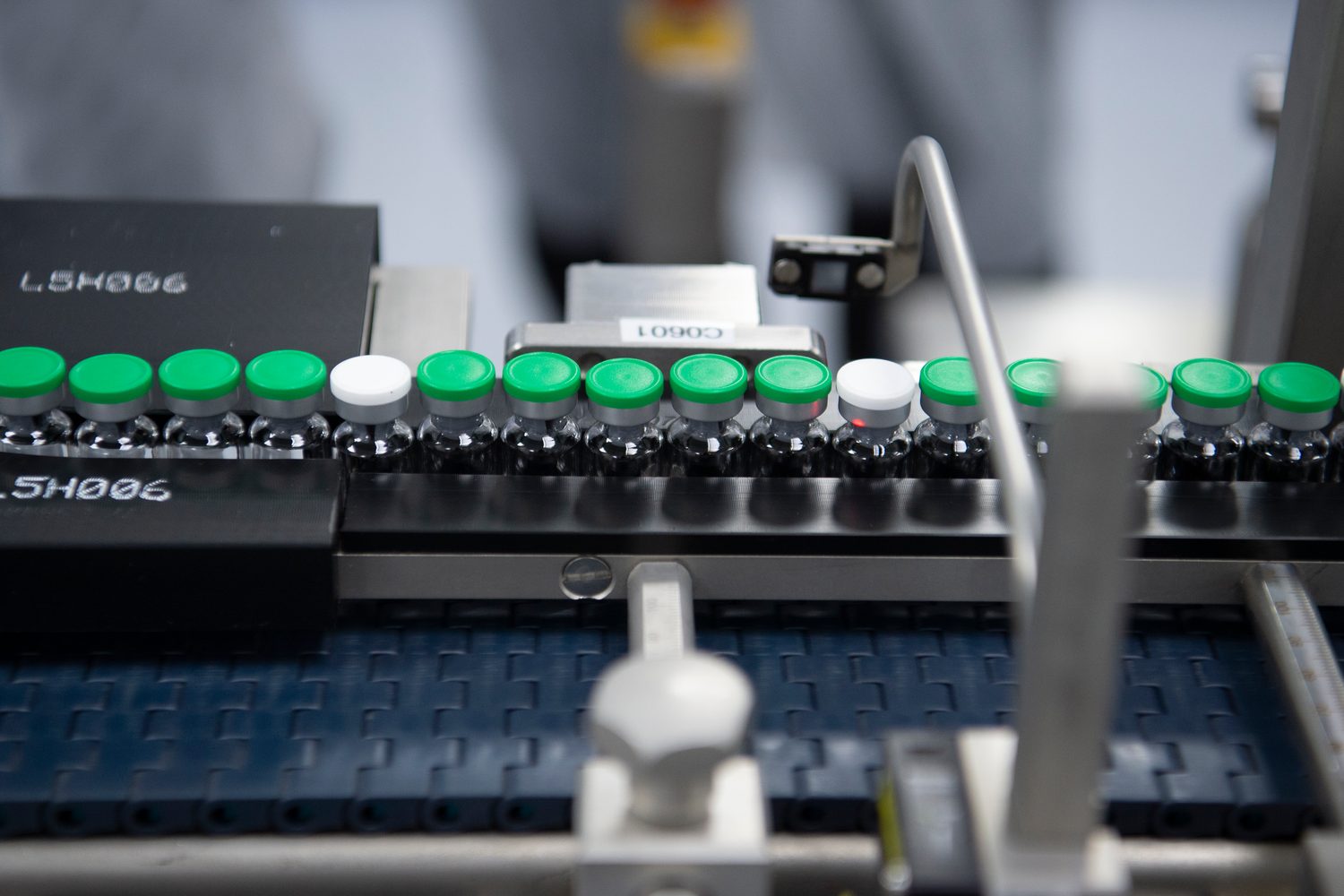 A pharmaceutical production line. Making a biologic runs from growing living cells, to purifying the protein they make, to filling vials like these — the whole pipeline this chapter maps in one view.
Pharmaceutical production line. Image by Josep Lago (European Commission), CC BY 4.0, via Wikimedia Commons.
A pharmaceutical production line. Making a biologic runs from growing living cells, to purifying the protein they make, to filling vials like these — the whole pipeline this chapter maps in one view.
Pharmaceutical production line. Image by Josep Lago (European Commission), CC BY 4.0, via Wikimedia Commons.
Making a biologic (a medicine made by living cells, not by mixing chemicals) is really three big jobs in a row. First you grow living cells that pump out the antibody. Then you pull that antibody out of the messy soup and clean it up. Finally you put the pure medicine into vials or syringes. That's the entire pipeline in one breath — and almost every monoclonal-antibody medicine on the market today is built this way.
Think of brewing. Upstream is the brewing itself — yeast eats sugar and makes the good stuff. Downstream is filtering and purifying the cloudy brew until it's crystal clear and pure. Fill-finish is bottling. The only difference is that here the "brew" is a life-saving medicine, so the cleanliness is extreme — far beyond any brewery, measured in microbes per liter and parts per million of stray protein.
What this chapter covers
This is the map you'll keep coming back to. We'll walk the three stages — upstream, downstream, fill-finish — and name the unit operations inside each one. We'll meet the dials that operators watch and the quality targets the medicine must hit, with real numbers attached. We'll see how one full run becomes a traceable batch. Then we'll look at the two ways the industry runs this factory today: the proven fed-batch (grow the cells in one tank, feeding them as you go, then harvest once) plus Protein A (a bacterial protein that grabs antibodies to pull them out of the mixture) platform that makes most approved antibodies, and the emerging continuous, intensified approach that the field is helping mature. Everything after this chapter zooms into one room at a time; this is the floor plan. By the end you'll be able to point to any field on a batch record and name which machine on the factory floor produced it.
What actually happens
Three stages: upstream, downstream, fill-finish
The factory is split into three stages. The wall between the first two is the harvest — the moment we separate the living cells from the liquid that holds the medicine.
- Upstream — grow the cells. A few frozen cells are woken up and grown in bigger and bigger tanks until they fill a giant bioreactor (a clean, stirred tank that keeps cells warm, fed, and full of oxygen). The cells release the antibody into the liquid around them. Pilot runs use vessels of about 50–200 L; clinical-supply campaigns (a campaign is a planned series of production runs of one product) step up to 500–2,000 L; and commercial fed-batch plants run 2,000–20,000 L tanks. The liquid is now rich in antibody — but also crowded with cells and debris [1].
- Harvest — the boundary. We strain out the cells, like pouring brew through a fine filter. What's left is a cloudy liquid containing the antibody. This is where upstream ends and downstream begins.
- Downstream — purify the antibody. A series of cleaning steps grabs the antibody, throws away everything else, and inactivates or removes any viruses. The output is pure, concentrated antibody called the drug substance (DS) — the bulk medicine, not yet in its final container.
- Fill-finish — make the final product. The drug substance is mixed with stabilizers, then carefully filled into sterile vials or syringes. This finished, ready-to-inject form is the drug product (DP) — what a nurse actually gives a patient.
Each distinct step above — the bioreactor, the harvest, each cleaning column — is called a unit operation: one machine doing one job. Strung together, they form the full chain:

The first stage on the left is upstream; everything from harvest through UF/DF (ultrafiltration/diafiltration — concentrating the antibody and swapping its buffer, the pH-controlled liquid the antibody is dissolved in) is downstream; the last step is fill-finish.
One full run through this chain makes a batch (also called a lot) — one defined quantity of medicine made together, carrying one identity number so it can be traced for years. GMP rules require that every batch leaves behind a complete, signed production and control record, the legal proof of exactly what happened and who checked it [7]. Notice the small words doing real work here: this batch runs on that bioreactor, the drug substance is derived from this harvest, a unit operation is-a kind of process step. Each of those typed relationships is an edge in a lineage graph, and naming them precisely is what lets a question like "which raw-material lots touched this batch?" be answered by machine — the job the ontology book takes up in classes and taxonomy and relations and genealogy.
Anatomy of a batch record
That signed record is the physical anchor of everything this whole trilogy tracks, so it is worth opening one up. A batch record is not a single number; it is an identity card for one run, with every stage writing its own block of fields into it. The diagram below shows the shape of a finished record for one antibody lot — its identity and timestamps at the top, then the upstream result, the downstream quality attributes, the fill-finish tally, and finally the human signatures that make it legally meaningful.
 One batch record, field by field: the upstream, downstream, and fill-finish blocks each contribute their results, and the operator, reviewer, and QA signatures close it out.
Original diagram by the authors, created with AI assistance.
One batch record, field by field: the upstream, downstream, and fill-finish blocks each contribute their results, and the operator, reviewer, and QA signatures close it out.
Original diagram by the authors, created with AI assistance.
Read the card top to bottom and you have read the whole chapter in miniature. Every field on it is born somewhere on the factory floor — the titer at the production bioreactor, the monomer purity at a chromatography polishing step, the reject count at the vial inspection line. This is exactly the hand-off point between the three books of this series: each field here is a single data-point the moment a sensor or an analyst records it, which is where the companion data book picks up the thread in the data shadow and in where data is born; and the record as a whole becomes one concrete database row built on the ISA-88 batch model and the ISA-95 equipment model, which is where the open-source book shows the actual schema in its batch and equipment model chapter and the contextualization that joins those fields together in contextualization. The physical artifact here, the data-point there, the SQL row there: one continuous thread.
For that record to count as legal proof, each field must be trustworthy in its own right, not just present. The expectation is captured by data integrity — the principle, summarized as ALCOA+ (the record must be Attributable, Legible, Contemporaneous, Original, Accurate, plus complete, consistent, enduring, and available), that the same regulation behind cGMP enforces. When the record is electronic — and today it almost always is — an audit trail must log who changed what and when, the rule that 21 CFR Part 11 (and EU Annex 11) sets for electronic records and signatures. We only name these here; the data book unpacks them in data integrity and ALCOA+ and in records, signatures, and the law. For all those fields to travel cleanly from machine to machine, the floor speaks shared vocabularies — connectivity standards such as OPC UA for live instrument data and B2MML for the batch record itself — so a reading means the same thing wherever it lands, covered in the data book's connectivity standards.
Inside upstream: feeding, not pre-loading
Fed-batch culture: feeding schedule and titer accumulation
It's tempting to picture fed-batch culture as "fill the tank, walk away, harvest at the end." The real practice is gentler and more deliberate: the cells are fed in repeated small doses across the run, not loaded up at the start.
Operators inoculate the bioreactor — seed the tank with starter cells — then add nutrient feeds in repeated boluses — typically every 24–48 hours — to keep the cells fed without overwhelming them, and harvest once at the end of the run. A typical fed-batch run lasts 10–14 days, peaks at a viable cell density of roughly 5–20 million cells/mL, and reaches monoclonal-antibody (mAb) concentrations (the titer) of roughly 2–8 g/L, with high-performing platforms reaching ~10 g/L [1]. That titer is the number that sizes the whole plant: a 2,000 L fed-batch at 4 g/L and ~70% overall downstream yield yields roughly 5–6 kg of drug substance per run. The mechanics of that single tank — sparging, stirring, feeding, and holding the dials steady for two weeks — get a chapter of their own in the production bioreactor.
Critical process parameters and quality attributes
Underneath that calm schedule, a few dials decide whether the batch lives or dies. Operators don't dial in an oxygen rate directly; they hold dissolved oxygen (DO) at a setpoint — typically around 40% of air saturation (40% of the oxygen the liquid would hold if fully saturated with air) — using a control cascade (a chain of automatic responses) that raises agitation (stirring) and gas sparge (bubbling gas up through the liquid) whenever DO sags, so cells never starve. Hypoxia stresses them and can trigger antibody clumping (aggregation). pH is likewise held in a tight band (e.g., 6.8–7.2) by CO₂ sparge and base addition. Temperature is held near 37 °C and drift beyond about ±1 °C shifts the cells' metabolism, which can change subtle chemical tags on the antibody (its attached sugar chains and charge, detailed later) and alter its potency. These are exactly the critical process parameters — the settings you control — that warrant continuous, real-time monitoring rather than spot checks; a CQA, by contrast, is a property of the medicine itself that those settings are tuned to protect [6]. Each reading those probes take is the start of a long journey from sensor to signed record, which the data book follows step by step in the lifecycle of a data point. Some quantities operators most want to watch — titer above all — have no probe that reads them live, so a soft sensor (a model that infers a hard-to-measure value from easy-to-measure ones) can estimate them in real time from the dials that are measured; the machine-learning book builds exactly such a soft sensor for this bioreactor in the production bioreactor.
Inside downstream: catch it, then polish it
Protein A capture and the downstream train
Downstream begins the instant the run ends. First comes harvest and clarification: a centrifuge spins the broth at roughly 3,000–5,000 × g (thousands of times the force of gravity) for 10–20 minutes, dropping the cell density from about 10⁷ cells/mL to under 100 cells/mL — removing well over 99% of the cells. (Each factor of ten is one log: that drop from 10⁷ to roughly 10² is about 5 logs, a hundred-thousand-fold reduction — a unit worth fixing early, because every clearance claim downstream is counted this way.) Which harvest hardware does the job is itself a choice driven by scale and culture mode: large fed-batch trains use a continuous disc-stack centrifuge followed by depth filters; smaller or single-use trains often skip the centrifuge and clarify with depth filters alone; and perfusion (a continuous-culture mode introduced below) relies instead on a cell-retention device — an alternating or tangential-flow filter (ATF or TFF), a fine filter that holds the larger cells back inside the reactor while clarified product flows out continuously. The liquid then passes through depth filters (coarse 5–20 micron layers that trap fine debris) and finally a 0.2–0.45 micron filter that brings stray microbial contamination (bioburden) below the detection limit, leaving a clear feed ready for purification [2].
The first purification step is capture, almost always on a Protein A platform. Protein A is a bacterial protein that grabs the constant region of an antibody — the stable stem shared across all antibodies of a class, introduced in what is a biologic — like a perfectly shaped catcher's mitt, ignoring nearly everything else in the broth. Packed onto resin in a column, it holds roughly 40–80 g of antibody per liter of resin on modern high-capacity resins — this is its dynamic binding capacity (DBC), the amount it can grab at real flow rates (older first-generation resins held 10–20 g/L). A short wash clears the leftovers, then a mildly acidic buffer at pH 2.5–3.5 releases the antibody — recovering more than 98% of it while stripping out 1–2 logs (a 10- to 100-fold reduction — for example, 10⁷ host-cell-protein molecules in, near 10⁵ out) of host cell proteins (stray proteins made by the production cells, an impurity that must be cleared) in a single pass [3]. That single, reusable step is why Protein A remains the dominant capture chemistry for marketed mAbs; mixed-mode and other alternatives exist and are growing, but they have not displaced the platform. The dedicated capture chapter walks the load–wash–elute cycle in full.
After capture, the antibody runs a short obstacle course. Viral inactivation holds the already-acidic Protein A eluate (the liquid that comes off the column) at pH 3.0–3.5 for 1–2 hours. The low pH dissolves the fatty outer coat — the lipid envelope — of enveloped viruses; non-enveloped viruses have no such coat and survive this step, which is exactly why a separate, size-based viral filtration follows. (The worst-case concern from the CHO — Chinese hamster ovary — production cells is retrovirus, because those cells carry retrovirus-like particles in their own genome.) Because the eluate is already acidic, this step costs no extra processing — though the same low pH will drive the mAb itself to aggregate if the hold runs too long or too acidic, a real process tension to bound carefully.
Polishing chromatography typically pairs two complementary columns that separate molecules by their electrical charge, over 6–8 hours — usually a bind-elute step (often cation exchange, CEX, where the antibody sticks to a negatively-charged resin and is eluted clean) followed by a flow-through step (often anion exchange, AEX, where the antibody passes straight through while negatively-charged contaminants stick) — to scrub out the last impurities and aggregates. Viral filtration physically sieves out anything virus-sized through a ~20 nm membrane. Together these steps build viral safety the way the field requires it: from orthogonal mechanisms — different physics each credited a log-reduction value (LRV) that sum to a validated total clearance under ICH Q5A(R2) [11] — so no single failure leaves the product unprotected. Finally UF/DF (8–12 hours) concentrates the antibody and exchanges it into its final formulation buffer. Out comes the drug substance.
Embedding all of this is the project's central contrast — the proven batch train versus the emerging continuous one:
 Fed-batch monolithic-batch processing (left) vs. continuous intensified perfusion with multi-column capture (right): differences in bioreactor operation, capture dynamics, process duration, and yield.
Original diagram by the authors, created with AI assistance.
Fed-batch monolithic-batch processing (left) vs. continuous intensified perfusion with multi-column capture (right): differences in bioreactor operation, capture dynamics, process duration, and yield.
Original diagram by the authors, created with AI assistance.
How clean is clean enough?
A critical quality attribute (CQA) is a measurable feature of the medicine itself that must stay inside set limits — and the bar is genuinely strict. International guidance (ICH Q6B — ICH is the international body whose Q-numbered guidelines set the technical standards regulators worldwide expect) frames the acceptance criteria that release tests must meet [4]. In practice a final mAb drug product typically must reach the limits below, where each row pairs a limit with what it measures and the assay that reads it:
| Attribute | Typical limit | What it is | Measured by |
|---|---|---|---|
| Monomer purity | ≥95% monomer (about 5% or less aggregate) | the intact antibody vs. clumps of it | size-exclusion HPLC (SEC), which sorts molecules by size |
| Host cell protein | ≤100 ppm | leftover protein from the production cells | ELISA, an antibody-based assay |
| Residual DNA | ≤10 ng per dose | leftover cell DNA | qPCR, a DNA-amplification count |
| Endotoxin | per-dose limit set by patient weight | fever-causing lipopolysaccharide from gram-negative bacteria | LAL test, a clotting assay using horseshoe-crab lysate |
The endotoxin row deserves a word, since the limit looks odd at first. The pharmacopeial ceiling (USP <85>) is K = 5 endotoxin units (EU) per kilogram of body weight per hour of dosing — so for a 70 kg adult it works out to about 350 EU per dose; companies then routinely set a tighter in-house limit (here about 175 EU per dose, half of 350) to leave headroom. (Each attribute here is a CQA, defined just above.) It helps to separate two ideas a beginner easily conflates: how clean a single process step makes the antibody (an individual polishing column may deliver well over 99% step purity) is not the same as what the final drug-product release spec demands (the looser ~5%-aggregate limit, set to hold across the product's whole shelf life). Purity and strength are the headline attributes, but aggregation, the antibody's chemical modifications, and its circulating half-life are equally watched, because all of them touch how safe and how potent the medicine is in a patient.
Design space: where the process lives and what happens outside
The way you keep hitting those numbers is by controlling the process, not by inspecting quality in at the end. Modern development defines a design space — proven safe ranges for each parameter, such as temperature within ±2 °C, pH within ±0.3 units, and chromatography residence time within ±10% — inside which the product stays consistent (ICH Q8) [5]. Cross those lines and things break in predictable, expensive ways: a pH excursion beyond about ±0.5 units can damage the Protein A resin so antibody slips through uncaptured, and the temperature and oxygen drifts mentioned earlier quietly shift the molecule itself. Watching the right dials in real time, the goal of process analytical technology, is how operators stay safely inside the space [6]. How that space is mapped and defended is developed further in process development.
Picture the space as a set of nested boxes. The innermost box is the proven-safe operating region the batch is steered into; a wider box around it is the fully characterized range that is still acceptable but watched closely; and everything outside is the failure field where the product no longer meets spec.
 Two parameters of the multidimensional design space: a proven-safe core (green) nested inside the characterized spec range (cyan), surrounded by the failure zone (rose) where the product breaks.
Original diagram by the authors, created with AI assistance.
Two parameters of the multidimensional design space: a proven-safe core (green) nested inside the characterized spec range (cyan), surrounded by the failure zone (rose) where the product breaks.
Original diagram by the authors, created with AI assistance.
What goes wrong: real deviations and their cost
The failure zone is not abstract — it is a catalogue of specific, expensive ways a run can be lost, and each one traces back to a dial that drifted out of the box. A pH excursion during capture is the cleanest example: push the load or wash outside about ±0.5 units and the Protein A ligand starts to degrade, its binding capacity falls, and antibody breaks through the column uncaptured instead of sticking — a recovery loss measured in kilograms of drug substance, on a resin bed already worth tens of thousands of dollars. Upstream, roughly two hours of hypoxia (the oxygen transfer rate sagging and dissolved oxygen falling) stresses the cells enough to drive antibody aggregation, and aggregates are the one impurity polishing struggles to fully clear. And a late-run dissolved-oxygen drop, even one that never trips an alarm, can shift the cells' metabolism just enough to change the antibody's post-translational modifications — its glycosylation and charge variants — and therefore its potency, the subtle drifts the upstream dials were guarding against. None of these necessarily ruin a vial outright; the deeper danger is that they make this batch different from the batches the product was approved on. Demonstrating that a change has not altered safety or efficacy is the whole subject of comparability guidance (ICH Q5E), and the cheapest comparability case is the one you never have to make because the dials stayed inside the space [10]. This is why the right answer is always to monitor in real time and correct early rather than to test the damage in at the end [6].
Why it matters
The whole floor plan reduces to three things worth holding onto: three stages joined at the harvest (upstream grows it, downstream cleans it, fill-finish bottles it); a chain of unit operations, each one machine doing one job; and a handful of dials kept inside a design space, with the batch record as the legal proof that they were. Everything that follows is a zoom into one of those.
Every stage depends on the one before it. If upstream grows weak or contaminated cells, no amount of cleaning downstream can rescue the batch. If downstream leaves impurities behind, a patient's body might react badly. If fill-finish lets in a single stray microbe, an injected vial could cause a dangerous infection.
So manufacturers watch the key dials closely. A critical process parameter (CPP) is a setting you must control — like temperature, pH, or dissolved oxygen — because changing it changes the medicine. A critical quality attribute (CQA) is a feature of the medicine itself that must stay within limits. Along the way, in-process controls (quick tests taken during production) confirm each step worked before moving on. All of this happens under cGMP — current Good Manufacturing Practice, the body of regulation (in the U.S., 21 CFR Part 211, with parallel ICH and EMA guidance) that makes every batch safe, pure, and consistent with the last [7]. "Current" matters: the rules expect manufacturers to keep up with evolving best practice, not just meet a frozen checklist.
In the real world
Real-world equipment and suppliers
The standard commercial setup runs the bioreactor as a fed-batch culture followed by a Protein A capture platform — a reliable recipe behind most antibodies on the market today. It runs on named, qualified equipment: single-use and stainless Sartorius Biostat STR bioreactors spanning roughly 50 L to 2,000 L (with the wider STR family extending much larger); the Sartorius ambr 250 system, which runs twelve 250 mL mini-bioreactors in parallel so scientists can test many conditions at once in a design-of-experiments study; pre-packed, ready-to-use chromatography columns from suppliers such as Cytiva and Pall; and Cytiva ÄKTA modular chromatography skids that can be configured for continuous, multi-column operation. The hardware itself is built to a recognized hygienic-design standard — ASME BPE — so that stainless-steel surfaces can be reliably cleaned and validated between batches [8].
Continuous and intensified processing
A newer approach is continuous and intensified processing: perfusion bioreactors that continuously feed fresh medium and drain spent broth (keeping cells alive and productive far longer), paired with continuous multi-column capture. Single-use perfusion vessels of about 100–500 L can run 21–42 days and reach 3–15 g/L, and because product flows out steadily rather than waiting for one big harvest, the bioreactor footprint and the capital cost per gram can fall by roughly 40–60% when paired with continuous capture [9]. Economics drive much of this: Protein A resin is expensive — on the order of thousands of dollars per liter, so a single capture column can represent tens of thousands of dollars of consumable per batch — and a continuous three-column system keeps that resin working across 10–15 cycles, spreading the cost. Fed-batch still dominates approved products today, so think of continuous as the rising direction rather than the current norm.
Key terms
- Upstream — growing the cells so they produce the antibody.
- Downstream — purifying the antibody out of the harvested liquid.
- Fill-finish — putting the pure medicine into its final vials or syringes.
- Harvest — separating cells from the medicine-bearing liquid; the boundary between upstream and downstream.
- Drug substance (DS) — the purified bulk antibody, the output of downstream.
- Drug product (DP) — the final, ready-to-inject vial or syringe.
- Unit operation — one step or machine doing one job in the chain.
- Batch / lot — one defined quantity of medicine made in a single run, with a traceable ID and a complete signed record.
- CPP (critical process parameter) — a setting that must be controlled because it changes the medicine (e.g., temperature, pH, dissolved oxygen).
- CQA (critical quality attribute) — a measurable feature of the medicine that must stay within set limits (e.g., monomer purity, host cell protein, endotoxin).
- In-process control — a quick test during production to confirm a step worked.
- GMP (Good Manufacturing Practice) — the legal rules ensuring every batch is safe, pure, and consistent; "current" GMP (cGMP) expects manufacturers to keep pace with best practice.
- Bioreactor — a clean, stirred, monitored tank that keeps cells warm, fed, and oxygenated while they make the antibody.
- Fed-batch culture — the standard mode: inoculate, add nutrient feeds in repeated boluses, then harvest once at the end of a 10–14 day run.
- Protein A platform — the standard capture step that grabs antibodies with high recovery and clears most impurities in a single pass.
- Continuous and intensified — running steps without stopping (perfusion plus multi-column capture) to shrink the plant and cut cost per gram.
- Perfusion — a bioreactor mode that continuously feeds fresh medium and removes spent broth, keeping cells productive for weeks.
- Titer — how much antibody the cells make per liter of culture; a headline measure of upstream productivity.
- UF/DF (ultrafiltration/diafiltration) — the final downstream step that concentrates the antibody and swaps it into its formulation buffer.
- Design space — the proven range of parameter settings inside which the product stays consistent.
- Batch record — the complete, signed identity card of one run: identity, timestamps, upstream and downstream and fill-finish results, and the operator and QA signatures.
- Deviation — a documented departure from the expected process (e.g., a pH excursion or a dissolved-oxygen drop) that must be assessed for its effect on the product.
- Comparability — the demonstration, guided by ICH Q5E, that a change in process or material has not altered the product's safety or efficacy.
- Data integrity / ALCOA+ — the principle that each recorded value is trustworthy: Attributable, Legible, Contemporaneous, Original, Accurate, plus complete, consistent, enduring, and available.
- Audit trail — the automatic log of who changed an electronic record, what they changed, and when, required for Part 11 / Annex 11 electronic records.
- Soft sensor — a model that infers a hard-to-measure value (such as titer) in real time from quantities that are measured.
Where this leads
Now you can see the whole factory from the balcony — three stages, a chain of unit operations, a handful of dials, and a strict set of quality targets. But before any of it can run, someone has to decide which antibody to make and what it must do in the body. That decision shapes every parameter downstream. So we rewind to the very beginning: the next chapter, It starts with a target, is where the medicine is first imagined.