The last mile: cold-chain to the patient
📍 Where we are: Stop 21 of 21 · the final stop — the finished medicine leaves the factory and travels all the way to the patient, kept cold and watched over every step of the way.
The medicine is made. It has been formulated and filled into vials, and it has passed every test and earned its batch release. But it is not safe in a patient's body yet — it still has to travel there, and biologics are fragile. Most marketed monoclonal antibodies (mAbs) are labeled to be stored refrigerated, commonly between 2 and 8 °C, from the moment they leave the factory until the moment they are used [2]. That unbroken refrigerated path is called the cold chain (an uninterrupted series of refrigerated storage and transport steps). The whole purpose of this last mile is twofold: keep the medicine cold, and prove that it stayed cold.
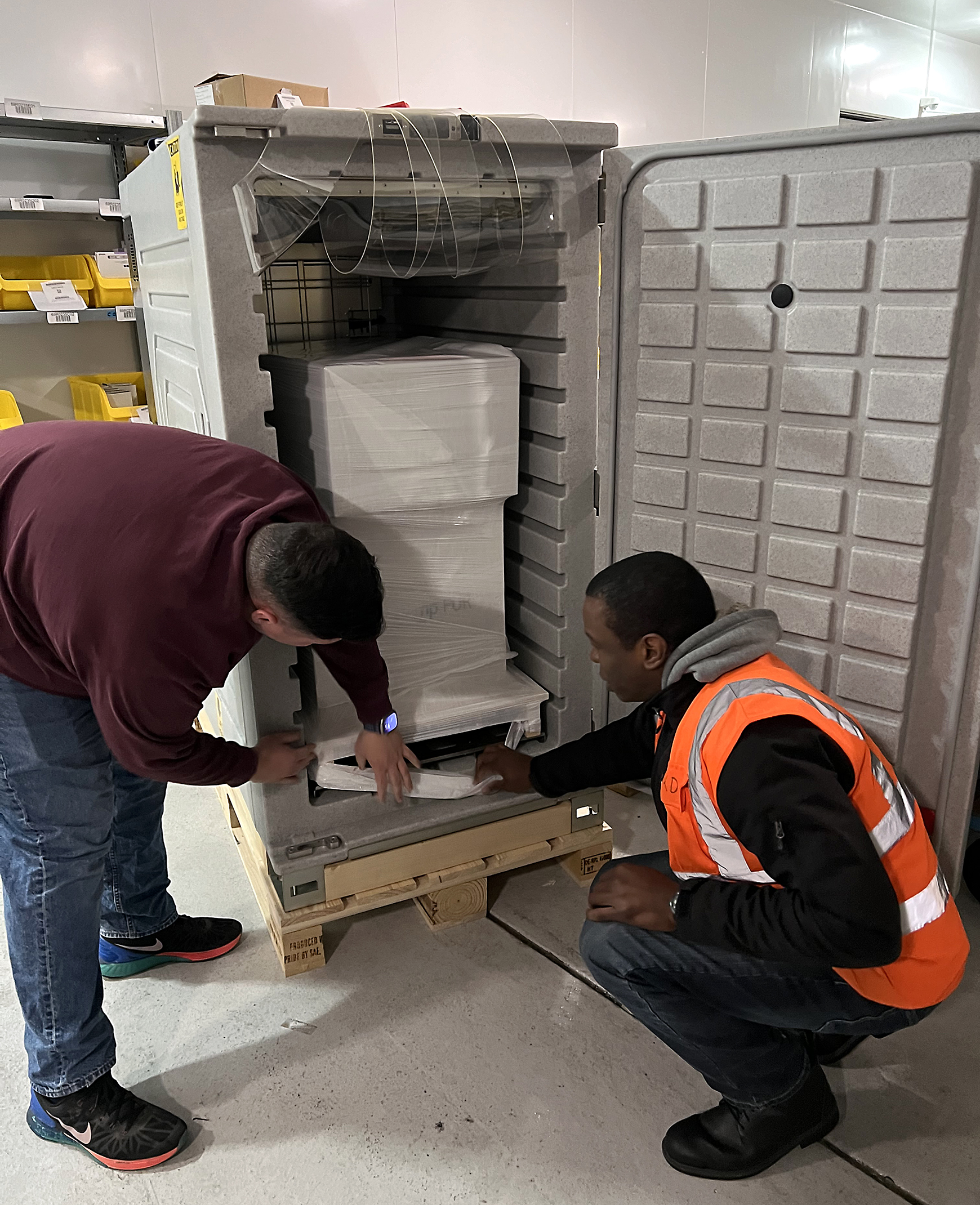 Workers load refrigerated medicines into a battery-powered cold-chain container engineered to hold a steady 2–8 °C during transport.
Refrigerated cold-chain shipping container. Image by U.S. Army Medical Logistics Command, public domain, via Wikimedia Commons.
Workers load refrigerated medicines into a battery-powered cold-chain container engineered to hold a steady 2–8 °C during transport.
Refrigerated cold-chain shipping container. Image by U.S. Army Medical Logistics Command, public domain, via Wikimedia Commons.
Think of a relay race where the runners pass a baton from hand to hand without ever dropping it. Here the "baton" is the cold. From factory to truck to warehouse to pharmacy to patient, the medicine is handed off again and again, and it must stay cold the whole time. Drop the baton — let it get warm — and the medicine can spoil, just like ice cream left on a sunny counter never tastes right again even after you refreeze it.
What this chapter covers
We will follow a finished vial out the factory door and all the way to a patient. First, why temperature is the enemy — and exactly how warmth damages a protein. Then the engineered box it rides in, the little electronic witness that travels with it, and the global logistics network that moves it across oceans. We will meet the rulebooks that define a medicine partly by its storage temperature, see what happens when the temperature strays out of bounds, and peek at where ultra-cold shipping and live tracking are taking the field next. Throughout, we will name the real systems and standards that make this work in practice, not just in theory.
Temperature as the medicine's identity
Temperature as regulatory identity: the stability dossier and the label claim
Here is a fact that surprises most beginners: a biologic's approved storage condition is part of its legal identity. When a company files for approval, it must submit stability data — months and years of evidence that the product still meets every quality limit when stored at a stated condition, such as 2–8 °C, or 25 °C paired with 60 % relative humidity (the moisture content of the surrounding air — a standard part of the test condition, since for some products humidity, like heat, can affect stability). International rules spell out exactly which conditions to test and for how long; these rules are published as numbered guideline documents (the "Q" codes below are simply chapter numbers in the ICH guideline set). ICH Q1A(R2) sets the storage conditions and shelf-life data packages for drugs in general [2], and ICH Q5C adds the special rules for biologics, which are far more temperature-sensitive than ordinary small-molecule pills [1]. (ICH is the International Council for Harmonisation, which writes the technical guidelines that the major regulators agree to follow.)
The number printed on the label — "Store at 2 °C to 8 °C. Do not freeze." — is therefore not a casual suggestion. It is a tested, dossier-backed promise. The cold chain exists to keep that promise true from the factory loading dock to the patient's bedside.
A note on exceptions, because the real world is not tidy. The 2–8 °C "refrigerated" condition is the dominant standard for marketed mAbs, but it is not universal. Some products carry an allowance to be kept at controlled room temperature (often 20–25 °C) for a defined window — a few weeks to a few months — late in their shelf-life, which gives pharmacies breathing room. A handful of newer or frozen formulations are stored at −20 °C or colder. And, famously, the mRNA COVID-19 vaccines required ultra-cold storage. The lesson is to read the label, not to assume: each product's condition is whatever its own stability data supports.
| Storage condition | Temperature | Typically used for |
|---|---|---|
| Refrigerated (the standard) | 2–8 °C | Most marketed mAbs |
| Controlled room temp (allowance) | 20–25 °C | A defined window late in shelf life |
| Frozen | −20 °C or colder | Some newer or frozen formulations |
| Ultra-cold, dry ice in transit | about −78 °C | Frozen products, and mRNA COVID-19 vaccines |
Why aggregation happens: temperature-dependent unfolding kinetics
A biologic is a protein, and a protein is a long chain folded into a precise three-dimensional shape. That shape is the medicine — change it, and the drug no longer fits its target. Heat (and freezing, and shaking) feeds energy into the molecule and nudges it to partly unfold. Two unfolded antibodies can then stick to each other and clump into aggregates (clumped, misshapen protein), which no longer work and which the immune system may attack as if they were invaders [3]. Cold slows this molecular fidgeting and keeps the shape locked in place.
How fast does damage happen? Not instantly, but faster than intuition suggests, and the rate climbs steeply with temperature. Aggregation follows temperature-dependent kinetics (how fast the reaction runs): a mAb that is rock-solid for years at 5 °C can show measurable aggregate growth within days at 25 °C, and within hours at the higher temperatures a tarmac or an unrefrigerated truck can reach [3]. This is why a single warm afternoon matters, and why "I'll just put it back in the fridge" does not undo the harm — the clumps that formed do not un-clump. It is also why pre-validated tolerance limits (more on those below) are calculated from real formulation-stability data rather than guessed.
Cold is not automatically safe, either. The "Do not freeze" half of the label is just as binding as the upper limit. When a liquid mAb freezes, ice crystals create a vast air-like solid interface that denatures protein at the ice front. The dissolved salts and the buffer (the chemical mix that holds the liquid at a steady, safe pH) left behind concentrate dramatically as the ice grows (cryoconcentration), and a more concentrated mix can swing to a different pH the formulation was never designed to survive. And the surfactant — a soap-like additive that coats the protein and shields it where liquid meets a surface (the "interfacial stress") — is excluded from the freezing zone, leaving the protein exposed exactly where it is most fragile. For many formulations a single accidental freeze — often from direct contact with a gel pack that is colder than intended — fails the product as surely as a heat excursion. That is why a real cold-chain logger alarms on a low threshold as well as a high one. This is also the moment the formulation work pays off, or fails to: the buffer, the surfactant, and any stabilizing sugar were chosen upstream precisely to widen the protein's tolerance to exactly these heat, freeze, and interfacial stresses — but no formulation can survive an unbounded excursion, which is why the cold chain still has to hold.
"It got warm (or it froze), so I'll just put it back in the fridge and it'll be fine." It will not. The damage from a heat excursion or a freeze is done the moment it happens — returning the vial to 2–8 °C cannot un-clump aggregates or re-fold denatured protein. The vial may look perfectly clear and still be compromised. The only correct response is to log it, quarantine it, and let an investigation decide.
The system that keeps it cold — and proves it
Qualified shipping container design and ISTA thermal validation
The vials do not just go in a cardboard carton with some ice. They go into a qualified shipping container — an insulated cooler that has been proven by testing to hold the target temperature for a stated number of days. "Qualified" is the key word: the design is built, packed exactly as it will ship, loaded with phase-change material (gel packs or specialized refrigerants that absorb and release heat at a set temperature), and then run through punishing hot-and-cold profiles in a test lab before anyone trusts it with real medicine [6].
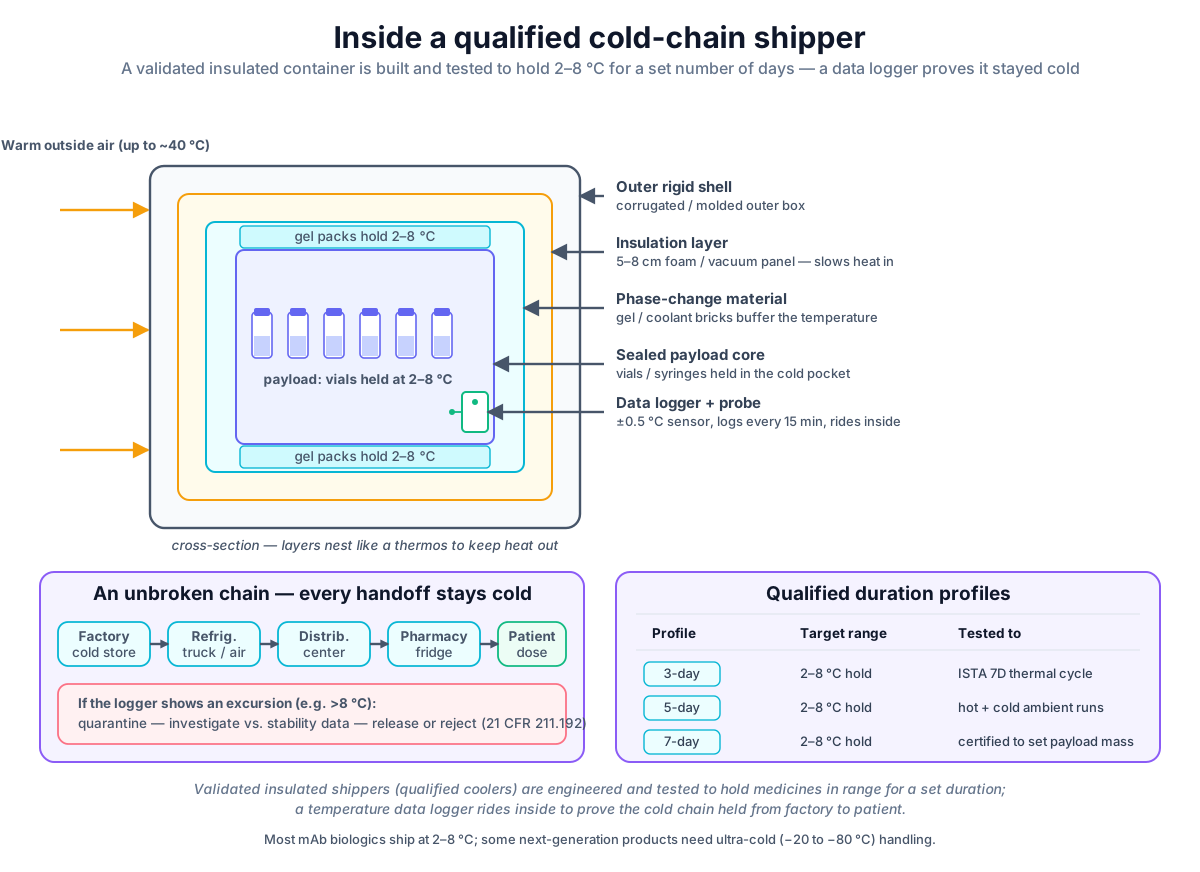 Validated insulated shipping containers (qualified coolers) are engineered and tested to hold medicines at the target temperature range for a specified duration; temperature data loggers ride inside to prove compliance.
Original diagram by the authors, created with AI assistance.
Validated insulated shipping containers (qualified coolers) are engineered and tested to hold medicines at the target temperature range for a specified duration; temperature data loggers ride inside to prove compliance.
Original diagram by the authors, created with AI assistance.
Vendors such as Cold Chain Technologies, Sonoco ThermoSafe, and Pelican BioThermal sell pre-qualified systems rated for specific duration profiles — typical offerings hold 2–8 °C for 72 hours (3 days), 120 hours (5 days), or 168 hours (7 days), certified to a defined payload mass and tested against thermal-shock protocols like the ISTA 7D standard, which simulates summer and winter shipping lanes. Refrigerated products ride with gel packs that, inside a qualified box, keep the interior in the 2–8 °C window; frozen products use dry ice (frozen carbon dioxide), which sits at roughly −78 °C and keeps things far colder than any gel pack can. Choosing the right validated profile for the route — and never overloading or under-packing it — is what turns a clever box into a trustworthy one.
The data logger: a continuous witness to the shipment
Engineering the box is half the job; proving it worked is the other half. So a small electronic data logger rides inside with the medicine, recording temperature continuously for the entire trip. When the box is opened, the logger holds a complete, time-stamped history of what the medicine actually experienced.
Industry loggers are precise, modest instruments: temperature accuracy on the order of ±0.5 °C, with recording intervals typically set at 15 or 30 minutes — frequent enough to catch a meaningful excursion, infrequent enough to last the whole journey on a coin-cell battery. Familiar names include Sensitech TempTale and LogTag recorders. Reading them rarely means plugging in a cable anymore; modern units are read wirelessly over Bluetooth or NFC (near-field communication, the tap-your-phone technology) by tapping a phone or scanner, and many flag any out-of-range event automatically the moment the box is received [7]. Compendial guidance — rules in the official drug compendium, the U.S. Pharmacopeia (USP), the legally recognized standards book for U.S. medicines — such as USP General Chapter <1079> describes exactly this kind of risk-based monitoring, including the use of mean kinetic temperature (MKT) — a single calculated number that weights time spent at higher temperatures more heavily, giving a fairer picture of cumulative heat stress than a simple average [7].
Anatomy of a qualified shipment and its logger trace
Strip a delivered shipper down to what the quality unit actually inspects, and it resolves into a single record: a description of the box, plus the witness's testimony. The container half names the insulation, the mass and placement of the phase-change material, the vial position in the cold core, and exactly where the logger probe sat — by convention the warmest payload corner (the worst-case spot found by a thermal-mapping study, i.e. measuring which spots inside the packed box warm up first), so the single logger witnesses the harshest temperature the medicine actually sees. The logger half is the trace itself: dozens of time-stamped readings sampled every fifteen minutes across seventy-two hours or more, each carrying a value and a quality flag, plus the derived numbers a reviewer reads at a glance — the mean kinetic temperature for the whole trip and any alarm flag raised on receipt.
 One shipment as a single record: the engineered container, the logger's time-stamped temperature trace, the derived mean kinetic temperature, and the alarm flag that links straight to a disposition decision.
Original diagram by the authors, created with AI assistance.
One shipment as a single record: the engineered container, the logger's time-stamped temperature trace, the derived mean kinetic temperature, and the alarm flag that links straight to a disposition decision.
Original diagram by the authors, created with AI assistance.
That record is the physical artifact this whole book has been building toward at the last mile, and it is also a data object with a life of its own. Each logged reading is born, moves, and is stored exactly as the lifecycle of a data point describes; the quality and alarm flags travelling with every value are a worked example of ALCOA — the five-word checklist (attributable, legible, contemporaneous, original, accurate) that regulators use to judge whether a record can be trusted — made concrete. The vial is the physical anchor; the logger trace is its first downstream data shadow (the growing digital twin-record a physical batch leaves behind), and that trace does not float free — it stays tagged to this exact shipment and batch, so the cold-chain readings join the same data shadow every earlier step has been filling. Naming that link precisely is itself a small piece of modeling: the logger trace is derived-from this shipment, the shipment is-a qualified shipper carrying batch BATCH-2026-001 — the kind of typed lineage edge the ontology book makes formal in relations and genealogy. Later books trace where that data goes: the same trace, captured at the cold-store door, is what an edge gateway (the small computer that collects sensor readings at the cold-store door) ingests in an open-source software stack, lands as a row in the reference architecture those tools assemble, and the excursion logic below is the kind of rule an analytics and alerting layer evaluates in code.
The path itself is a chain of refrigerated handoffs, factory to patient (figure below):

Every box in that chain carries a logger, and every arrow has to stay cold. Every handoff between the links — factory to truck, truck to warehouse, warehouse to pharmacy — is a place the chain can break, so each one is documented and monitored in turn.
Global cold chain and Good Distribution Practice (GDP)
Most of those arrows cross enormous distances. A mAb made in one country may travel by refrigerated truck to an airport, fly across an ocean, sit on a tarmac in a hot climate, clear a customs delay, and only then reach a regional distribution center — all while never leaving the 2–8 °C window. This is a logistics problem of real scale, and a whole industry exists to solve it. Specialized pharmaceutical cold-chain networks — FedEx, DHL, and freight forwarders working with carriers like Thermo Fisher's logistics services — route temperature-sensitive shipments through controlled-temperature hubs at major air-cargo gateways such as Memphis, Frankfurt, and Singapore, where the medicine can be transferred between aircraft without ever sitting in the open heat.
This whole apparatus runs on a formal rulebook called Good Distribution Practice (GDP) — the distribution-side counterpart to the manufacturing-side cGMP (current Good Manufacturing Practice, the binding quality regulations a factory must follow). The European Union's GDP guidelines, for example, require that transport maintain defined temperature conditions, that vehicles and equipment be qualified, and that the integrity of the medicine be protected the whole way to the customer [5]. The World Health Organization publishes a parallel international model for storing and transporting time- and temperature-sensitive products, covering qualified shipping, continuous monitoring, and temperature mapping — the practice of measuring the warm and cold spots inside a warehouse or truck before trusting it with product [4].
When the chain breaks: excursions and disposition
This chapter has named a handful of code-named rulebooks and standards. They are not all the same kind of document, and the difference matters — a binding law carries more force than a voluntary guideline. Here they are at a glance, with who writes each one:
| Code | What it is / who writes it | What it covers here |
|---|---|---|
| ICH Q1A(R2) / Q5C | Harmonized international guideline (International Council for Harmonisation) | Stability-testing conditions; Q5C is the biologics-specific one |
| USP General Chapter <1079> | Compendial chapter from the U.S. Pharmacopeia | Risk-based temperature monitoring and MKT |
| GDP | Distribution rulebook (EU / WHO) | Temperature-controlled transport and storage |
| cGMP / 21 CFR Part 211 | Binding U.S. regulation (Code of Federal Regulations) | Investigation (§211.192) and quarantine/hold (§211.142, §211.150) |
| 21 CFR Part 11 | Binding U.S. regulation | Trustworthy electronic records and signatures |
| PDA Technical Report 39 | Industry technical report (Parenteral Drug Association) | How to qualify containers and handle excursions |
| ISTA 7D | Test standard | Thermal-shock shipping profile |
| Form FDA 483 | FDA inspection-finding document | The list of cGMP deviations an inspector issues |
Mean kinetic temperature: cumulative heat stress in one number
A logger does not hand a reviewer a verdict; it hands them a column of numbers. The first thing those numbers get distilled into is mean kinetic temperature. A simple average would treat an hour at 20 °C the same as an hour at 5 °C, which badly understates the harm of the warm hour — chemical damage rises steeply, not linearly, with temperature. MKT applies an Arrhenius weighting (a standard chemistry formula in which higher temperatures count for disproportionately more heat damage) — by convention using a single default activation energy of about 83 kJ/mol (the USP General Chapter <1079> / ICH value) — so warmer hours count for much more than a simple average would credit.
That default is a deliberately conservative, generic chemical-degradation surrogate, not a product-specific model of antibody unfolding or aggregation (real antibody clumping does not always speed up with heat in one simple, predictable way — the actual physical pathway can change as it gets warmer — so the generic default is only a rough screen, never a stand-in for testing the real product). MKT is therefore the screening number; the product-specific test is the excursion budget below, calculated from the actual formulation-stability data. The result is a single temperature that represents the cumulative heat stress of the whole journey, and it is the number the stability dossier was written to be compared against.
A trip can dip out of range briefly and still post an MKT comfortably inside the limit: a journey that spent 69.5 hours at 5 °C and a 2.5-hour spike to 11.8 °C works out to an MKT near 5.4 °C — still well inside the budget, even though a peak of 11.8 °C was touched (this is the 5.4 °C line in the decision figure below). That is exactly why the budget below is written in terms of both a peak and a cumulative figure.
Excursion budgets and disposition under 21 CFR Part 211
Sometimes, despite everything, the logger shows that the temperature went out of range. This is a temperature excursion, and it does not automatically mean the medicine is ruined — but it does mean no one is allowed to simply guess.
A well-run cold chain plans for this in advance. Drawing on the product's stability data, the manufacturer defines an allowable excursion budget: short, bounded departures the data has already shown the product can survive. Crucially the budget is a band, not just a ceiling — it sets a high limit (a brief stay at up to, say, 25 °C for a limited number of hours, or a cumulative MKT below a set limit) and a low limit (no drop below about 0–2 °C, since a single freeze can fail a liquid mAb outright), which is why shipment loggers are configured to alarm on both. As long as the recorded excursion stays inside that pre-validated budget, the medicine can be accepted. Cross the budget on either side, and the product must be set aside while a formal review weighs the actual temperature history against the stability data and reaches a documented decision [8]. One subtlety reviewers internalize: the budget is cumulative across the whole shelf life, not reset per shipment. Every excursion is debited against a finite stability allowance shared by all handling events over the product's life, so a borderline-acceptable departure early on can still pass yet leave less room — meaning a later, otherwise-survivable excursion may be the one that fails.
The decision looks like this in practice:

In U.S. cGMP terms, that "set aside" step is precise. Under 21 CFR Part 211 (Title 21 of the U.S. Code of Federal Regulations, Part 211 — the binding U.S. cGMP regulation for finished drugs), an unexplained discrepancy such as an excursion triggers a documented investigation (§211.192), and the affected batch is placed on hold under the warehousing and quarantine controls (§211.142, §211.150) — held aside, unavailable for use, the FDA's regulation using "quarantine" and "hold" for exactly this controlled status — until a responsible person reviews the records and makes a disposition: accept or reject [8]. Once product has physically left the manufacturer, those cGMP record-and-quarantine controls are mirrored on the distribution side by GDP, which carries the same investigate-and-hold discipline out to the distributor and pharmacy. The Parenteral Drug Association's Technical Report 39 is the long-standing industry reference for how to qualify the containers, validate the thermal testing, and handle these excursions consistently [6]. The principle is the same as the batch-release gate we just left: a human, working from data, signs their name to the verdict. Nothing reaches a patient on a shrug.
A logged excursion that ended in a reject
The accept path is the common one; the reject path is the one regulators check for. A concrete shape: a refrigerated mAb shipment arrives, the logger is read, and it shows the box sat on an airport tarmac long enough to climb above the budget — say a peak near 30 °C with cumulative warm time well past the validated few hours. The shipment is quarantined, an investigation is opened against the stability data, and because the recorded history falls outside the pre-validated budget the only defensible disposition is reject — the product is destroyed, not sold. The hazard regulators actually cite is the missing version of this discipline. The FDA's data-integrity guidance and its routine inspection observations (Form FDA 483, the list of cGMP deviations an FDA inspector issues after an inspection) and warning letters repeatedly fault distributors for storage and transport that fell outside labeled conditions without a documented investigation, or for temperature records that were incomplete, unreviewed, or unreliable [9]. The lesson is blunt: an excursion that is logged, investigated, and rejected is the system working; an excursion that is unlogged or waved through is the citation.
In short, the last mile is three jobs working together:
- Keep it cold — a qualified, ISTA-tested shipping box loaded with the right phase-change material.
- Prove it stayed cold — a continuous data logger plus the mean kinetic temperature distilled from its trace.
- Decide — the pre-validated excursion budget, and a 21 CFR Part 211 hold-and-investigation when the budget is crossed.
Why it matters
Every earlier step — choosing the target, building the cell, growing it in a bioreactor, purifying and polishing the protein, filling the vials, running every release test — was about making a medicine that is safe and effective. If the cold chain breaks on the last day, all of that work can be undone in a few warm hours. A patient could receive a vial that looks perfectly clear but no longer works, or that now carries aggregates the immune system reacts to. That is why a single excursion triggers a full investigation instead of a shrug, and why the box, the logger, and the rulebook all exist. The medicine is not truly finished until it is safely in the patient's hands, still as good as the day it was made.
In the real world
The cold chain is getting both colder and smarter. On the colder front, next-generation biologics are pushing into the ultra-cold chain. The mRNA COVID-19 vaccines were the public's introduction to −20 °C and −80 °C shipping, and cell and gene therapies routinely demand cryogenic storage in liquid nitrogen vapor near −150 °C to −196 °C. This brings a new toolkit — vacuum-jacketed cryogenic shippers (so-called "dry shippers" that hold liquid nitrogen absorbed in a porous core, such as those from MVE and Credo), specialized handling training, and carefully scripted thaw procedures — and a much smaller margin for error, since a thaw can be irreversible.
On the smarter front, monitoring is moving from retrospective to real-time. Instead of reading a logger only when the box arrives, IoT-enabled smart containers stream their location and temperature continuously over cellular networks, so a logistics team can see a problem developing and reroute a shipment before the medicine is lost. Once that live stream exists, a model can be laid over it: a predictive monitor that learns from past lanes can flag a box drifting toward its excursion budget hours before it crosses, and demand forecasting can keep less product sitting in warm transit in the first place — the kind of cold-chain prediction the ML book takes up in Distribution: cold-chain prediction and demand forecasting. These systems increasingly tie into tamper-evident chain-of-custody records (an unbroken, hard-to-alter log of who held the shipment and when, sometimes built with blockchain-style technology that makes after-the-fact edits detectable) and into electronic-signature controls under 21 CFR Part 11, the cGMP rule that governs trustworthy electronic records and one thread of the broader quality, regulation, and data framework that binds the whole journey. A medicine made with continuous, sensor-rich manufacturing deserves a distribution leg that is just as continuously watched.
Key terms
- Cold chain — the unbroken series of refrigerated storage and transport that keeps a medicine within its labeled temperature range from factory to patient.
- Qualified shipping — using insulated containers proven by testing to hold the correct temperature for a stated duration throughout the trip.
- Data logger — a small device that travels with the shipment and records its temperature continuously, typically at 15- or 30-minute intervals.
- Data shadow — the growing digital record a physical batch leaves behind; the logger's tagged temperature trace is the cold-chain step's contribution to it.
- Temperature excursion — an event where the medicine's temperature goes outside the allowed range.
- Excursion budget — the pre-validated allowance, derived from stability data, for how warm or how cold and for how long a product may stray before it must be held and investigated; a two-sided band (high and low limits), debited cumulatively across the whole shelf life.
- Quarantine — holding a product aside, unavailable for use, until an investigation confirms whether it is still safe; in U.S. cGMP this controlled, unavailable status is termed quarantine or hold.
- Aggregate — clumped, misshapen protein that forms when a biologic is damaged, for example by heat, and that may no longer work or may provoke the immune system.
- Phase-change material — gel packs or refrigerants engineered to hold a set temperature inside a shipping container by absorbing and releasing heat.
- Mean kinetic temperature (MKT) — a single calculated value that weights time at higher temperatures more heavily, used to judge cumulative heat stress over a trip.
- Good Distribution Practice (GDP) — the regulatory rulebook governing temperature-controlled transport and storage of medicines in the supply chain.
- Ultra-cold chain — storage and transport at temperatures well below freezing (−20 °C, −80 °C, or cryogenic −150 °C to −196 °C) for products that demand it.
Where this leads
Our vial has reached the patient, still as good as the day it was made — but the system that made this possible is bigger than any one shipment. The next chapter, Quality, regulation, and data, steps back to look at the rules, records, and data systems that bind the entire journey together, from the first cell to this final cold-chain mile.