Fill-finish: from bulk to vials (drug product)
📍 Where we are: Stop 18 of 21 — we take the purified bulk liquid and turn it into the sealed vial or syringe a patient actually receives.
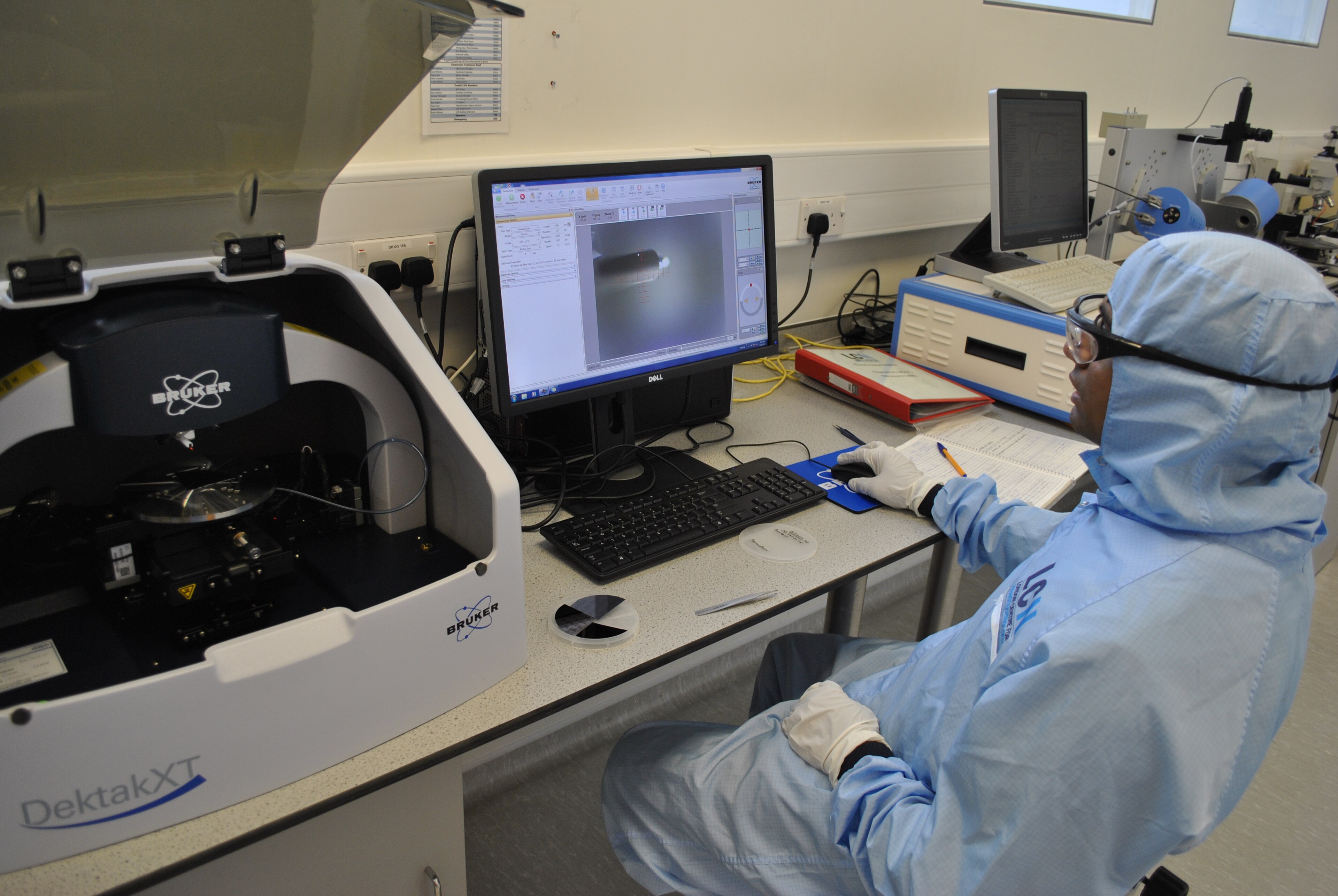 A fully gowned operator works inside a cleanroom. Fill-finish runs under exactly this kind of contamination control, because once a vial is sealed there is no way to clean what is inside.
Cleanroom laboratory. Image by UCL Mathematical and Physical Sciences, CC BY 2.0, via Wikimedia Commons.
A fully gowned operator works inside a cleanroom. Fill-finish runs under exactly this kind of contamination control, because once a vial is sealed there is no way to clean what is inside.
Cleanroom laboratory. Image by UCL Mathematical and Physical Sciences, CC BY 2.0, via Wikimedia Commons.
After all the purification, the antibody is finally clean — but it is still just a big tank of liquid in a holding vessel. Fill-finish is the step that turns that bulk drug substance (DS) (the purified active medicine) into the drug product (DP) (the finished, sealed container). It is the last time anyone touches the medicine before it is closed up forever, and so it is run under the tightest sterility controls in the entire factory: once the container is sealed, there is no way to decontaminate what is inside [2].
Imagine a soda bottling line — bottles whizzing past, getting filled and capped. Now imagine running that exact line inside a hospital operating room, where the air is filtered hundreds of times an hour, every surface is scrubbed, and the workers wear full sterile gowns with not one inch of skin exposed. That is fill-finish: precision bottling at extreme cleanliness, where a single invisible bacterium in a single vial counts as a failure.
What this chapter covers
We will follow the purified bulk from the holding tank all the way to a sealed, labeled dose. You will see the five steps that get it there — formulation, sterile filtration, aseptic filling, sealing, and optional freeze-drying — and the real numbers behind each: the excipient recipe that keeps the protein folded, the 0.2 micron filter that strains out bacteria, the cleanroom that holds fewer particles than a hospital surgical suite, and the freeze-dry cycle that can run for days. We will meet the named machine builders who supply these lines and the standards that govern every move. Throughout, one idea repeats: this is the last open door, so everything is built to keep it shut.
What actually happens
- Final formulation. The bulk DS is diluted to the exact dose strength and mixed with the final excipients — inactive helper ingredients that keep the protein stable and comfortable in the body. A typical mAb recipe is not random: a buffer holds the pH (how acidic or alkaline the liquid is — and the wrong acidity can unfold the protein) steady (often histidine or sodium phosphate, in the mildly acidic-to-neutral pH 5.5–7.5 window where antibodies are happiest), a sugar such as trehalose or sucrose (commonly 5–15% by weight) acts as a stabilizer that cushions the protein, and a tiny amount of a surfactant such as polysorbate 80 (only 0.01–0.1% by weight) stops the antibody from sticking to surfaces and clumping at air-liquid interfaces. Each ingredient fights a specific failure mode of the protein — unfolding, aggregation, surface adsorption — which is why the recipe is developed with real care [5]. (See keeping the protein stable.)
- Sterile filtration. The liquid is pushed through a sterilizing-grade filter — a membrane rated at 0.2 micron. That rating is not just a hole size: a filter only earns the "sterilizing-grade" label after it is validated to remove a punishing challenge of a tiny test bacterium (Brevundimonas diminuta — one of the smallest known bacteria, chosen precisely because it is the hardest case: if the membrane stops this, it stops anything bigger — at roughly 10⁷ organisms per square centimeter of membrane) with no breakthrough, the standard set out in the pharmaceutical industry's sterilizing-filtration guidance [4]. We cannot heat-sterilize the product the way you boil a baby bottle, because heat would cook and unfold the delicate protein. So we strain the microbes out instead — and before and after the run, the filter itself is integrity-tested (a bubble-point test wets the membrane, then measures the gas pressure needed to push air through its tiny liquid-filled pores; an oversized hole lets gas through too easily, so a too-low reading betrays a flaw) to prove it never had a flaw that could let bacteria slip through.
- Aseptic filling. Inside an ultra-clean cleanroom — the cleanest zone, called Grade A under EU GMP (Good Manufacturing Practice) rules — the very top of the four-level A-to-D cleanliness scale, where A is cleanest — equivalent to ISO 5 (on the ISO scale a lower number is cleaner, so ISO 5 is near the cleanest end) — machines fill the sterile liquid into vials or prefilled syringes (syringes that arrive already loaded with the dose). "Aseptic" means we never let microbes in, rather than killing them afterward, and it is the defining philosophy of this whole step [3]. Air, surfaces, and operators are all extraordinarily controlled, and the riskiest moment — open product passing under the filling needles — happens under unidirectional filtered air that sweeps particles away from the product.
- Stoppering and capping. A sterile rubber stopper is pressed into each vial, then an aluminum crimp cap (commonly the 20 mm standard for vials, 13 mm for smaller ones) is rolled tight to lock it. The stopper is usually a coated butyl or fluoropolymer-laminated elastomer chosen so it does not shed particles or leach chemicals into the protein over years of storage. The medicine is now sealed.
- Optional freeze-drying (lyophilization). Some products need a longer or more robust shelf life than a liquid allows. These vials are frozen, then placed under deep vacuum so the ice turns straight to vapor and leaves behind a dry powder "cake." Later, a nurse adds sterile water to reconstitute it back into liquid right before use. It is "optional" only in the sense that not every product needs it — but for proteins that are not stable enough as a liquid to meet a multi-year shelf life, it is essential rather than a nicety [6].
| Step | What happens | Key spec |
|---|---|---|
| 1. Final formulation | Dilute to dose strength; add buffer, sugar, surfactant | pH 5.5–7.5 |
| 2. Sterile filtration | Push through a sterilizing-grade membrane | 0.2 micron; integrity-tested |
| 3. Aseptic filling | Fill vials or prefilled syringes under the cleanest air | Grade A / ISO 5 |
| 4. Stoppering & capping | Press in a rubber stopper, roll on a crimp cap | 20 mm vial standard |
| 5. Optional freeze-drying | Freeze, then sublime the ice under deep vacuum | residual moisture a few % |

Each of those five steps deserves a closer look, because each fights a different failure mode and is governed by its own controls. On closer inspection the five headline steps expand into a few more — container-closure selection, the subvisible-particle problem, and the in-process controls split out as sections of their own. The sections below walk through them in order — formulation, sterile filtration, aseptic filling, vial and stopper selection, stoppering and capping, container-closure integrity, subvisible particles, and freeze-drying — and end with the in-process controls and final inspection that decide, vial by vial, what ships.
Each step, up close
Formulation: the recipe and the failure mode each excipient fights
It is worth lingering on the formulation, because to a beginner "add some sugar and salt" sounds trivial, and it is anything but. An antibody in water is a marginally stable thing. Left alone it will slowly unfold, aggregate (clump into clusters), and adsorb (stick) to glass, plastic, and the air at the surface of the liquid — and clumps of mis-folded protein are not just inactive, they can trigger an immune response when injected. The excipients are a small team of bodyguards, each assigned to one threat.
| Excipient role | Example | Typical amount | Failure mode it fights |
|---|---|---|---|
| Buffer | histidine or sodium phosphate | pH 5.5–7.5 | pH drift / unfolding |
| Stabilizing sugar | trehalose or sucrose | 5–15% by weight | aggregation (keeps the protein folded) |
| Surfactant | polysorbate 80 | 0.01–0.1% by weight | surface adsorption / interfacial clumping |
The buffer pins the pH so a stray drift does not denature the protein. The sugar is a stabilizer: it is preferentially excluded from the protein surface, which thermodynamically nudges the antibody to stay tightly folded. The surfactant parks itself at the air-liquid and container interfaces so the protein does not, sparing it the shear and stress of those surfaces. Get the recipe right and the antibody stays folded and happy for years; get it wrong and you grow invisible aggregates that fail release testing or, worse, harm a patient [5]. The science of which excipient fights which degradation pathway is developed back in the lab — see measuring quality and keeping the protein stable — and the final recipe is essentially fixed by the time bulk reaches the fill suite. Moving that recipe from a small lab batch onto a full-speed commercial line is a formal tech transfer: the same formulation and fill parameters are scaled up and re-proven on the production equipment, and every new line is qualified through the standard IQ-OQ-PQ ladder — installation qualification (it was installed right), operational qualification (it runs right empty), and performance qualification (it makes good product at full conditions) — before it ever fills a saleable dose.
Sterile filtration: the 0.2 micron membrane and its integrity test
The formulated bulk is now correct in composition but not yet sterile, so it makes one last passage that no later step can repeat: it is pushed through a sterilizing-grade filter, a membrane rated at 0.2 micron. The rating is a guarantee, not a pore size — the membrane only earns the label after it is validated to fully retain a punishing bacterial challenge (Brevundimonas diminuta, roughly 10⁷ organisms per square centimeter of membrane) with zero breakthrough, the standard codified in the industry's sterilizing-filtration guidance [4]. Because heat would cook and unfold the protein, filtration is the only sterilization route available, which puts enormous weight on proving the filter was sound. So the membrane is integrity-tested before and after the run — a bubble-point measurement (the wetted membrane holds liquid in its tiny pores until you push gas hard enough to blow it out, so a too-low blow-out pressure betrays an oversized hole) or diffusional-flow test that would expose any flaw large enough to pass a bacterium. The filter is not the only line of defense: the bioburden (the count of live microbes already in the bulk before it is filtered) entering the filter is itself a controlled limit (commonly stated as not more than 10 CFU — colony-forming units, each a clump that can grow into one visible colony — per 100 mL of bulk before the final filter under Annex 1, the EU GMP rulebook for sterile manufacturing), so the membrane is never asked to do more than it was validated for, and lines frequently run a redundant second sterilizing filter in series so that a single post-use integrity failure does not automatically condemn the lot. A failed post-use integrity test can still condemn an entire filled lot, which is why the pressure, flow, and bubble-point readings from this step are captured as formal records, not casual notes — electronic records that must satisfy data integrity expectations (the ALCOA+ principles: attributable, legible, contemporaneous, original, accurate, and more) and the electronic-record rules of 21 CFR Part 11 and EU Annex 11, with the computer system that records them validated under modern computer software assurance (CSA) thinking rather than the older, paperwork-heavy computer system validation (CSV). (How those readings become structured, queryable data points — and why each is a tagged entry in the batch's data shadow — is the subject of the data companion's chapters on where data is born and automation and control data.)
Aseptic filling in Grade A / ISO 5: airflow, isolator vs RABS
Now the sterile liquid meets the open air — the single riskiest moment in the whole factory — and the numbers around it are genuinely striking. In a Grade A / ISO 5 zone during operation, the air is allowed no more than about 3,520 particles of 0.5 micron or larger per cubic meter — and for living microbes the target is essentially zero, with action limits of less than one colony-forming unit per cubic meter of air [1]. For comparison, ordinary room air can carry tens of millions of such particles per cubic meter. The Grade A zone sits inside a slightly less strict Grade B support area (the background environment for the gowned operators), and the cleanliness is held by HEPA-filtered, unidirectional ("laminar") airflow that washes downward over the open product and by high air-change rates.
The modern choice is how aggressively to separate people from product: an isolator is a fully sealed enclosure where operators reach in only through built-in glove ports and never share air with the product, while a restricted-access barrier system (RABS) is a more open guarded enclosure that still relies on the surrounding Grade B room. The isolator-versus-RABS decision, and the whole contamination-control strategy around it, is laid out in the EU's heavily revised Annex 1, which came into operation in 2023 and is now the global benchmark for sterile manufacturing [1].
Filling a vial and filling a prefilled syringe are not the same mechanical act: a vial is filled open, then a stopper is dropped and a cap crimped, whereas a syringe barrel arrives pre-siliconized and the rubber plunger must be placed precisely under vacuum, with headspace and trapped-bubble control as a dedicated step — the plunger is seated inside a chamber that first pulls the air out so no bubble (the headspace, the air gap above the dose) is trapped above the liquid, since a trapped bubble could later expand or shift and push liquid past the plunger — and because the silicone film is what lets the plunger glide at all, it is functionally required rather than optional, which is exactly why the subvisible-particle tradeoff (below) is unavoidable in a PFS. Before any line ever touches product it is proven by a media fill (aseptic process simulation): units are filled with sterile growth medium instead of drug, incubated, and read for contamination, with a target of zero positive units and defined intervention limits under Annex 1 — the concrete evidence behind the claim that an aseptic process is validated before use. Throughout the run, the cleanroom itself is continuously watched by particle counters and microbial samplers whose readings stream out as plant-floor data — the kind of environmental-monitoring signal the data companion follows in its chapter on plant information systems.
Grade A is the cleanest class and lower ISO numbers are cleaner, so the zones line up like this:
| Zone | EU GMP grade | ISO class | Particle limit (≥0.5 µm per m³) |
|---|---|---|---|
| Filling point (open product) | Grade A | ISO 5 | ≤3,520 |
| Gowned support room | Grade B | — | higher (in operation, less strict) |
| Ordinary room air | — | — | tens of millions |
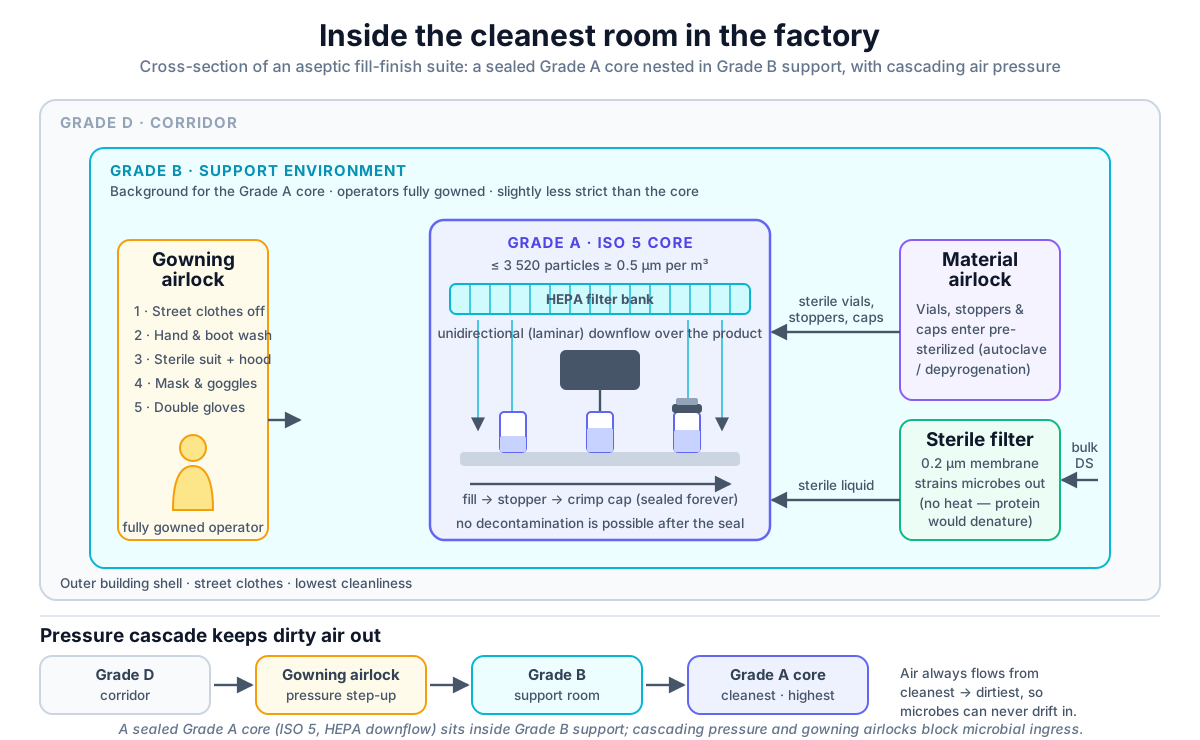 Aseptic fill-finish cleanroom layout: the Grade A operation zone (≤3,520 particles/m³) is isolated from Grade B support areas, with unidirectional HEPA airflow and personnel gowning controls to prevent microbial ingress.
Original diagram by the authors, created with AI assistance.
Aseptic fill-finish cleanroom layout: the Grade A operation zone (≤3,520 particles/m³) is isolated from Grade B support areas, with unidirectional HEPA airflow and personnel gowning controls to prevent microbial ingress.
Original diagram by the authors, created with AI assistance.
Vial and stopper selection: glass and elastomer choices
The container is not a neutral cup; it is in chemical contact with the protein for years, so it is chosen as carefully as the formula. Vials are typically Type I borosilicate glass, prized for low alkalinity and low leaching, though the field increasingly weighs polymer alternatives where glass delamination or breakage is a concern. The stopper is an elastomer — usually a coated butyl or fluoropolymer-laminated rubber — selected so it neither sheds particles nor leaches plasticizers and other extractables into the liquid over a multi-year shelf life. Every interface the protein touches is a potential source of degradation, which is why the container-closure system is qualified as part of the product, not bolted on at the end.
Stoppering and capping: the seal as final barrier
Once filled, each vial receives a sterile rubber stopper pressed into its neck, and then an aluminum crimp cap (commonly the 20 mm standard for vials, 13 mm for smaller ones) is rolled tight over the stopper flange to lock it permanently. That crimped seal is the final barrier: after it is in place, nothing — no filter, no wash, no later purification — can reach inside to remove a contaminant. The integrity of that seal is therefore treated as a critical quality attribute in its own right, and on a freeze-dried product the stopper is seated under vacuum at the very end of the cycle so the closed cake stays dry. From this moment the unit is a sealed, traceable object rather than a volume of liquid.
Container-closure integrity: proving the seal held
Calling the seal the final barrier only means something if you can prove it holds — which is the job of container-closure integrity testing (CCIT), the subject of USP <1207>. The older approach was probabilistic: a dye-ingress test immerses sealed vials in a dye bath under vacuum and then inspects for any dye that crept inside, and a microbial-ingress challenge immerses them in a bacterial broth — both consume the sample and only pass-or-fail it, with poor sensitivity to a small leak. The chapter's 2016 revision pushed the field toward deterministic, quantitative leak tests that measure an actual leak rate against a defined maximum allowable leakage limit: vacuum decay (seal the container in a test chamber, evacuate it, and watch for the pressure rise a leak path feeds — the method of ASTM F2338), high-voltage leak detection (HVLD) (sweep a high-voltage probe along a liquid-filled container and read the current a pinhole conducts), helium leak (fill with a helium tracer and count the atoms a mass spectrometer catches escaping), and headspace analysis (a laser reads the oxygen, moisture, or pressure sealed inside the container without opening it, so a rising oxygen level or a lost vacuum betrays a breach). CCIT is not a one-time gate at fill: because a stopper can relax or back out over years of cold storage, integrity is re-verified across the product's stability program, and for a lyophilized vial sealed under vacuum the headspace pressure itself becomes the running proof the closure never leaked. This is the test behind the claim that the crimped seal is a critical quality attribute — a claim is only ever as strong as the measurement that can fail it.
Subvisible particles and the silicone-oil failure mode
Not every threat to a sealed dose is microbial. The container and closure can themselves seed protein damage, and the clearest example is the prefilled syringe (PFS). A PFS comes already loaded with the dose, ready to inject — convenient for at-home self-injection, and governed by standards such as ISO 11040 so it fits reliably into autoinjector devices — but it carries a subtle trap. To let the rubber plunger glide smoothly, the inside of the glass barrel is coated with a thin film of silicone oil; the same siliconization is sometimes applied to vial stoppers. Tiny droplets of that oil can shed into the liquid and act as nucleation seeds for protein aggregation, producing subvisible particles — clumps too small to see by eye but large enough to matter immunologically, and counted at release against the compendial limits of the U.S. Pharmacopeia particulate-matter test (USP <788>, which sets ceilings on particles 10 micron and larger). A landmark commentary by Carpenter and colleagues warned the field in 2009 that these subvisible particles had been routinely overlooked in therapeutic protein products and could carry real immunogenicity risk, a gap that may compromise product quality [7]. The modern response runs on two tracks: container and closure choices (low-silicone or silicone-free systems, particle-controlled stoppers) are now treated as part of the formulation rather than an afterthought, and the broader contamination-control strategy — including the RABS-versus-isolator decision — is formalized under the EU's revised Annex 1 on sterile products, which makes minimizing particle and microbial ingress an explicit, documented program [1]. The lesson is that a perfectly sterile vial can still fail on particles, so the physical inputs that touch the protein are now part of the quality conversation from the start.
Freeze-drying: the three-act cycle and residual moisture
When a liquid formulation simply cannot survive long enough on the shelf, the product is lyophilized (freeze-dried). The cycle has three acts. First the filled vials are frozen solid on cooled shelves. Then comes primary drying: the chamber is pulled down to a deep vacuum (on the order of a few to ~30 pascals, far below atmospheric pressure) and the shelves are warmed just enough that the ice sublimes — passes straight from solid to vapor without melting — which can take anywhere from a half-day to a couple of days depending on how thick the frozen cake is. Finally secondary drying gently warms further to drive off the last stubbornly bound water, until the residual moisture in the cake is typically pulled down to only a few percent by weight, because leftover water shortens shelf life. As the water freezes into pure ice, everything else — protein, sugar, buffer — is squeezed into the shrinking pockets of unfrozen liquid between the ice crystals; that crowded leftover syrup is the freeze-concentrated formulation. Chilled far enough, that syrup stops flowing and sets rigid like glass, and the temperature where it stiffens is its glass-transition temperature (Tg'). The single parameter the whole cycle is built around is the collapse temperature (Tc), which sits just above Tg': warm the part-dried cake a few degrees past it and the syrup softens again. Primary drying must keep the product temperature below Tc, because crossing it lets the cake soften and slump into a collapsed, meltback structure that traps high residual moisture and reconstitutes poorly. That is the real reason the shelf temperature and chamber pressure are so tightly constrained. The recipe of shelf-temperature ramps, pressure, and timing is developed carefully (often with structured design-of-experiments studies) so the cake comes out elegant and uniform rather than collapsed [6]. The reward is a dry, robust product that can sit stable for years and is simply rehydrated at the point of care — like instant coffee, where the water is removed for shelf life and added back only at the moment of use.
 The three acts of a lyophilization cycle: freeze the product solid, sublime the ice under deep vacuum (primary drying), then warm gently to strip bound water to a few percent residual moisture (secondary drying) before the stopper seats under vacuum.
Original diagram by the authors, created with AI assistance.
The three acts of a lyophilization cycle: freeze the product solid, sublime the ice under deep vacuum (primary drying), then warm gently to strip bound water to a few percent residual moisture (secondary drying) before the stopper seats under vacuum.
Original diagram by the authors, created with AI assistance.
In-process controls and final inspection
A filling line does not simply trust that every unit is correct; it measures, and it decides. The most important in-process control is the checkweigh: a high-precision balance weighs filled units (often a statistical sample, sometimes 100% on modern lines) and compares the mass against the target, because at a known formulation density (around 1.01 g/mL for a typical aqueous mAb) the weighed mass is a direct proxy for the dosed volume. The arithmetic is simple but powerful: a 1.00 mL fill should weigh about 1.01 g, and the line rejects anything below a 0.95 mL commercial floor — so the rejected vial's 0.9463 mL (just under that floor) corresponds to only about 0.956 g, a shortfall a balance reads instantly even though no one can see it. A unit that falls outside the accept band is automatically rejected and diverted, with the reason recorded — and that weighing, like every measurement on the line, lands as a timestamped, tagged data point in the batch's data shadow — the running digital record the data companion follows from the moment each value is born. After sealing, every container is inspected — by high-resolution cameras on commercial lines, by trained human eyes for smaller or higher-risk batches — for cracks, particles, wrong fill levels, or seal defects. These checks are not telemetry; each accept-or-reject outcome is a quality decision attached to a specific serialized unit, which is exactly why the next section dissects one such unit's record field by field. The camera inspection itself is now the strongest production use of machine learning in the whole factory — a trained computer-vision model that learns to tell a true defect from a harmless air bubble — and the same modeling toolkit can tune a freeze-dry recipe or flag a drifting fill weight; the ML companion works exactly this fill-finish node in its chapter on formulation and fill-finish.
One subtlety sits behind that target weight: the fill target is set deliberately above the labeled dose. Liquid is always left behind wetting the vial wall, the stopper, and the needle or syringe used to withdraw it — the hold-up volume — so a container labeled to deliver 1.0 mL is filled to a little more. USP <1> (Injections) tabulates the recommended excess volume: about 0.10 mL for a 1.0 mL mobile aqueous liquid, rising toward 0.15 mL for a slightly viscous mAb, so the fill target lands near 1.10–1.15 mL — a target weight of roughly 1.11–1.16 g at the ~1.01 g/mL density — and the withdrawable deliverable volume that results is confirmed at release against USP <697> (Container Content for Injections). That overfill is kept as small as the deliverable-volume requirement allows, because it is pure giveaway: an extra 0.15 mL across a 200,000-vial batch is 30 L of finished drug substance that never reaches a patient.
Anatomy of a sealed vial record
A bioreactor tag is one number sampled over and over; a filled vial is the opposite — one record per physical thing, and that thing either ships to a patient or is destroyed. It is worth dissecting a single unit's record field by field, because every field is load-bearing and a rejected vial is the most instructive specimen of all. The card below takes one stoppered, crimped vial and lays out its identity (batch and serialized SGTIN), its timestamp, the dosed volume and the two weighings that police it, the closure spec, the freeze-dry endpoint, and the accept/reject verdict with the tolerance bands that produced it.
 One sealed vial as a record: identity and dose at the top, the accept/reject verdict highlighted with its nested tolerance bands, and a relationships panel mapping the unit up to its batch and out to the serialization tree.
Original diagram by the authors, created with AI assistance.
One sealed vial as a record: identity and dose at the top, the accept/reject verdict highlighted with its nested tolerance bands, and a relationships panel mapping the unit up to its batch and out to the serialization tree.
Original diagram by the authors, created with AI assistance.
Read top to bottom, the record tells a complete story. The batch_id is the join key back to the GMP batch record, so the vial is never an orphan. The vial_serial is the unit's unique identity — a Serialized GTIN (SGTIN), which pairs the product code under GS1 (the global barcode-standards body) Application Identifier (01) — the prefix that tags the digits as a product code — with a one-of-a-kind unit serial under Application Identifier (21) — printed on the label as a scannable DataMatrix (a square 2-D barcode). Then come the numbers that decide its fate: the dosed fill_volume_mL, the weighed fill_weight_g, and the independent ipc_checkweigh_g, reconcilable through the formulation density. The decisive field is reject: in the example shown, a fill volume of 0.9463 mL fell below the 0.95 mL commercial floor, so the unit is flagged reject = True with reason low_fill — a tight commercial accept band (0.95–1.05 mL) nested inside the wider physical clip (0.90–1.10 mL). A rejected unit keeps its serial but is barred from the aggregation tree (the parent-child map of which vials sit in which carton and which cartons sit in which case), so it never joins a carton or case. Each of those links is a typed relationship — the vial is-a drug-product unit, it is derived-from its batch, and it is contained-in a carton — exactly the kind of typed lineage edge the ontology companion makes machine-checkable in its chapters on classes and taxonomy and relations and genealogy. This is the physical anchor of a data thread that runs the length of the trilogy: this same vial surfaces as an environmental-and-fill record in the data companion's plant information systems, and then a concrete fill_events row with exactly these columns — landed in PostgreSQL alongside its equipment model — in the open-source build's fill-finish and environmental-monitoring chapter.
Pulling the eight subsections back together, the whole step is best remembered as a chain of barriers, each guarding the dose against one failure mode: the excipient barrier (buffer, sugar, surfactant) keeps the protein folded, the filter barrier strains out bacteria, the air barrier of Grade A unidirectional flow keeps microbes from ever landing, the closure barrier of stopper and crimp seals the dose forever, and — for lyophilized products — the moisture barrier of a dry cake buys years of shelf life. Lose any one barrier and the others cannot fully cover for it, which is why every one is validated in its own right.
Why it matters
This is the last open door. Once the cap is crimped on, there is no further chance to remove a stray contaminant — no downstream step can reach inside a sealed vial. Every earlier purification step removed impurities you could not see; here, the danger is something alive — a single bacterium — getting into a vial meant to be injected straight into a person [2].
Many biologics are given by injection, often to patients whose immune systems are already weakened by their disease or its treatment. A contaminated injection can cause a dangerous, even fatal, infection that bypasses all the body's normal defenses. Dosing errors matter too: too little medicine and it does not work; too much and it can harm. And the threats are not only microbial — a flawed excipient recipe, a shedding stopper, or silicone droplets can quietly breed protein aggregates that are just as unacceptable. That is why this step is filled, sealed, and checked with obsessive care, and why every aseptic and sterilization process here must be written down, validated, and proven to work before it is ever used on real product [3].
Fill-finish is the final step before the container is sealed shut. There is no "remove the germs later" stage afterward. If a microbe gets in here, it stays in — and goes straight into a patient. This is why the room, the machines, and the people are controlled more tightly than almost anywhere else in the whole factory, and why decisions about what could go wrong are made formally, using a structured quality risk management approach rather than gut feel [8].
In the real world
Fill-finish is where the long journey becomes the object in a nurse's hand: a vial or prefilled syringe with a label. The lines that do it are built by a small set of specialist engineering firms. Machine builders such as Bausch+Strobel, Syntegon (the former Bosch Packaging Technology), and IMA and Groninger supply the filling lines, in capacities that span from slow, flexible clinical machines doing tens of vials a minute up to high-speed commercial lines running several hundred containers a minute. The same suppliers increasingly deliver the whole sterile core as a sealed isolator so that, in line with modern Annex 1 thinking [1], human operators never share air with the open product at all.
Once each container has passed the in-process checkweigh and the final inspection described above, the accepted units move on to packaging and labeling and then to final quality control and release. It is in that release testing, not on the filling line itself, that the product also faces its endotoxin (bacterial-fever-toxin) and sterility assays — the formal proof that the obsessive controls here actually worked. The accept/reject flags, environmental-monitoring excursions, and serialization links produced on the line are all regulated records, and the open-source companion shows precisely how they are captured and kept on the right side of the GxP boundary in its fill-finish and environmental-monitoring chapter.
The same controls apply no matter how the antibody was grown upstream. Whether the process was traditional fed-batch culture (cells grown in a tank that is fed and then harvested all at once) with Protein A capture (the affinity-purification step that grabs antibodies) — still how the great majority of approved mAbs are made — or a modern continuous / intensified process using a perfusion bioreactor (one that is fed and drained nonstop so cells keep producing) and multi-column capture, the medicine still meets the patient as a single, perfectly sealed, sterile dose; fill-finish is the shared finish line for both.
Key terms
- Drug substance (DS) — the purified active medicine in bulk form, before final packaging.
- Drug product (DP) — the finished, sealed container (vial or syringe) given to a patient.
- Final formulation — diluting to the exact dose and adding the final stabilizing ingredients.
- Excipient — an inactive helper ingredient (buffer, sugar, surfactant) that keeps the protein stable and safe.
- Buffer — an ingredient (such as histidine or phosphate) that holds the pH steady so the protein does not denature.
- Surfactant — a small additive (such as polysorbate 80) that stops the protein sticking to surfaces and clumping.
- Sterile filtration — straining the liquid through a validated 0.2 micron filter to remove microbes without heat.
- Sterilizing-grade filter — a 0.2 micron membrane proven to fully retain a standard bacterial challenge.
- Bioburden — the count of live microbes in the liquid before it is filtered, kept under a controlled limit (measured in CFU, colony-forming units).
- Integrity test — a check (bubble-point or diffusional-flow) proving a filter had no flaw that could let bacteria through.
- Aseptic filling — filling sterile product in ultra-clean conditions so no microbes ever get in.
- Cleanroom (Grade A / ISO 5) — the cleanest controlled environment (≤3,520 particles ≥0.5 µm per m³), with HEPA-filtered unidirectional air.
- Isolator / RABS — a sealed barrier letting operators work through glove ports without sharing air with the product.
- Prefilled syringe (PFS) — a syringe that comes already loaded with the correct dose, ready to inject.
- Subvisible particles — protein clumps too small to see, an aggregation risk that can drive immunogenicity.
- Container-closure system — the matched vial (or syringe) and stopper, qualified together as part of the product because both touch the protein for years.
- Stopper / crimp cap — the rubber closure and aluminum cap that seal a vial shut.
- Container-closure integrity testing (CCIT) — the tests that prove a sealed container has no leak path (deterministic: vacuum decay, HVLD, helium leak, headspace analysis; older probabilistic: dye- or microbial-ingress), governed by USP <1207> and repeated across stability.
- Checkweigh — an in-process weighing of filled units that, at the known formulation density, polices the dosed volume and triggers automatic rejects.
- Overfill (overage) / deliverable volume — the small validated excess filled above the labeled dose (recommended by USP <1>) so the full labeled volume can still be withdrawn after hold-up losses; the withdrawable volume is confirmed against USP <697>.
- SGTIN (Serialized GTIN) — a unit's unique "license plate": the product code under GS1 AI (01) plus a one-of-a-kind serial under AI (21), printed as a scannable DataMatrix.
- Lyophilization (freeze-drying) — removing water under vacuum (by sublimation) to leave a dry, longer-lasting powder "cake."
- Reconstitute — adding sterile water to a freeze-dried product to turn it back into an injectable liquid.
- Endotoxin — a fever-causing toxin from bacteria, tested for at release to confirm sterility controls held.
- Quality risk management — the formal, structured way decisions about contamination hazards are made.
- Tech transfer / IQ-OQ-PQ — moving the fixed recipe onto production equipment and proving each line through installation, operational, and performance qualification before it fills a saleable dose.
- Subvisible-particle test (USP <788>) — the compendial test that caps how many particles 10 micron and larger a dose may carry.
- Data integrity (ALCOA+) — the principles (attributable, legible, contemporaneous, original, accurate, and more) that every electronic record on the line must meet, under 21 CFR Part 11 and EU Annex 11.
- cGMP (current Good Manufacturing Practice) — the legally binding rules requiring controlled, documented, validated conditions for every step.
Where this leads
The vial is now filled, sealed, and inspected — a finished sterile dose, but still a bare container that cannot yet be shipped. In the next chapter, packaging, labeling and serialization, we give every single pack its own unique identity: a label, a leaflet, and a one-of-a-kind code that lets anyone follow that exact dose from the factory all the way to the patient's bedside.