Harvest: separating cells from the medicine
📍 Where we are: Stop 12 of 21 · the end of upstream. The cells have finished their job — now we collect the medicine they made and hand it across to the purification team.
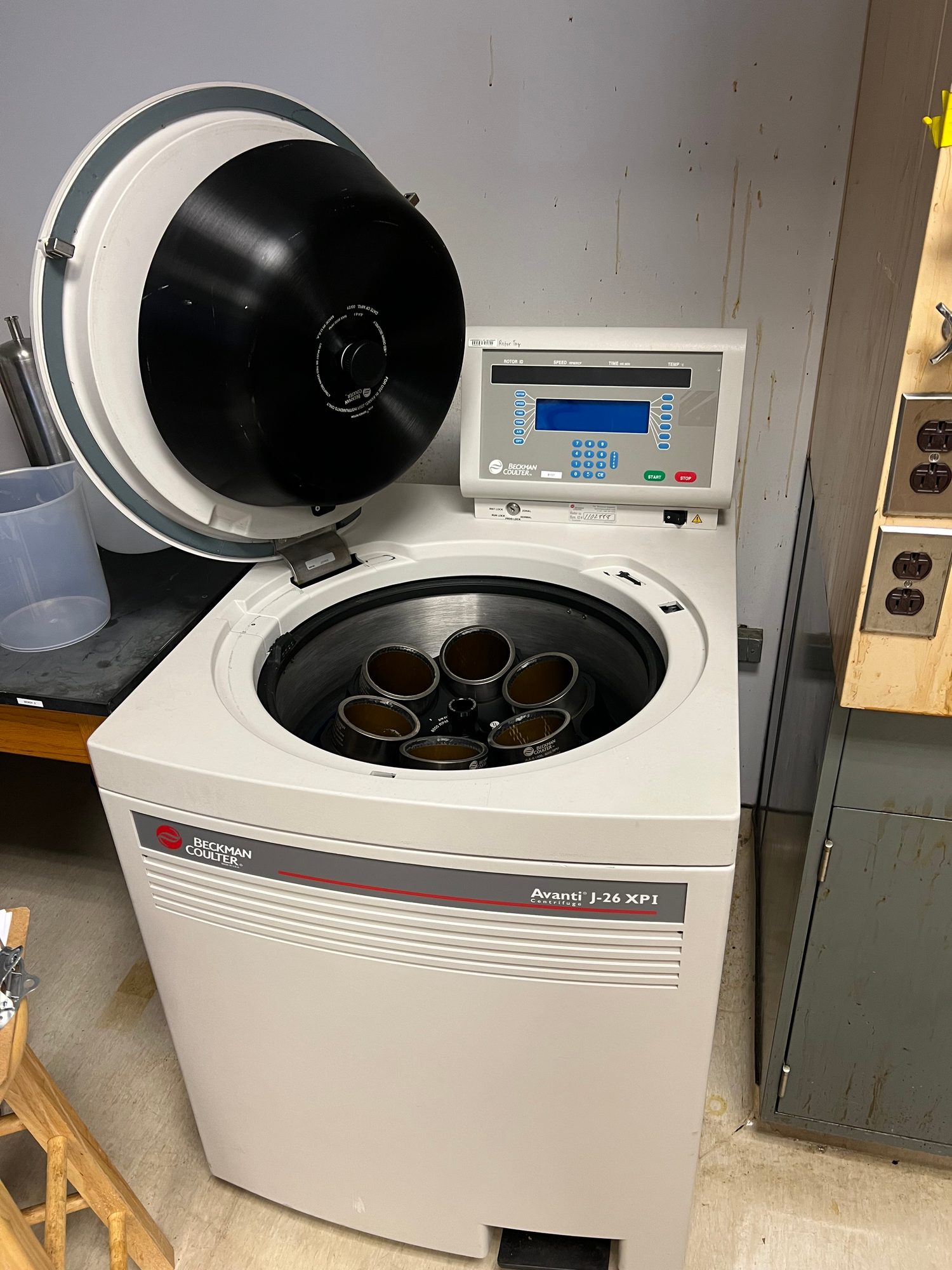 A floor-standing centrifuge spins samples so heavier cells and debris pack against the wall while the clarified liquid stays clear — the same density-based separation used, at far larger scale, to harvest a bioreactor.
Laboratory centrifuge. Image by Ivangiesen, CC0, via Wikimedia Commons.
A floor-standing centrifuge spins samples so heavier cells and debris pack against the wall while the clarified liquid stays clear — the same density-based separation used, at far larger scale, to harvest a bioreactor.
Laboratory centrifuge. Image by Ivangiesen, CC0, via Wikimedia Commons.
Your production bioreactor — the big tank from the last chapter — is now full of a cloudy soup. Floating in that soup are billions of tiny cells, the antibody medicine they spent two weeks secreting, and a slurry of broken-cell debris. In this step — called harvest and clarification — we throw away the cells and keep only the clear liquid that holds the medicine.
Imagine a big pot of cloudy homemade broth. You only want the clear liquid, not the chunks. So you let the heavy bits sink, pour off the clear part, then run it through finer and finer strainers until it pours out crystal clear. That is exactly what harvest does — just at a giant, super-clean, tightly measured scale, with the antibody as the prize hiding in the clear liquid.
What this chapter covers
We will follow the cloudy broth as it leaves the bioreactor and is turned into a clear, cell-free liquid ready for purification. You will see the two real machines that do the work — an industrial centrifuge and a layered depth filter — with the actual forces, pore sizes, and flow rates engineers use. We will put numbers on what "clean" means here: how much of the cell's other protein and DNA gets stripped out — the antibody medicine is itself a protein the cell was engineered to make, while the cell's thousands of native proteins are unwanted impurities — and how cloudy-to-clear the liquid really goes. We will look at how a fragile protein can be damaged if this is done too hard, too hot, or too slowly, and at the rulebook (cGMP — current Good Manufacturing Practice — and the ICH — International Council for Harmonisation — guidelines) that keeps it safe. Finally, we will see how modern continuous processes keep cells in the tank and let the medicine flow out gently, day after day.
What actually happens
Why harvest matters: the upstream-downstream doorway
Before the machinery, hold the geography in mind. Harvest is the doorway between two worlds. Everything before it is upstream — the production bioreactor and the seed train that fed it, all about growing cells. Everything after it is downstream — about purifying the product. Harvest is the exact hinge where one ends and the other begins, and it is the first time the medicine and the cells that made it are forced apart.
The liquid leaving the bioreactor is called the broth or harvest. It is rich in the antibody we want, but it is also a messy mixture of things we do not want: whole cells (often 5–20 million cells per milliliter in a modern fed-batch run — the standard recipe where one tank grows and is harvested all at once, explained more fully later; intensified high-density processes push higher), cell pieces, and the soluble junk those cells release — host cell proteins (HCPs) — the thousands of other proteins the cell naturally makes for its own living, as opposed to the single antibody protein it was engineered to manufacture and secrete for us — and host cell DNA. Our goal here is narrow but important: get the cells and debris out, fast and gently, without harming the antibody.
It usually happens in two stages, in sequence.
Centrifugation: the disk-stack workhorse
The broth is spun very fast in a machine called a centrifuge. Spinning creates a force much stronger than gravity, measured as a multiple of g (one g being normal gravity), so the denser cells get flung outward (just as spinning throws the heaviest things to the edge) and pack into a dense layer while the lighter, clearer liquid stays toward the center, where it is drawn off [1]. It is the same physics as a washing-machine spin pressing water out of clothes — but where a washing machine reaches a few hundred g, a harvest centrifuge runs far harder and colder.
There is more than one kind, and the choice depends on scale and on whether you are running a single batch or a continuous stream [2]:
- A disk-stack centrifuge is the workhorse for large fed-batch harvests. A tall stack of closely spaced cone-shaped disks inside the bowl spins at roughly 10,000–20,000 g, giving the cells very little distance to travel before they hit a surface and slide down to the bowl wall. Crucially, it runs continuously: broth feeds in, clarified liquid flows out, and solids are discharged on a timer — so one machine can clear thousands of liters at flow rates in the tens of liters per minute. Vendors you will hear named include Alfa Laval (Westfalia), GEA, and ANDRITZ SEPARATION.
- A basket centrifuge (a batch design with a removable basket) spins more gently — often 2,000–3,500 g — and processes one batch at a time, packing solids into the basket. It suits smaller volumes (roughly 100–2,000 L) and gentler duty; Carr and Flottweg are typical names here. A related tubular-bowl design is also a one-batch-at-a-time machine, but it is the opposite of gentle — it runs at very high g (commonly 13,000 g and higher) and is used when you need hard sedimentation of fine solids in a small footprint.
- A chamber centrifuge is used in some perfusion setups, where the same gentle clarification has to run nonstop for weeks.
| Centrifuge type | Force | Mode | Best for | Example vendors |
|---|---|---|---|---|
| Disk-stack | 10,000–20,000 g | Continuous | Large fed-batch harvests (thousands of L) | Alfa Laval (Westfalia), GEA, ANDRITZ |
| Basket | 2,000–3,500 g | One batch at a time | Smaller volumes (~100–2,000 L), gentler duty | Carr, Flottweg |
| Tubular-bowl | 13,000 g and higher | One batch at a time | High-g hard sedimentation of fine solids in a small footprint | — |
| Chamber | Low (gentle) | Continuous (runs nonstop for weeks) | Perfusion setups | — |
Throughout, the broth is kept cold — typically 2–8 °C — because cold slows the chemistry that would otherwise let cells leak more protein and let the antibody clump. The whole machine is a closed, sterilizable, stainless-steel system, because nothing about this can be open to room air [5].
Anatomy of a disk-stack centrifuge
It is worth opening the workhorse up. A disk-stack centrifuge is not a single spinning drum but a precisely engineered geometry. Inside the rotating bowl sits a tall stack of nested conical disks, spaced only fractions of a millimetre apart. That tight spacing is the whole trick: instead of a cell having to sink the full radius of the bowl, it only has to settle across one thin gap before it hits a disk surface and slides outward to the wall. Stacking dozens of disks multiplies the effective settling area into something far larger than the machine's footprint. Spun at 10,000–20,000 g inside a 316L stainless-steel (a pharma-grade, corrosion-resistant steel), jacket-cooled, sterilizable bowl, the device runs continuously through three ports: broth enters down the central feed tube, clarified liquid is drawn off near the centre, and packed cell solids are ejected on a timer at the bowl wall.
 A disk-stack centrifuge read as an identity card: the green block names its three ports, while the violet panel shows how its controllable inputs (g-force, feed rate, temperature, hold time) drive the product's quality attributes.
Original diagram by the authors, created with AI assistance.
A disk-stack centrifuge read as an identity card: the green block names its three ports, while the violet panel shows how its controllable inputs (g-force, feed rate, temperature, hold time) drive the product's quality attributes.
Original diagram by the authors, created with AI assistance.
Every one of those controllable settings is a Critical Process Parameter (CPP) that a control system reads, displays, and records continuously. The rule worth fixing now: a CPP is an input you control (a knob like g-force or temperature), while a Critical Quality Attribute (CQA) is a quality output it drives (an outcome like aggregate level) — the whole discipline of Quality by Design is keeping the CPPs in range so the CQAs stay in spec. The physical knob on the skid — the g-force setpoint, the jacket temperature, the feed pump rate — is the very thing that becomes a tag in the plant historian (the system that continuously logs every instrument reading over time) and a row in the batch record (the official document of how this batch was made). Book 2 picks up exactly this thread, tracing how a parameter like centrifuge speed is born as a sensor and instrument signal and then governed as automation and control data; every such reading also becomes a tagged data point in the batch's data shadow, the digital twin of the physical lot (where data is born, the data shadow).
The relationships hiding in that last sentence are themselves typed, and naming them is the first step toward a machine-readable record. This clarified harvest is-derived-from the production-bioreactor batch, which is-derived-from the cell bank; a CPP affects a CQA; the centrifuge step runs-on the skid. Those verbs are exactly the ontology edges that the ontology book makes explicit, turning a flat list of readings into a genealogy you can walk back to its class in the taxonomy.
Depth filtration: the polishing step
The liquid leaving the centrifuge looks clear to the eye, but it still carries a fog of fine, tiny specks — sub-micron cell fragments, colloids, and bits that the spin could not catch. So it flows through a depth filter: not a single screen but a thick, layered pad that traps particles all the way through its depth, not just on the surface [3].
The trick is an engineered gradient. The media is built so the pores get finer as the liquid travels through — a nominal rating that steps down across the pad, often from around 10 µm at the inlet face to roughly 0.2 µm deep inside (a micron, µm, is a thousandth of a millimeter; a human hair is about 70 µm across). Coarse bits catch in the open first layers; the finest specks lodge deep in the tight final layers — picture a series of strainers, from kitchen colander to coffee filter, fused into one pad. The media itself is usually cellulose fiber loaded with diatomaceous earth (a fine, porous mineral powder) and sometimes a charged resin so that some impurities stick by electrostatic attraction, not just by being too big to pass. Common vendors include Pall (now part of Danaher), Sartorius, Merck Millipore, and Asahi Kasei.
Two numbers matter to the engineer running it. The first is flux — how fast liquid moves through each square meter of filter, typically 10–100 liters per square meter per hour — which sets how much filter area you need. The second is hold-up volume — the precious clarified liquid left soaking in the pad at the end, which is recovered with a careful buffer flush so the antibody is not thrown away with the filter.
Engineers size the filter from a small-scale throughput study (the Vmax sizing test, which projects the maximum volume — in liters of broth per square meter of media — a filter can clear before it clogs) and then run the full-scale stage until the pressure difference across the filter assembly — the train (the depth-filter capsules plus the downstream sterilizing filter, plumbed in series) — climbs to a stopping point, commonly around 15–20 psid (pounds per square inch of differential pressure, the pressure lost as liquid pushes through), or to a turbidity breakthrough at the outlet, whichever comes first; that pressure trend is the live signal the operator watches.
That live pressure trend, together with the upstream cell density and viability at harvest, is exactly the kind of signal a data-driven model can learn from: a soft sensor (a model that predicts a hard-to-measure quantity from easy-to-measure ones) could forecast filter clogging and the right Vmax area, or call the clarification endpoint, before the pressure stops the run. That is the subject of the machine-learning book's harvest chapter; here we only note where such a model would plug in.
One detail completes the train: almost every real harvest ends in a 0.2 µm bioburden-reduction filter (sterilizing-grade by construction, but operated here for bioburden control) before the harvest reaches the hold tank or the Protein A load (the feed onto the first purification column, introduced at the end of this chapter). That filter — not the depth filter — is what reduces the microbial load (bioburden) entering the hold tank; the depth filter is a nominal pre-filter whose job is to protect it from blinding (clogging — when trapped particles plug the pores and choke off flow). The fully validated sterile boundary — backed by a bacterial-challenge retention test — comes later, at the final sterilizing filtration before fill-finish.
What comes out of all this is the clarified harvest: a clear, almost colorless liquid, free of cells, ready for the next stage.
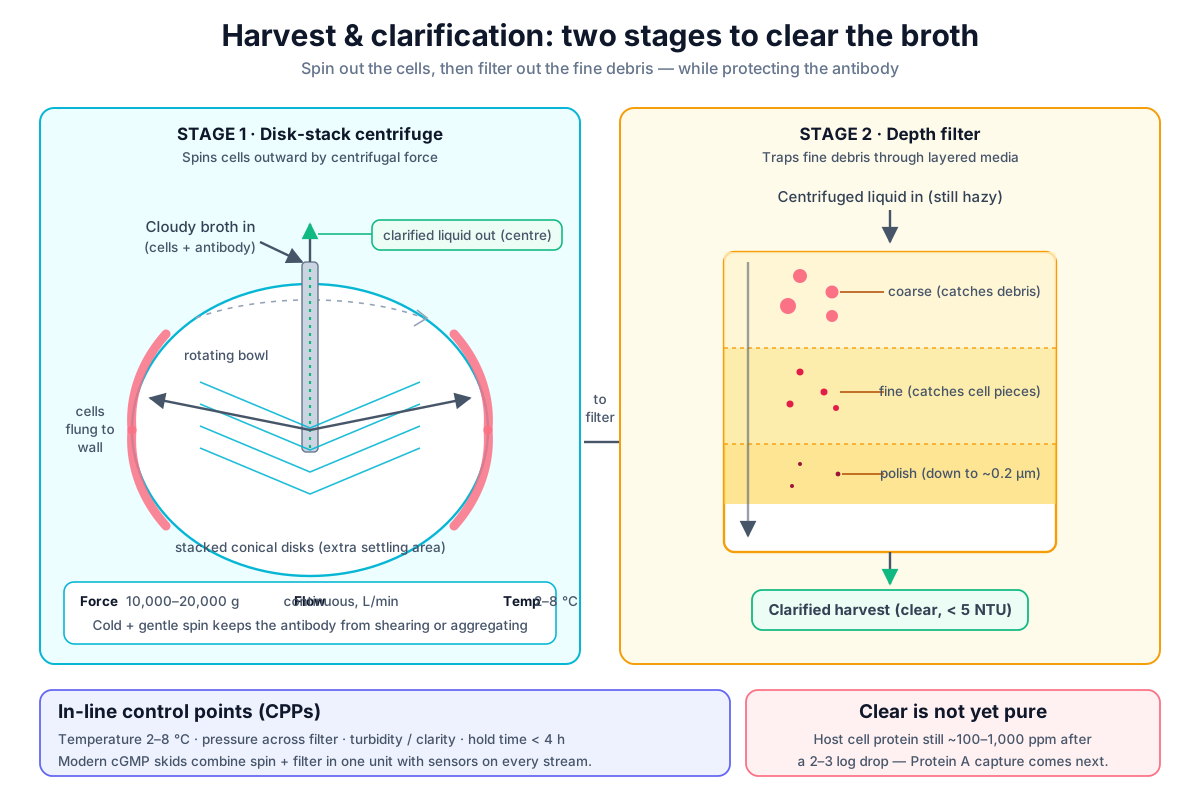 Two-stage harvest: disk-stack centrifugation (left) uses 10,000–20,000 g to sediment cells radially, while depth filtration (right) traps fine impurities throughout a layered media matrix. Modern systems integrate both into a single cGMP-compliant skid with in-line monitoring of temperature, pressure, and clarity.
Original diagram by the authors, created with AI assistance.
Two-stage harvest: disk-stack centrifugation (left) uses 10,000–20,000 g to sediment cells radially, while depth filtration (right) traps fine impurities throughout a layered media matrix. Modern systems integrate both into a single cGMP-compliant skid with in-line monitoring of temperature, pressure, and clarity.
Original diagram by the authors, created with AI assistance.

Clarity metrics: turbidity, HCP, and DNA logs
Here is the single most important idea in this chapter: clear does not mean pure. When you hold a vial of clarified harvest up to the light, it looks like clean water — the cloudiness is gone, the turbidity (a haziness measurement read in NTU, Nephelometric Turbidity Units) has dropped from over 1,000 NTU in the raw broth to under about 5 NTU. But dissolved in that clear liquid, invisible, are still huge numbers of impurity molecules.
To put real numbers on it: clarification typically removes about 2–3 logs of host cell protein — that is, it divides the HCP level by roughly 100 to 1,000 — taking it from something like 10,000–100,000 ppm down to around 100–1,000 ppm (ppm here means nanograms of HCP per milligram of antibody) [3]. Working one through: 100,000 ppm divided by 1,000 leaves 100 ppm — that factor of 1,000 is a 3-log drop. (HCP itself is measured later by ELISA, charge variants by icIEF, and aggregate by size-exclusion chromatography; this chapter only clears the bulk, the analytics chapter does the counting.) Host cell DNA drops by a similar 2–4 logs. Those are big reductions, and dual-stage filtration can push them further — but they are nowhere near final-product clean. A safe medicine needs HCP measured in single-digit ppm and DNA in picograms per dose. Clarification only clears the cells and the bulk debris; the careful molecular purification — pulling out the remaining HCP, DNA, and other unwanted molecules — happens in the chromatography chapters that follow [4].
Why it matters and where it can go wrong
As upstream titers have climbed over the years — from under 1 gram per liter decades ago to 2–8 grams per liter today, with high-performing platforms reaching ~10 grams per liter — harvest and clarification quietly became a bottleneck, because every extra gram of antibody comes packaged with more cells and more debris to clear out [7]. And this is the big-picture boundary where any failure to deliver a clean stream is inherited by every step that follows. Doing it well matters for two concrete reasons.
First, the antibody is fragile. Spin too hard, get too warm, or take too long, and the protein can be damaged or clump into aggregates (clumped, misfolded protein) — and aggregated medicine is both less effective and potentially unsafe, so it cannot be released. The damage has two main causes. One is shear — the violent fluid stress at the edges of a high-g centrifuge or across a filter under pressure — which can physically unfold a protein. The other is time and temperature: the longer the harvest sits warm, the more dying cells leak HCP and proteases (enzymes that chew up protein) into the liquid, and the more the antibody aggregates. As a rule of thumb, plants try to keep the warm hold short — often under about 4 hours above 20 °C — and otherwise keep everything chilled. Gentle, cold, and fast wins.
Second, whatever you fail to remove now makes life much harder later. If too much debris gets through, the downstream filters and chromatography columns clog and foul, run pressures climb, and impurities ride along toward the final medicine. Clarification is also the last upstream barrier against microbial contamination: the depth-filter stage reduces bioburden, and the 0.2 µm bioburden-reduction filter that follows it reduces the microbial load (bioburden) entering the hold tank — so a clean, well-controlled harvest directly protects the bioburden and safety of everything downstream. (The fully validated sterile boundary comes later, at the final sterilizing filtration before fill-finish.) Since HCPs and host cell DNA can be unsafe for patients, getting a clean start here protects the capture step that follows.
The aggregate risk: shear, hold time, and temperature
These two failure causes converge on a single fragile molecule, and it helps to picture them together. Shear is a place — the high-g feed edges of the centrifuge and the pressure drop across the filter — while hold time and temperature are a process condition that builds with every passing minute.
 The three levers that protect the antibody: gentle (low shear), cold (2 to 8 degrees), and fast (short hold). When the warm hold runs long, the aggregate curve climbs out of its validated window — and every reading that proves it is captured continuously.
Original diagram by the authors, created with AI assistance.
The three levers that protect the antibody: gentle (low shear), cold (2 to 8 degrees), and fast (short hold). When the warm hold runs long, the aggregate curve climbs out of its validated window — and every reading that proves it is captured continuously.
Original diagram by the authors, created with AI assistance.
A logged hold-time excursion that breaches the HMW limit
Consider a concrete, documented way this goes wrong. The clarified harvest is collected into a hold tank to await the Protein A capture step, but a chiller fault or a scheduling delay lets it sit above 20 °C for longer than the validated 4-hour window. Aggregation is not instantaneous; it follows kinetics that accelerate with both temperature and time, so as the warm hold stretches on, dying cells keep leaking proteases and the high-molecular-weight (HMW) aggregate fraction — so called because clumped antibody molecules are larger and heavier than the single, correctly folded ones — climbs [10]. Eventually the HMW species exceed the aggregate limit written into the product specification under ICH Q6B (the international guideline on specifications for biological products) [4] — a CQA (the aggregate level) has failed, driven by a CPP (hold time and temperature) that drifted out of range. That HMW fraction is later quantified by size-exclusion chromatography at release testing.
What turns this from a guess into a verdict is the data trail. Under PIC/S PI 041-1 (the GMP data-integrity standard), the timestamped hold-time and temperature records are exactly the kind of contemporaneous, attributable evidence (recorded as it happened, by an identifiable system or person) an investigation depends on: they pin down when the excursion began, how warm it got, and how long it lasted, so the deviation can be assessed against the validated window rather than argued about [11]. "Contemporaneous" and "attributable" are two of the ALCOA+ attributes — the data-integrity checklist that 21 CFR Part 11 (the US rule on electronic records and signatures) and EU Annex 11 make enforceable, and that Book 2 unpacks in full (data integrity and ALCOA+). For those records to count, the system that captured them must itself be validated — the IQ/OQ/PQ qualification and the modern, risk-based shift from CSV to CSA (Computer Software Assurance) that Book 2 covers in validating computerized systems. The physical excursion in the hold tank becomes a row of timestamped readings — and Book 3 shows the open-source downstream-chromatography implementation that captures and stores precisely these process values as the harvest is handed downstream.
In the real world
Perfusion vs fed-batch: continuous vs batch harvest
The standard commercial recipe is fed-batch culture: the tank grows for about 10 to 21 days (the exact length depends on the cell line and the media design), and then the entire batch is harvested in one large centrifuge-and-filter event at the end. One tank, one harvest, one big clarification. It is the proven, dominant approach behind most approved monoclonal antibodies, and the disk-stack-then-depth-filter sequence described above is its platform workhorse [1].
The modern, intensified alternative is perfusion (continuous culture). Here fresh food flows in and clarified product flows out continuously, while a cell-retention device keeps the cells inside the bioreactor — and it is worth being precise about that device, because it is not simple sedimentation. Real perfusion systems use active retention [8]:
- Alternating tangential flow (ATF) — a hollow-fiber filter through which liquid is pumped back and forth, the reversing flow constantly sweeping the fiber surface clean so it does not clog. Repligen's XCell ATF system is the best-known example.
- Acoustic separation — standing sound waves that gently nudge cells into clumps heavy enough to settle, with no filter to foul at all.
- Fixed-bed (packed-bed) systems, where cells live on a solid matrix while medium washes through.
These devices let a perfusion bioreactor hold cells at very high density — often 50–100 million cells per milliliter or more — while a steady trickle of cell-free, clarified product flows out, day after day, for weeks. Instead of one giant spin at the end, harvest becomes a gentle, continuous stream, which means the protein spends far less time being stressed and tends to aggregate less. That clarified stream can then feed directly into a continuous capture step, with no batch tank in between.
The rulebook: cGMP, ICH Q6B, and QbD
All of this sits inside a strict rulebook, and it helps to bucket the instruments before the acronyms land: one umbrella standard (cGMP), one specification guideline (ICH Q6B), one viral-safety guideline (ICH Q5A(R2)), and one design philosophy (QbD). The umbrella requirement is cGMP — the FDA's enforceable standard for how medicines must be made — and harvest equipment falls squarely under 21 CFR 211.67 (a section of the US Code of Federal Regulations, the body of enforceable federal rules), which requires that equipment be designed, cleaned, and maintained so it cannot contaminate or degrade the product [5]. The acceptance limits for residual HCP, DNA, and aggregate that this step is judged against come from ICH Q6B, the international guideline on specifications for biological products [4]. The viral-safety logic — including the idea that clarification is part of an upstream contamination barrier — is framed by ICH Q5A(R2), whose 2023 revision was expanded to cover exactly these continuous-manufacturing setups [6]. And tying it all together is Quality by Design (QbD): the discipline of identifying which Critical Process Parameters (CPPs) — here temperature, hold time, centrifuge g-force and feed rate, and filter pressure — drive which Critical Quality Attributes (CQAs), such as HCP level, DNA level, aggregate content, and visual clarity, and then controlling the parameters to keep the attributes in range [9]. Even something as humble as "the harvest should be clear and colorless" is a real, written, visual control point.
Key terms
- Broth (harvest) — the cloudy liquid from the bioreactor, containing cells plus the antibody and dissolved impurities.
- Centrifugation — fast spinning (a multiple of gravity, g) that flings heavy cells outward so the clearer liquid can be drawn off.
- Disk-stack centrifuge — the continuous, high-g (10,000–20,000 g) workhorse centrifuge for large fed-batch harvests.
- Depth filtration — filtering through a thick, gradient-pore pad that traps particles throughout its depth, not just on its surface.
- Clarified harvest — the clear, almost colorless, cell-free liquid that still holds the antibody and dissolved impurities.
- Turbidity (NTU) — a measure of cloudiness; harvest takes the liquid from over 1,000 NTU down to under about 5 NTU.
- Upstream / downstream — growing the cells versus purifying the product; harvest is the boundary between them.
- Host cell protein (HCP) — the cell's own proteins, an impurity reduced by 2–3 logs here and removed further downstream.
- Host cell DNA — leftover DNA from the cells, reduced by 2–4 logs during clarification.
- Aggregate (HMW species) — clumped, misfolded protein — the high-molecular-weight fraction — formed by shear, heat, or long hold times, that must be kept out of the final medicine.
- Hold-time window — the validated maximum time the warm harvest may sit (often under 4 hours above 20 °C) before aggregation risk breaches the specification.
- Shear — the violent fluid stress (in a centrifuge or across a filter) that can physically damage the fragile antibody.
- Perfusion — continuous culture where product flows out steadily while a cell-retention device keeps cells inside the tank.
- Cell-retention device — the active separator (ATF, acoustic, or fixed-bed) that holds cells in a perfusion bioreactor while clarified product flows out.
- cGMP — current Good Manufacturing Practice, the enforceable standard governing how medicines must be made.
- Critical Process Parameter / Critical Quality Attribute (CPP / CQA) — the controllable inputs (temperature, hold time, g-force, pressure) and the quality outputs (HCP, DNA, aggregate, clarity) that Quality by Design links together.
- Soft sensor — a model that predicts a hard-to-measure quantity (such as the clarification endpoint or filter clogging) from easy-to-measure signals like pressure and cell density.
- Data shadow — the digital twin of a physical lot: the growing set of tagged, timestamped readings that records everything done to this harvest.
Recap
Before we cross the doorway, four things to lock in:
- Two stages, in sequence — a disk-stack centrifuge sediments the bulk of the cells, then a depth filter (backed by a 0.2 µm bioburden-reduction filter) polishes out the fines.
- Clear is not pure — turbidity drops from over 1,000 NTU to under 5 NTU, but HCP falls only 2–3 logs and DNA only 2–4 logs; the molecular cleanup is still all ahead.
- Three levers protect the fragile antibody — gentle (low shear), cold (2–8 °C), and fast (a short warm hold), because shear, heat, and time all drive aggregation.
- Harvest is the hinge — it is the exact boundary where upstream ends and downstream begins, and a clean hand-off here is inherited by every purification step that follows.
Where this leads
The clarified harvest is now a clear liquid carrying our antibody — but, as we have seen, still swimming with dissolved HCP, DNA, and other molecules. The next job is to reach into that crowded liquid and grab only the antibody, leaving everything else behind. That is the work of the first and most powerful purification step, capture chromatography, where a Protein A column acts like a molecular magnet built to catch antibodies and nothing else. We turn to it in the next chapter, Capture: grabbing the antibody (Protein A).