Preface — Teaching the Process to Learn
📍 Where we are: Right at the door of the fifth and final book. Before we train a single model, let us agree on what this book is really about — and, just as important, what it is not. This is the lens that everyone is most excited about and that the plant floor has adopted the least.
Welcome. This is a book about learning. The first four books in this series taught how a biologic medicine is physically made, how the data it sheds is managed, how to build the open-source software that holds that data, and how to model the whole process as a machine-readable knowledge graph. This book asks the next question: now that every reading, result, and record exists — and means something — can a machine learn from them? Can it predict a quality attribute, infer a value too slow to measure, flag a drifting batch, or design a better experiment — well enough to be trusted with a decision about a medicine for a person?
The answer is genuinely exciting and genuinely sobering, and this book refuses to give you one without the other. Machine learning is real in biomanufacturing, it is valuable, and it is far narrower in routine GMP use — GMP being Good Manufacturing Practice, the legally binding, regulator-inspected rules for making a medicine to a fixed, validated procedure — than the marketing suggests. We will walk the same process the rest of the series walks — from the cell bank to the filled vial — and at every step we will ask what a model can actually learn there, what it cannot, and how to tell an honest result from a press release.
You need no background in machine learning to read this. If you have never trained a model, never heard of PLS or a neural network, never thought about overfitting, you are exactly the reader we wrote for. We define every specialized term the first time it appears, and again in a Key terms box at the end of each chapter.
Imagine the bioprocess is a student you want to teach to predict the future — will this batch pass? what is the titer (the antibody concentration in the tank) right now? — from everything the plant records. The good news: it has a flood of cheap, fast clues (a sensor every few seconds, a spectrum every minute). The hard news: the true answers arrive only once or twice a day from a slow bench test, each batch costs weeks and a fortune, and no two batches behave quite alike. So the student learns from dozens of examples, not millions — and a student who has only seen dozens of cakes should not be left to run the oven alone. This book is about what such a student can genuinely learn, where it helps today, and why the most powerful results come from combining what we already know about the physics with what the data can add — not from data alone.
What this chapter covers
A quick map of the preface: who this book is for and the promise it makes; the one-process-five-lenses structure that makes this the learning lens onto a process four books already built; the honest thesis stated plainly up front — that ML in biomanufacturing has the most pilots and the fewest scaled implementations; the running example, one antibody campaign with a golden batch and an out-of-spec sibling, that every chapter trains and predicts against; the small-data ceiling and why hybrid modeling wins because of it; the two conventions — maturity and evidence tier — that ride on every number; the runnable example suite that backs each claim in code; the eight parts that follow the medicine from cell bank to patient and then out into the industry that builds it.
One process, five lenses — this one is learning
This series re-walks a single bioprocess spine five times, each time through a different lens. Book 1, Biologic Drug Manufacturing, shows how a monoclonal antibody is physically made — discovery, cell line, process development, analytics, the seed train, the production bioreactor, harvest, capture and polishing, formulation and fill, QC release, packaging, and distribution. Book 2, Data Management, follows the data shadow that manufacturing casts — how a reading becomes a contextualized, attributable, FAIR (findable, accessible, interoperable, reusable) data point rather than a bare number in a log. Book 3, Open-Source Bioprocess Data Systems, stores and serves that data in real software — a historian, a database schema, a SPARQL endpoint you can actually run. Book 4, Ontologies, models its meaning as a knowledge graph a machine can reason over — so that BR101.Temp.PV and the lab's culture_temp are known to be the same physical quantity, and a drug-substance lot can be walked back to the cell bank it grew from in one query.
This book is the fifth lens: learning. Same spine, same molecule, same batch — but now we ask, at each step, what a model can be taught from the data the first four books made, managed, stored, and gave meaning to. The ordering is not arbitrary. The four prior books are, between them, the prerequisite, because a model is a function from data to a decision: if the data is siloed it cannot be assembled, if it is non-FAIR it cannot be joined, if it has no shared meaning it cannot be trusted across systems, and if it is not stored in something you can query it cannot be served to a training pipeline at all. The single most common reason an ML program stalls in this industry is not the model — it is that the data underneath it was never made ready. Book 5 assumes that readiness has been earned and asks what learning becomes possible on top of it. Where it depends on a foundation an earlier book laid, it links back by route rather than re-deriving it: the data shadow for contextualized tags, the open-source stack for the historian and the multivariate core, the knowledge graph for the meaning that lets features join cleanly.
The honest thesis, stated up front
Most books about AI in manufacturing open with a promise. This one opens with a gap, because naming it now sets the standard the rest of the book is held to. There is a wide distance between what ML can demonstrate and what it does in routine GMP use — and AI/ML, of every digital technology in pharmaceutical manufacturing, has the most pilots and the fewest scaled implementations, a finding consistent with the ISPE 7th Pharma 4.0 survey, which reports AI/ML adoption concentrated in planning and pilot phases rather than systematic deployment [1]. The pilots category is not just high; it is high and stagnant — projects that demonstrate well and then never cross into routine use.
What is genuinely in production today is a short, solid list, and it has a family resemblance: it monitors and infers rather than autonomously decides, it sits inside a human-supervised loop, and most of its methods are at least a decade old even where the "AI" label is new. The list, which the closing chapter grades in full:
- Multivariate statistical process monitoring (MSPC) — PCA (principal component analysis) and PLS (partial least squares) models that fingerprint a whole batch trajectory and flag deviations against a golden batch. The most thoroughly deployed learning method in the industry, and forty-year-mature mathematics; what is new is the packaging, not the math.
- In-line Raman soft sensors — PLS calibrations that turn a Raman spectrum into a glucose, lactate, or titer reading every minute or two, up to documented closed-loop control of a feed nutrient (glucose), not a quality attribute. This is the cleanest "ML controls something" story in the book, and it is worth being precise about what it controls.
- Deep-learning computer-vision inspection — convolutional models that inspect filled vials and syringes for particulates, cracks, and fill defects. The strongest production deep-learning case in QC, earned over years of validation work and regulator conversations.
- Mechanistic chromatography modeling — physics-based simulation that designs and troubleshoots purification steps in commercial CMC (Chemistry, Manufacturing, and Controls) work. It earns its place on the production list precisely because it is mechanistic physics, not ML: the physics does the work that a handful of runs cannot.
- Human-in-the-loop documentation — review-by-exception execution on an electronic batch record, with ML increasingly layered on as advisory anomaly flags and deviation-triage suggestions. The human gate is the regulated control; the model is the assistant.
One property quietly unites the whole production list: every method on it is a locked model — its parameters are fixed at validation and changed only under predetermined change control, never silently in production. That is not a coincidence; it is the same property the draft EU/PIC/S GMP Annex 22 requires for any model touching a critical GMP decision, which is why the methods that scaled are the ones that hold still.
What is not on that list is just as important, and the omissions are the whole point: no autonomous adjustment of a critical quality attribute (a CQA — a product property such as purity or potency that, if it drifts, directly affects whether the medicine is safe and effective), no self-learning model in a critical control loop, no generative AI authoring a released record. The book's one-sentence verdict, which the closing chapter delivers in full, follows from this: ML in biomanufacturing is production-grade for seeing and inferring, pilot-grade for optimizing, and deliberately fenced out of autonomously deciding — and the fence is there on purpose.
The running example: one antibody, learned
Rather than scatter toy datasets, this book learns from one monoclonal antibody campaign, the same one the whole series follows — a CHO cell line making the IgG monoclonal antibody mAb-A. Its genealogy is the chain every chapter trains and predicts against (each manufacturing and purification step below is explained in Book 1):
a working cell bank
WCB-CHO-001seeds a seed trainSEED-001, which inoculates the production bioreactor batchBATCH-2026-001, purified through capture, viral safety, polishing, and ultrafiltration into a drug-substance lotDS-001, filled into a drug-product lotDP-001.
Two batches anchor the learning, and the contrast between them is the workhorse of the book. BATCH-2026-001 is the golden run — the one that passes cleanly, with a size-exclusion monomer purity of 98.611 percent. Its sibling BATCH-2026-004 is the out-of-spec (OOS) case — it breaches a pre-agreed release limit, its specification: it fails on host-cell protein (a process-related impurity carried over from the CHO cells), with an HCP of 128 ng/mg against a specification of 100 ng/mg maximum (the highest value still allowed to pass). That one OOS batch does an enormous amount of work across the chapters. It is the failing sibling a release predictor must catch before the slow assay confirms it; it is the held-out batch a leak-free split must keep genuinely unseen, so the score we report is the score a reviewer would see on a brand-new run; and it is the deviation an investigator actually has to scope — which other lots share its lineage, what upstream signal foreshadowed the failure, where the model would have flagged it. By learning on the same genealogy the other four books made, managed, stored, and modeled, every prediction in this book lands on a real, traceable consequence rather than an abstract metric on an anonymous dataset.
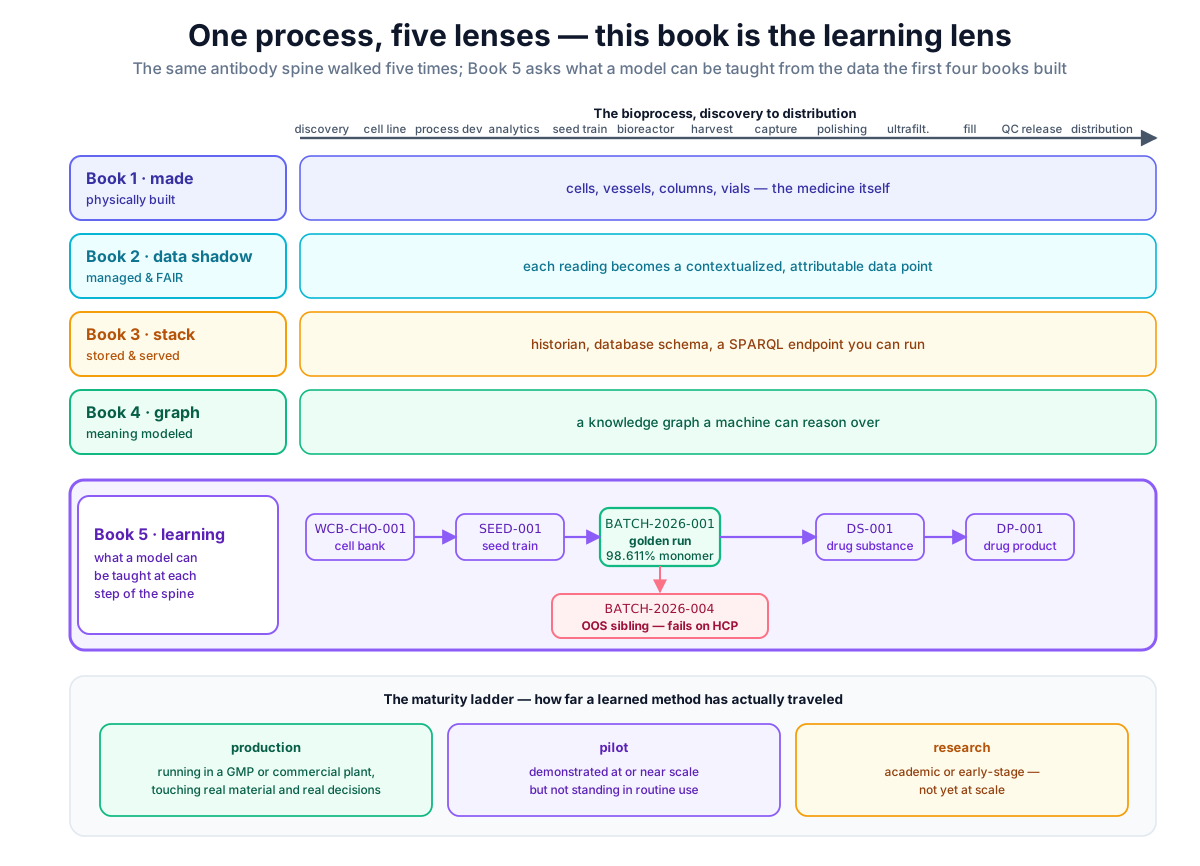 One process, five lenses: the same antibody genealogy walked five times, with this book — the learning lens — asking at every step what a model can be taught from the data the first four books made, managed, stored, and gave meaning to.
Original diagram by the authors, created with AI assistance.
One process, five lenses: the same antibody genealogy walked five times, with this book — the learning lens — asking at every step what a model can be taught from the data the first four books made, managed, stored, and gave meaning to.
Original diagram by the authors, created with AI assistance.
Why bioprocess is hard to learn: the small-data ceiling
Before the conventions, one idea has to land, because it explains more of this book than anything else. The bioprocess breaks the data-science rulebook in three ways at once. The data is small — a batch costs weeks and a fortune, so a team learns from dozens of runs, not the millions a deep network was designed for. It is slow — the offline reference assay that tells you the truth (the titer, the purity, the HCP) is measured only once or twice a day, while the sensors stream every few seconds, so the labels you can train against are scarce even when the inputs are abundant. And it is alive — run-to-run variability is large, cell lines drift, raw materials vary lot to lot, and a model that fit last quarter's runs decays in production. This variability is not sloppiness to be engineered away; it is an intrinsic property of a living system that the whole control strategy is built to contain, which is exactly why a model trained on it must be re-checked on a schedule rather than trusted indefinitely. Together these are the small-data ceiling, and it is the single fact that explains the most.
It is why pure data-hungry models starve or overfit — fit the training batches so closely they memorize their noise rather than the real pattern: give a neural network a few dozen batches and it will happily memorize them and then collapse on the next real run. It is why the most important discipline in the whole book is not the model architecture but the batch-grouped split — keeping whole batches wholly in train or wholly in test, never spread across both — because the alternative produces a flattering score that evaporates the moment a genuinely new batch arrives. And it is why hybrid modeling — a mechanistic backbone that encodes the physics and chemistry we already know, with a learned component covering only the residual that physics cannot write down — consistently wins over both pure approaches in this regime [2]. The physics constrains what the data is allowed to conclude, so the model generalizes more safely across the design space and is far easier to defend to a regulator. The peer-reviewed evidence is consistent, if self-authored: in one DataHow/Bristol Myers Squibb study a hybrid model reached about a third better product-quality accuracy with roughly half the training data of a black box [2]. Keep the small-data ceiling in mind on every page; almost every "why doesn't ML just solve this?" question in biomanufacturing terminates there.
A few conventions: every number carries its evidence
This is a popular book in tone and a textbook in rigor, and in a field this full of marketing those two only stay honest if every claim travels with its provenance. So the book carries two small tags on every result, and learning to read them is the most durable skill it teaches.
Maturity answers how far has it gotten? — written inline as (production) (running in a GMP or commercial plant, touching real material and real decisions), (pilot) (demonstrated at or near scale but not standing in routine use), or (research) (academic or early-stage).
Evidence tier answers how good is the evidence? — a four-rung ladder from press-release-only, up through vendor-self-reported, to peer-reviewed-self-authored, and finally peer-reviewed-independent. Only at the top rung — independent verification — may a number be stated as established fact. Below it, the number is labeled illustrative or self-reported, every time, in the same sentence as the number itself.
The two rungs are independent, and conflating them is the most common error in the field. A claim can be high on one and low on the other: automated visual inspection is (production) maturity but only vendor-self-reported tier; the best hybrid-modeling result is only (pilot) maturity yet reaches peer-reviewed-self-authored tier. You need both rungs to know what to do with a claim. The discipline sounds pedantic and is not: of the field's most-cited named deployments, almost none clears the peer-reviewed-independent floor, so nearly every headline efficiency number you will read must be hedged. Carrying the tier in the same breath as the number is what separates a careful reader from a credulous one [3]. One caution the tier ladder does not by itself catch: an independently published number can still be inflated if it came from a leaky, randomly-split evaluation. The evidence tier tells you who verified a number; the batch-grouped split tells you whether it was honestly measured. You need both.
Inline citation markers like [1] link to a single References page; the visible number is local to each chapter and restarts at [1]. The book is published in English and Korean (한국어). Product and standards-body names mentioned here belong to their respective owners and are used for identification only.
This book teaches how to think about learning from a regulated process. It is not regulatory advice, and a trained model is not a validated system. Real manufacturing decisions must follow current official guidance and your organization's approved, validated procedures — a point Part VII and Part VIII return to in full, including why the draft Annex 22 deliberately keeps adaptive and generative AI out of critical GMP decisions.
The runnable example suite: code that learns on real data
This is not a thought experiment waiting for adopters. Every modeling claim in the book is backed by a runnable example suite in the companion repository at examples/platform/ml/ — built on scikit-learn (with PyTorch for the two deep-learning comparisons), a suite of 33 modules in all, and trained entirely on the series' simulated datasets (the Raman spectra, online state, offline assays, and HPLC release results the open-source book's simulator produced for this exact genealogy). A shared data layer, dataio.py, loads those datasets with the batch_id group key preserved on every row, so the batch-grouped split — putting whole batches wholly into train or test, never both — is the default path, not an extra discipline you have to remember. That one choice is the difference between a score you can defend to a reviewer and a fantasy R² (R-squared, the share of variance a model explains — higher looks better) that collapses on the next batch.
From that foundation the suite builds, among others, a soft sensor (soft_sensor_pls.py and soft_sensor_deep.py — PLS and a 1D-CNN, head to head, so the small-data lesson is concrete rather than asserted), a clone ranker (clone_rank.py), a hybrid model (hybrid_model.py), a drift detector (drift.py), an MSPC monitor (mspc.py) and release predictor (release_predict.py), a vision inspector (vision_avi.py), and chromatography, viral-clearance, resin-lifetime, cold-chain, and deviation-triage modules — every one running over the same committed datasets and the same WCB-CHO-001 → … → DP-001 genealogy. A single harness, run_all.py, executes the modules whose prose claims must be reproducible from the committed data and checks each against its own acceptance gate — twenty-one models on the pinned datasets, every one clearing its gate (21/21) — so if a headline claim is not reproducible, the harness is where it shows. The suite closes with case_ledger.py: not a model but a structured, machine-checkable survey of named industrial deployments (cases.csv), each carrying its maturity and evidence tier, that computes the very distribution this book quotes and flags every headline number that is not allowed to be stated as fact. The code is real where it claims to be; where a snippet is illustrative configuration rather than a runnable artifact, it says so.
How to read this book: eight parts, following the medicine
The book is one continuous argument, told in eight parts that trace the batch from cell bank to patient, step back to assemble the whole learning system, then survey the real industry before delivering an honest verdict.
- Part I — Foundations of Learning in Bioprocess. Why bioprocess data is small, slow, and alive; data readiness and leak-free features as barrier number one; the ladder of models from PLS to transformers and how each must be validated under GxP (the umbrella of Good-Practice rules — GMP, GLP, GDP, and the rest — that govern regulated work).
- Part II — Discovery and Development, Learned. Where learning is first applied: target and concept, generative molecule design and developability, cell-line selection, model-guided process development, and learned analytical methods.
- Part III — Upstream, Learned. The seed train and the production bioreactor — soft sensing, the Raman success story, and the viable-cell-density signal that stubbornly resists it.
- Part IV — Downstream, Learned. Capture, viral safety, polishing, and ultrafiltration — where mechanistic models and physics-informed learning do the work that a handful of runs cannot.
- Part V — Fill-Finish and Release, Learned. Formulation and fill, the deep-learning vision inspection that is the strongest production deep-learning case, QC release prediction, and the cold chain to the patient.
- Part VI — The Whole System. Assembling the pieces: hybrid models and digital twins, MLOps and the lifecycle of a model that must be distrusted on a schedule, and the regulation and governance that bound it.
- Part VII — ML/AI in Industry Today. Stepping out of the running example to survey the real ecosystem — the vendors, the named case studies, the frontier of foundation models and autonomous labs, and generative AI and LLMs — each graded, not advertised.
- Part VIII — The Verdict. An honest reckoning of what is genuinely production today, what is pilot, what is hype, the structural tensions that hold the gap open, and concrete advice for a team starting an ML program now.
A thread runs through all eight: the discipline of separating maturity from evidence tier, asking who measured a number and against what, and recognizing that the production list is short for structural reasons no demo overcomes. Keep that habit close — it is the most valuable thing the book has to give.
The unsolved part
It would be tidy to promise that more data and bigger models simply close the gap. The honest truth is harder, and this book is more useful for admitting it now than for discovering it late. Two ceilings hold the production list short, and neither yields to enthusiasm. The first is the small-data ceiling itself: the candidate escapes — foundation models that amortize learning across many processes, federated learning that pools data without sharing it — are today aspiration more than product, and it is genuinely uncertain whether enough comparable, shareable bioprocess data will ever exist to train them. The second is harder still, because even if the data ceiling lifted, the regulatory ceiling might not. A model that learns continuously and controls a quality attribute autonomously is, by the current draft of Annex 22, kept out of critical GMP regardless of how good it gets. The binding constraint on autonomous bioprocessing may turn out not to be what a model can learn, but what we are willing to let an unsupervised model decide about a medicine for a person. That is not a problem more data solves, and the book treats it as the open question it is rather than pretending it is closed.
Why it matters
In a regulated process that makes medicine for people, the difference between a model that helps and a model that harms is not its accuracy on a slide — it is whether anyone can tell, honestly, what it has actually learned and how far that learning can be trusted. ML genuinely makes biomanufacturing better: safer monitoring, faster inference of values too slow to measure, fewer wasted runs, auto-released vials. It does so today almost entirely in a human-supervised, non-autonomous register, and that is not a failure of the technology. It is the appropriate posture for software that helps make medicines, where being wrong has a cost a confusion matrix cannot capture. The most valuable thing you can carry out of this book is not a model architecture; it is the reflex to separate maturity from evidence tier, to ask who measured a number and against what, and to recognize that the production list is short for reasons no demo overcomes.
Key terms
- Machine learning (ML) — fitting a model to data so it can predict or infer, rather than coding the rule by hand; in this book, almost always learning from dozens of batches, not millions of rows.
- Soft sensor — a model that infers a value that is slow or expensive to measure directly (titer, glucose) from cheap, fast signals (a Raman spectrum, online state), updating every minute instead of once a day.
- Hybrid model — a mechanistic backbone that encodes known physics and chemistry, with a learned component covering only the residual physics cannot write down; the paradigm that wins under the small-data ceiling.
- Small-data ceiling — the binding constraint of bioprocess ML: too few costly runs, slow offline labels, and a living process that drifts, so data-hungry models starve or overfit.
- Batch-grouped split — keeping whole batches wholly in train or wholly in test, never spread across both, so the reported score reflects performance on a genuinely unseen batch rather than a leak.
- Maturity — how far a deployment has gotten:
(research),(pilot), or(production). - Evidence tier — how good the evidence is: press-release-only, vendor-self-reported, peer-reviewed-self-authored, or peer-reviewed-independent; only the top rung lets a number be stated as fact.
- MSPC — multivariate statistical process monitoring; PCA/PLS models that fingerprint a whole batch trajectory and flag deviations against a golden batch.
- PLS / PCA — partial least squares and principal component analysis: workhorse methods that compress many correlated sensor channels into a few latent factors to predict a value (PLS) or fingerprint a batch (PCA).
- Overfit — when a model fits the quirks and noise of its training batches instead of the real pattern, scoring well in training but collapsing on a new batch.
- R² (R-squared) — a goodness-of-fit score for how much of the variation a model explains; higher looks better, but it is only trustworthy when measured on a genuinely unseen batch.
- Titer — the concentration of antibody in the bioreactor or harvested broth; the headline upstream product output and a central soft-sensor target.
- FAIR — findable, accessible, interoperable, reusable; the data-governance properties (defined in Book 2) a reading must have before features can be joined and trusted across systems.
- GMP (Good Manufacturing Practice) — the legally binding, regulator-inspected rules for how a medicine is made; a
(production)deployment is one running inside a GMP plant, and a model touching a GMP decision must be locked and change-controlled. - GxP — the umbrella for the Good-Practice rules (GMP, GLP, GDP, and others) a regulated activity must satisfy.
- Critical quality attribute (CQA) — a product property such as purity or potency that, if it drifts, directly affects whether the medicine is safe and effective; no model may adjust one autonomously.
- Golden run / OOS sibling — the running example's two anchor batches:
BATCH-2026-001, which passes cleanly, andBATCH-2026-004, which fails out-of-spec (OOS — it breaches its release specification) on host-cell protein.
Where this leads
We have claimed that the bioprocess is a hard place to learn — small data, slow truth, a living system — and that this is exactly what makes the field so much more pilots than production. The next chapter, The Learning Problem, makes that case precisely: it lays out why the data-science rulebook does not transfer, what the small-data ceiling really costs, and why, in this domain, the question is never just "which algorithm?" but "what can honestly be learned here at all?"