The Honest Verdict: Where ML/AI in Biomanufacturing Really Stands
📍 Where we are: Part VIII · The Verdict — Chapter 30. The frontier chapter sketched foundation models, autonomous labs, and agentic AI as the next horizon, and the connectivity chapter took the one near-term agentic application apart. This chapter does the opposite of both: it stops looking forward and totals up the ledger, separating what already runs in a GMP plant from what only runs in a slide deck.
Twenty-nine chapters behind us, this thirtieth ends the spine — and the temptation is to end on a flourish, to declare the bioprocess "intelligent" and the scientist soon to be replaced by a model. That would be dishonest, and the whole point of this book has been honesty. So this chapter does the unglamorous accounting instead. It walks the same spine one last time, not to add a new technique but to grade the techniques already covered: which are production (running in a GMP — Good Manufacturing Practice, the legally enforceable, regulator-inspected rules a regulated drug plant runs under — or commercial plant, making or informing real decisions), which are pilot (demonstrated at or near scale but not standing), and which are hype (a press release, a single self-reported number, or a demo that never became routine).
The verdict, stated plainly up front: machine learning in biomanufacturing is real, valuable, and far narrower than the marketing suggests. It dominates monitoring and inference — telling you what is happening and what a number probably is — and it has barely touched autonomous control of critical quality attributes (CQAs — the few measured product properties, such as purity or potency, that must stay within spec for the medicine to be safe and effective). The gap between those two is not an engineering oversight waiting to be closed next quarter; it is the product of six structural tensions that every preceding chapter ran into, and that this chapter names in one place.
Imagine grading a class where everyone's report card says "A+, revolutionary." You ignore the self-grades and look at what each student can actually do, unsupervised, when it counts. A few can do real work in production — read a spectrum, inspect a vial, flag a drifting batch. Many can perform impressively in a demo but freeze on the real exam. And a handful only ever got an A+ because they graded themselves. This chapter is the teacher who insists on watching the exam, not reading the self-assessment. The single most important habit it teaches: when someone quotes a number, ask who measured it and against what before you believe it.
What this chapter covers
- The production-vs-pilot-vs-hype ledger across the whole bioprocess spine, grounded in a runnable evidence tally
- The six recurring unsolved tensions that gate every chapter: the small-data ceiling, VCD soft-sensing, validation-versus-learning, the self-reporting problem, closed-loop GMP real-time-release scarcity, and where draft Annex 22 draws the line
- The anatomy of one honest evidence claim — the
(company, application, claim, maturity, tier, note)tuple that is the real unit of truth in this field - Concrete, sequenced advice for a team starting an ML program today
- The through-line that ties Book 5 back to Books 1 through 4 — the same process, seen through five lenses
What is genuinely production today
Strip away the conference keynotes and a short, solid list remains: the ML and statistical-learning applications that actually run inside GMP plants, touching real material and real decisions. They share a family resemblance — they infer or monitor rather than autonomously decide, they sit inside a human-supervised loop, and most of them are at least a decade old as methods even where the "AI" label is new. The list reads like a thesis statement for the whole book: every entry is a sensing or inferring function, none is a deciding one, and the boundary between those two verbs is exactly where the regulation, the data, and the physics all stop the field at once.
Multivariate statistical process monitoring (MSPC, also written MSPM). This is the practice of watching dozens of process signals together rather than one at a time: PCA and PLS — two classic statistical methods that compress many correlated measurements into a few summary scores — build a "fingerprint" of how a healthy batch trajectory looks, then flag any new batch that strays from it. These models are the most thoroughly deployed learning method in the industry, productized as Sartorius SIMCA / SIMCA-online and AspenTech ProMV and used for continued process verification, golden-batch monitoring, and fault detection (production) [1]. The method is independently published and forty years mature; what is new is the packaging, not the math — the underlying multiway-PCA of Nomikos and MacGregor predates the modern "AI" vocabulary by three decades. Book 5 made this concrete in the QC and release chapter's MSPC: a two-component PCA fit on five PASS batches sets two alarm thresholds — a Hotelling T² limit of 30.57 (how far a batch sits from normal inside the fingerprint) and an SPE limit of 4.95 (how badly it fails to fit the fingerprint at all) — then flags BATCH-2026-004 alone (SPE 356.59 against a fleet of 0.5–2.8), with the contribution plot pointing 83 percent at HCP_ng_per_mg — the real out-of-spec (failing-the-release-limit) mechanism, host-cell-protein carry-over (residual protein from the production cells that must be cleared), not a guess. That release-panel PCA is the end-of-batch fingerprint; the companion batch_mvda.py carries the genuine multiway-PCA of Nomikos and MacGregor — DTW-aligning, unfolding, and scoring whole trajectories — and flags the stressed batches (SPE 356.95 and 375.47 against a limit of 48.50) as trajectory outliers. Book 3 built the open-source multiway-PCA core underneath the same idea. This is production precisely because it never decides anything: it draws a control ellipse and a human reads the contribution plot.
In-line Raman + chemometric soft sensors. A soft sensor is a model that infers a hard-to-measure quantity from easy, continuous signals; here PLS calibrations turn a Raman spectrum (an optical scan of the culture) into a glucose, lactate, or titer reading every minute or two — including documented closed-loop glucose control in CHO culture — and are genuinely production [2][3]. This is the cleanest "ML controls something" story in the book, and it is worth being precise about what it controls: a feed nutrient (glucose, a process input), not a CQA (a quality property of the drug itself). The book's own soft-sensor run makes the case and its limit in one breath — a 5-component PLS over 701 wavenumbers (the points of the Raman spectrum) predicts titer (the grams of antibody per litre of culture) at R² 0.9944 (R² is a fit score where 1.0 is perfect, so this is near-perfect — which is exactly why the next clause matters: it is a within-batch interpolation split, scored on random held-out hours of batches it already saw, not a leak-free test on entirely unseen batches), and a 5,713-parameter 1D-CNN (a deep neural network) does not beat it (R² 0.9924) despite eight times the parameters. The deep model does not win; the small-data regime erases its advantage. So the production deployment is the simple model, and what it drives is a glucose set-point feedback loop (it nudges the glucose feed up or down to hold a target level), never a release decision. The production-bioreactor chapter and Book 2's soft-sensor chapter both land here.
Deep-learning automated visual inspection (AVI). Convolutional vision models — deep neural networks that learn directly from images — that inspect filled vials and syringes for particulates, cracks, and fill defects are the strongest production deep-learning case in QC. This is the one place a genuinely deep network earns its keep, because a single image carries millions of pixels of information (the "data density" a deep model needs to learn from) that a batch record's handful of logged numbers never will. Amgen reports roughly 95 percent of syringes and vials auto-released by such systems — a figure that is vendor/self-reported, took years of validation work and FDA conversations, and whose fully validated retrofit was a syringe line at Juncos, Puerto Rico (production) [4]. The book's vision AVI sketch (vision_avi.py) is deliberately honest about the gap between a working model and a deployed one: it fixes only the shape contract — a six-class network (accept, particulate, crack, fill_level, stopper, cosmetic) run in eval() mode, locked at validation — and explicitly tags the 95 percent number as vendor-reported, not something the sketch reproduces. The formulation-and-fill-finish chapter treats the deployed case in depth.
Mechanistic chromatography modeling. Cytiva's GoSilico and similar tools predict chromatography behavior — chromatography is the column-based purification step that separates the antibody from impurities — well enough to design and troubleshoot purification steps in commercial CMC work (production) [5]. The honest caveat, repeated from the capture-chromatography chapter: this is mechanistic modeling — built from first-principles physics equations rather than learned from data — not machine learning. It earns a place on the production list precisely because it is not ML — the physics (general-rate-model mass balances, a competitive steric-mass-action adsorption isotherm) does the work that data cannot do on a handful of runs. It is the living proof of the small-data thesis: where you can write down the equations, you do not need the data, and that is why this one application is more mature in production than any pure-data method in the book.
Review-by-exception execution. Körber PAS-X and similar MES platforms (Manufacturing Execution Systems — the software that runs and records the batch recipe on the floor) run electronic batch records (the digital record of every step of making a batch) with review-by-exception: the system auto-verifies the in-tolerance entries and surfaces only the deviations a human must judge (production) [6]. ML is increasingly layered onto this execution spine — anomaly flags, deviation triage suggestions — but the layer is advisory, and the human-in-the-loop gate is the regulated control, not the model. The book's deviation-triage module (deviation_triage.py) is exactly this layer rendered modestly: a TF-IDF plus logistic-regression classifier that routes a deviation narrative and a cosine-similarity retriever that surfaces the three most-similar prior cases — both explicitly advisory, with a human closing the CAPA (Corrective And Preventive Action — the formal fix-and-prevent record a confirmed deviation triggers), because under draft Annex 22 (the EU's emerging GMP rules for AI, detailed in tension 6 below) a probabilistic/generative model is excluded from the critical decision. The generative-AI chapter and manufacturing-operations chapter cover the layering.
That is the production list. Notice what is not on it: no autonomous adjustment of a CQA, no self-learning model in a critical loop, no generative AI authoring a released record. Every production item is monitoring, inference, vision, mechanistic physics, or human-supervised documentation. The pattern is the central finding of the Pharma 4.0 survey from ISPE (the International Society for Pharmaceutical Engineering, a major industry body) made concrete — AI/ML has the most pilots and the fewest scaled implementations of any digital technology, and the scaled ones cluster exactly in those non-autonomous categories [7].
What is pilot, and what is hype
One rung down from production sits a large and genuinely promising pilot layer: demonstrated at or near manufacturing scale, peer-reviewed in many cases, but not standing in routine GMP use. Hybrid digital twins (live software models that mix physics with learning) of CHO culture; physics-informed neural-network model-predictive control (a learned controller that plans ahead) of continuous capture; Bayesian-optimization (a smart search that picks the next experiment) of media and process development; ML-Raman predicting many CQAs in-line during Protein A capture; decoder-only transformers (the LLM-style architecture behind chatbots) running an autonomous smart lab at development scale. These are real results from real groups, and several are the strongest evidence the field has. The book's own Bayesian-optimization run (bayesopt_doe.py) is a clean, reproducible instance of the genre: a Gaussian-process optimizer (the engine behind Bayesian optimization) reaches a feed-policy titer of 6.269 g/L in 15 runs where a brute-force 25-run grid of fixed settings found 6.246 — the same answer, ten experiments cheaper — which is exactly the kind of development-scale win the pilot tier is full of. They are also, almost without exception, single-company self-reported and not yet routine, which is what keeps them off the production list — not a judgment about their quality.
A worked example of the pilot/hype boundary matters here, because the corrections in this book's research were earned by getting it wrong. The Boehringer Ingelheim work predicting 16 quality attributes in-line during Protein A capture is real and important — but the model was KNN regression, not a CNN, and the paper makes no deep-learning-superiority claim; citing it as evidence of a "deep-learning Raman wave" is a factual error [8]. National Resilience's widely-quoted "+50 percent titer" story is PAT (Process Analytical Technology — real-time process measurement) plus manual feed optimization, not an ML deployment, and presenting it as ML is simply wrong [9]. Two ownership facts that marketing copy routinely garbles: Insilico Biotechnology is owned by Yokogawa (not Cytiva), and DataHow is an independent ETH spin-off (not Sartorius-owned) [10]. None of these are pedantry. Each is the difference between a claim being true and being false, and a field that cannot keep its own attributions straight cannot ask a regulator to trust its models.
The hype tier is then easy to define operationally: any headline efficiency number that is single-company self-reported, often from a single press release, presented as established fact. The two that the book's own cases.csv ledger actually carries — WuXi's +26.8 percent average titer and Sanofi's +8 percent drug substance — each may be real, but neither clears the bar of independent verification, and each must be labeled illustrative/self-reported, never stated as fact; other figures that circulate in this register (Resilience's +50 percent, which is PAT-plus-manual-tuning rather than ML, and a widely-quoted Genentech improvement) are deliberately not curated into the ledger precisely because no committed, traceable source backs them [11]. The discipline is not to dismiss these numbers; it is to carry their evidence tier in the same sentence as the number, every time. Hype is therefore not defined by whether a number is large or a claim is exciting — it is defined by the evidence floor the claim fails to clear. A 5 percent improvement that is independently replicated outranks a 50 percent improvement in a press release, and the ledger below is the machine that enforces that ordering.
The six recurring tensions
Read the book straight through and the same six obstacles recur in chapter after chapter. They are not bugs in individual applications; they are structural properties of learning from a living process under GMP. Naming them in one place is the chapter's core contribution. Each is stated below as the constraint, the evidence in this book, and the escape, if any — because a tension you cannot name a workaround for is just a complaint.
1 — The small-data ceiling. A batch costs weeks and a fortune, so a team learns from dozens of runs, not millions. Pure data-hungry models starve or overfit. This is why hybrid modeling — a mechanistic backbone with a learned component covering only what physics cannot write down — outperforms both pure approaches in the small-data regime, and why transfer learning and Bayesian priors win where black boxes stall [12]. The book's hybrid model (hybrid_model.py) shows the mechanism on real BATCH-2026-001 state: a mechanistic-only titer model lands at R² 0.9865 (RMSE 0.1983 g/L); a pure NN does better in-domain (R² 0.9995, 801 params) but is the model that extrapolates worst; the hybrid — mechanistic backbone plus a residual network — wins outright at R² 0.9998 (RMSE 0.0228 g/L) while keeping the physics in charge of where the data is silent. Every upstream and development chapter ran into this; the hybrid-models chapter made it the dominant paradigm.
2 — VCD soft-sensing has no clean signal. Glucose, lactate, and titer have usable Raman signatures; viable cell density (VCD — the count of live cells per millilitre**)** does not have a direct one, so VCD soft sensors lean on capacitance (live cells hold a tiny electrical charge that a probe can read) and indirect inference and remain the persistent weak spot of upstream soft sensing. This is the honest counterweight to the Raman success story: the same probe that nails glucose (the soft-sensor run hits R² 0.99 on titer) struggles with the cell count, and the seed-train and production-bioreactor chapters both had to concede it. It is the one place where more wavenumbers do not help, because the analyte the controller most wants is the one the spectrum carries least directly — a physics limit, not a modeling one.
3 — Validation versus learning. A model that keeps learning after deployment is a moving target, and traditional one-time validation was never designed for something that changes. Amgen's own framing of the AVI challenge is the canonical statement of the paradox: how do you keep a learning model "in validation"? The resolution the whole industry has converged on is lock-then-relearn — a model frozen at validation, with a predetermined change-control plan (PCCP) governing any update — which is exactly what the MLOps chapter and the regulatory chapter detailed. The book's drift detector (drift.py) is the operational half of that bargain: an online-vs-offline glucose residual I-MR chart catches an injected probe-fouling drift (10 of 28 points out of control, max residual 1.04 g/L) and a cross-batch population-stability index flags BATCH-2026-006 at PSI 1.54 against the golden batch. Its governed companion lifecycle_retrain.py closes the loop the PCCP demands: once the drift fires, it trains a challenger, revalidates it on a held-out window (challenger residual 0.13 g/L versus the champion's 1.04 g/L), and records a change-controlled PROMOTE rather than relearning silently. You cannot keep relearning safely unless you are watching for the drift that would justify a relearn — and you watch on a schedule, because a locked model under GMP must be distrusted on purpose.
4 — The self-reporting problem. Nearly every disclosed efficiency win is reported by the company that built it, frequently from a single source, and almost none is independently verified. This is not cynicism — it is what the evidence ledger below actually shows: of sixteen carefully curated named deployments, zero clear the peer-reviewed-independent floor, and all seven numeric headlines must be hedged. The intellectually honest response is the evidence-tier convention this book uses throughout, and it is the single habit that most distinguishes a careful reader from a credulous one. There is no escape from this tension by waiting; it eases only when an independent group replicates a result, which the competitive structure of the industry makes rare.
5 — Closed-loop GMP real-time release is scarce. Real-time release testing (RTRT) — clearing a finished batch for sale using a live model's prediction instead of waiting on a slow lab assay — of a biologic CQA via a model, fully FDA-approved and disclosed, is frequently marketed and rarely (if ever) achieved. The strongest hard evidence for closed-loop RTRT is small-molecule continuous manufacturing (Janssen Prezista), not biologics; biologics examples are pilot-scale or estimated development-stage prototypes [13]. The book's release predictor (release_predict.py) shows why the gap persists even when the model "works": on an illustrative 120-batch cohort it reaches a nested-CV AUROC of 0.923 (AUROC is a 0-to-1 score of how well the model separates good from bad batches, where 0.5 is a coin flip and 1.0 is perfect; "nested-CV" tunes and scores the model on different data slices so the number is honest — the naive score read off the same slices is an optimistic 0.968), but at a 0.50 threshold it still misses 2 of 10 OOS (out-of-spec, i.e. failing) batches and raises 6 false alarms — a model good enough to inform a reviewer and nowhere near good enough to replace a release assay. The QC-and-release chapter was careful to say so.
6 — Where Annex 22 draws the line. The EU draft GMP Annex 22 draws the hardest boundary of all: for critical GMP applications it permits only static, deterministic models and explicitly excludes dynamic/continuously-learning, probabilistic, and generative AI/LLM models [14]. Vendors race to sell "agentic" platforms even as the draft regulation rules them out of the critical path. The Purolea cGMP warning letter (April 2026) — the first to cite AI, for a firm that used AI agents to generate specifications, SOPs, and master production records without quality-unit review — is the enforcement proof that the line is real [15]. This is the only tension on the list that no amount of data or modeling skill can dissolve, because it is a statement about accountability, not capability.
These six are not independent. The small-data ceiling (1) is why pure ML stalls and hybrid wins; the VCD blind spot (2) is the small-data ceiling localized to one stubborn analyte; the validation paradox (3) and the Annex 22 line (6) are why learning models cannot enter the critical loop; the self-reporting problem (4) is why the production list is so much shorter than the hype suggests; and RTRT scarcity (5) is the downstream consequence of all of them. They form one interlocking explanation for the gap between what ML can demonstrate and what it is allowed — and able — to do in routine GMP. Tensions 1, 2, and partly 3 are technical and may yet erode; tensions 4, 6, and the core of 5 are institutional and will not erode without a change in who is willing to be answerable for a medicine.
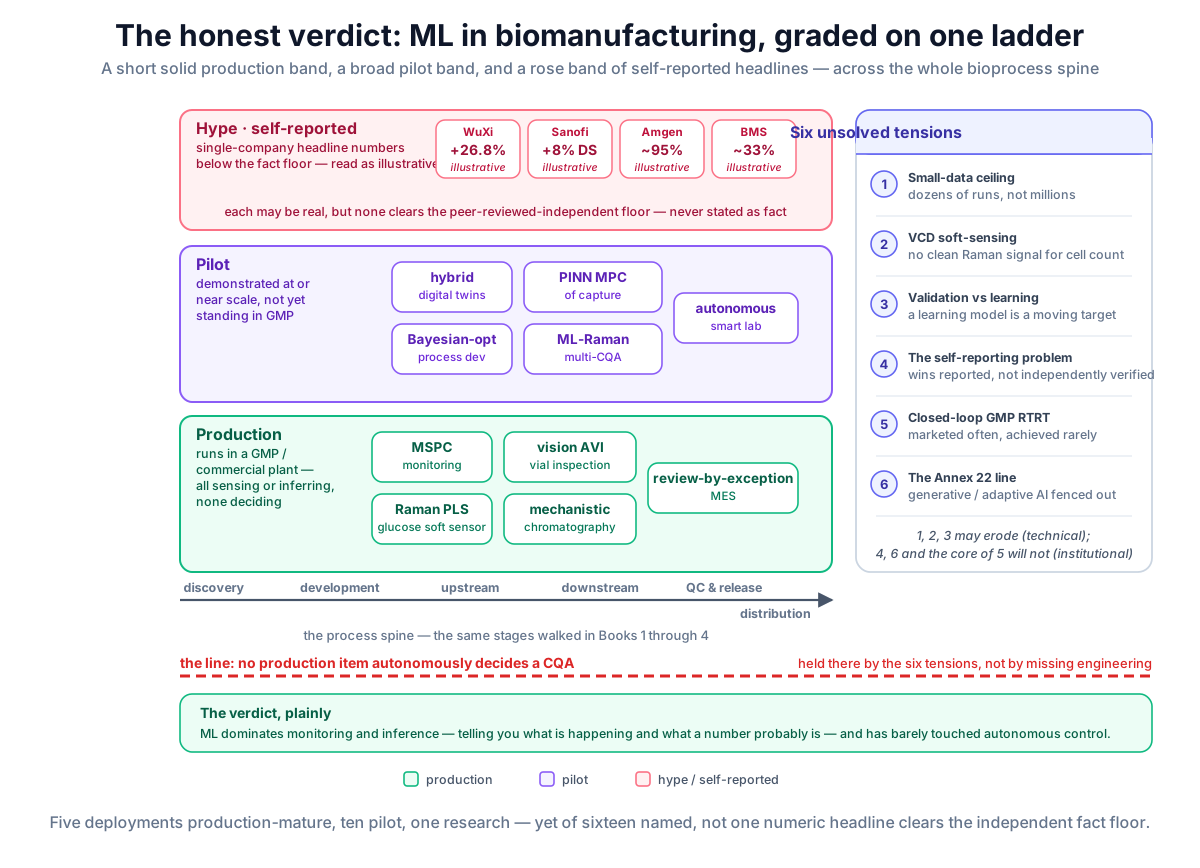 The whole book on one ladder: a short, solid production band (monitoring, Raman soft sensing, vision inspection, mechanistic chromatography, review-by-exception), a broad and promising pilot band, a rose band of self-reported headlines that must be read as illustrative, and the six structural tensions that hold the production band short of autonomous CQA control.
Original diagram by the authors, created with AI assistance.
The whole book on one ladder: a short, solid production band (monitoring, Raman soft sensing, vision inspection, mechanistic chromatography, review-by-exception), a broad and promising pilot band, a rose band of self-reported headlines that must be read as illustrative, and the six structural tensions that hold the production band short of autonomous CQA control.
Original diagram by the authors, created with AI assistance.
The evidence ledger, made runnable
The argument above is only as good as the discipline behind it, so Book 5 makes that discipline auditable in code. The closing module examples/platform/ml/case_ledger.py is not a model — it is a structured survey. Every named deployment in the book is one row carrying an explicit maturity (research / pilot / production) and evidence tier (peer-reviewed-independent / peer-reviewed-self-authored / vendor-self-reported / press-release-only), plus the verification caveat that keeps the claim honest. The two axes are deliberately orthogonal and ordered as tuples, so that comparing claims becomes index arithmetic rather than argument: a claim "clears the fact floor" if and only if its tier index is at or above the index of peer-reviewed-independent. The helpers then compute the distribution the chapter quotes and flag every headline number that is not allowed to be stated as established fact — anything below the floor:
# examples/platform/ml/case_ledger.py — the evidence is the artifact, not the code.
from dataclasses import dataclass

TIER = ("press-release-only", "vendor-self-reported",
        "peer-reviewed-self-authored", "peer-reviewed-independent")
FACT_FLOOR = "peer-reviewed-independent"   # state as fact only at/above this tier

@dataclass(frozen=True)
class Case:
    company: str
    application: str
    claim: str          # the disclosed headline, verbatim-ish
    maturity: str       # research | pilot | production
    tier: str           # one of TIER
    note: str           # the verification caveat

    def stated_as_fact_ok(self) -> bool:
        return TIER.index(self.tier) >= TIER.index(FACT_FLOOR)

def overstated_if_quoted(ledger):
    """Headlines carrying a number that do NOT clear the fact floor — hedge these."""
    return [c for c in ledger
            if any(s in c.claim for s in ("%", "+", "hrs", "doses"))
            and not c.stated_as_fact_ok()]
The two design choices that make this honest are worth naming. First, TIER is an ordered tuple, so stated_as_fact_ok is a single comparison of positions — there is no fuzzy judgment about whether a source is "good enough," only whether it reaches the named floor. Second, overstated_if_quoted keys off the presence of a number in the claim string (%, +, hrs, doses), because the danger is specifically a quantitative headline traveling without its tier; a qualitative claim ("improves monitoring") is not the thing that misleads a decision-maker. Running the module over the curated ledger of sixteen named deployments prints, verbatim, the tally that anchors this whole chapter:
case ledger: 16 named deployments
  by maturity: {'production': 5, 'pilot': 10, 'research': 1}
  by tier:     {'peer-reviewed-self-authored': 7, 'vendor-self-reported': 4, 'press-release-only': 5}

headline numbers that must be hedged (below peer-reviewed-independent): 7 of 7 numeric claims
  - Amgen (Juncos, PR): "~6 h harvest idle + ~10 h inter-column idle eliminated (illustrative)"  [peer-reviewed-self-authored]
  - Amgen: "~95% of syringes/vials auto-released (illustrative)"  [vendor-self-reported]
  - Bristol Myers Squibb (with DataHow): "~33% better accuracy with ~half the data vs black-box"  [peer-reviewed-self-authored]
  - Sanofi: "+8% drug substance over 3 yrs (illustrative)"  [vendor-self-reported]
  - Sanofi: "~80% stockout prediction (illustrative)"  [press-release-only]
  - WuXi Biologics: "+26.8% average titer across 3 CHO clones (illustrative)"  [peer-reviewed-self-authored]
  - Pfizer: "16,000 hrs/yr, +20,000 doses/batch (illustrative)"  [press-release-only]

claims that clear the established-fact floor: 0
Read the last line slowly. Of sixteen of the field's most-cited deployments, every single numeric headline must be hedged, and not one clears the bar of independent verification. The maturity distribution and the tier distribution tell two different stories that the chapter keeps insisting are different: five deployments are production-mature, yet not one of those reaches the peer-reviewed-independent tier — maturity and evidence quality simply do not move together. That is not an indictment of the work — much of it is excellent. It is the quantified shape of the self-reporting problem, and it is why this book labels numbers the way it does. The ledger turns "trust but verify" from a slogan into a function you can run, and the cases.csv companion turns it into a row you can append the next time a vendor hands you a percentage.
Anatomy of one honest evidence claim
The atomic unit of truth in this field is not a number — it is a tuple. A bare "+26.8 percent titer" is meaningless; the same figure as (WuXi, autonomous smart lab, +26.8% titer, pilot, peer-reviewed-self-authored, "single-company self-reported; PD scale, not GMP") is a claim you can actually weigh. Dissecting that tuple field by field is the discipline the whole chapter rests on.
 One claim, fully unpacked: the company and application that scope it, the verbatim headline that must travel with its illustrative tag, the maturity rung (pilot, not production), the tier rung (peer-reviewed-self-authored, one short of the independent fact floor), and the verification caveat that explains why — the structured record that turns a marketing number into a weighable piece of evidence.
Original diagram by the authors, created with AI assistance.
One claim, fully unpacked: the company and application that scope it, the verbatim headline that must travel with its illustrative tag, the maturity rung (pilot, not production), the tier rung (peer-reviewed-self-authored, one short of the independent fact floor), and the verification caveat that explains why — the structured record that turns a marketing number into a weighable piece of evidence.
Original diagram by the authors, created with AI assistance.
Take the tuple apart field by field, because each field answers a different question and each one fails differently when it is missing.
company— who built and reported it. This is the conflict-of-interest field. A win reported by the company selling the platform is not worthless, but it is the field that tells you the result has not yet survived an adversary. Whencompanyand the verifier are the same entity, the tier ceiling ispeer-reviewed-self-authoredno matter how good the paper.application— what, exactly, and at what scale. "Autonomous smart lab at process-development scale" is a different claim from "autonomous control at commercial GMP scale," and conflating them is the most common way a true pilot result gets mis-sold as production. This field is where the WuXi claim earns its pilot, not production, maturity: PD scale is not GMP scale.claim— the verbatim headline, with its number and its illustrative tag inseparable. The rule the ledger enforces in code is the rule the prose enforces in sentences: a number never travels without the tag. "+26.8% average titer across three CHO clones (illustrative)" is the whole claim; dropping the parenthetical converts a careful disclosure into a marketing fact.maturity— how far it has gotten: research, pilot, or production. This is an engineering-and-deployment fact, independent of how good the evidence is. WuXi sits at pilot.tier— how good the evidence is: the four ordered rungs from press-release-only to peer-reviewed-independent. WuXi sits at peer-reviewed-self-authored, exactly one rung below the fact floor — close enough to take seriously, not close enough to state as established fact.note— the verification caveat, in prose. This is the field that prevents the tuple from collapsing back into a number. "Single-company self-reported; PD scale, not GMP" is the human-readable reason the maturity and tier rungs sit where they do; without it, a future reader sees two labels and not the why behind them.
Because maturity and tier are independent, a claim can be high on one and low on the other: AVI is production maturity but only vendor-self-reported tier; the BMS/DataHow hybrid result is only pilot maturity but reaches peer-reviewed-self-authored tier. You need both rungs to know what to do with a claim — production-but-weakly-evidenced means "it runs, but watch the source," while pilot-but-well-evidenced means "trust the result, but do not assume it scales." This is the same contextualization discipline Book 2 applied to a single data point: the value is worthless without the metadata that scopes it.
What makes the model trustworthy is the graph underneath it
The evidence tuple above is a tiny ontology — typed fields, an ordered tier vocabulary, a defined fact floor — and that is not a coincidence. The same modeling discipline that makes a claim weighable is what makes a model trustworthy, and it is the thread this book shares with Book 4. An ML pipeline inherits its honesty from the knowledge graph beneath it in four concrete ways, none of them optional once a model touches a GMP decision.
A feature is a semantic identity, not a column name. The most fragile thing in any production pipeline is a feature pulled by a string — HCP_ng_per_mg, a header that a LIMS rename or a unit change silently breaks. Pull the same value by its ontology IRI (Internationalized Resource Identifier — a globally unique web name for a concept, such as bp:hcpPpm typed against QUDT units; see Book 4's identifiers-and-units chapter) and the feature carries its meaning, its unit, and its provenance with it. The contribution plot that pointed 83 percent at host-cell protein on BATCH-2026-004 is only auditable because that analyte is one identified, unit-typed thing across the LIMS, the historian, and the model — not three look-alike columns a reviewer has to reconcile by hand.
The release-gate shape is also the training-data gate. Book 4's release gate is a SHACL shape (Shapes Constraint Language — a closed-world validator that fails on a missing required result, where an open-world reasoner would merely shrug) that checks a lot's full CQA panel is present, singular, and in range before the lot may claim release. The identical shape is exactly the completeness contract a training set needs: a row whose monomer or HCP result is absent, duplicated, or out of its datatype is unfit to learn from for the same reason it is unfit to release. Validating the model's inputs with the release gate's own shapes means the data that trains the model meets the same bar as the data that releases the lot — one guarantee, reused.
The lineage edge is the cross-validation grouping key. The single most important honest-validation choice in this book — the batch-grouped split that the data chapter insists on, so a model is scored on entirely unseen batches rather than near-duplicate hours of batches it already saw — depends on knowing which rows share a production ancestor. That grouping key is not a label to be trusted; it is the head of a bp:derivedFrom chain, the transitive genealogy spine that roots every drug-substance lot back to one frozen cell-bank vial. Because the edge is declared transitive, "every example descended from the same seed culture" is a graph query, not a brittle string match — which is precisely the grouping a leave-one-batch-out split needs, and the reason the within-batch R² 0.9944 is honestly labeled an interpolation score rather than a generalization one.
And the graph is the ground the LLM stands on. Every generative-AI claim in this book is fenced by the same fact: a language model supplies fluent structure, and a knowledge graph supplies verified substance. Book 4's ontologies-and-AI chapter makes this literal with GraphRAG (graph-grounded retrieval-augmented generation), where the model answers a lineage question by traversing the typed bp:derivedFrom edges and citing them, rather than inventing a plausible chain — the BFO (Basic Formal Ontology) discipline of keeping a measurement (a continuant quality) distinct from the run that produced it (an occurrent) is what stops the graph, and therefore the model, from confusing a number with the event behind it. This is why the chapter's posture on generative AI is strict, not hostile: an LLM grounded against a SHACL-validated, lineage-typed graph is auditable; the same LLM improvising from training memory is the Purolea warning letter waiting to happen.
Honest advice for a team starting today
If you are standing up an ML program for a biologics process now, the book's whole argument compresses into a sequenced playbook. It is deliberately unglamorous, and the order is load-bearing — every step assumes the one before it is done.
Fix the data first. The number-one barrier across every survey is not the model — it is data: silos, non-FAIR records (data that is not Findable, Accessible, Interoperable, or Reusable — the FAIR data standard), hybrid paper-and-digital batch records, and the "cold start" of offline reference measured only once or twice a day [7]. A historian — the time-series database that stores tagged process data — with contextualized, attributable tags (Book 2's data shadow, Book 3's open-source stack) is the prerequisite, not an afterthought. No model survives bad data, and most ML programs that stall, stall here. The concrete test of readiness: can you trace one drug-product lot back to its working cell bank through every in-process tag, the way this book's genealogy WCB-CHO-001 → SEED-001 → BATCH-2026-001 → … → DP-001 does? If not, you are not ready for the model; you are ready for the historian.
What "fixed" actually means is more specific than "clean": the training set has to be governed the way the plant's records are governed, because under GMP the data a model learns from is itself a regulated record. Concretely, the tags must arrive over an interoperable transport rather than a vendor-locked one (OPC UA — the standard machine-to-historian protocol — replacing the legacy OPC DA), be contextualized against a shared equipment-and-process hierarchy (ISA-95 — the standard model of plant levels and batch structure — and the B2MML XML that serializes it, so a Raman tag is unambiguously this probe on this bioreactor in this batch), and carry consistent units and master-data identities (Book 2's semantic-interoperability and data-governance chapters are the whole subject). And the same ALCOA+ expectations a reviewer applies to a batch record apply to that training set: the data must be Attributable, Legible, Contemporaneous, Original, and Accurate (plus complete, consistent, enduring, and available), with every value backed by a Part 11 / Annex 11 audit trail (the FDA 21 CFR Part 11 and EU GMP Annex 11 rules for electronic records and signatures). A model trained on data that cannot meet ALCOA+ is not auditable, and an un-auditable model cannot be defended to an inspector no matter how good its score.
Start where the production list already is. Deploy MSPC monitoring and a Raman soft sensor before you reach for anything novel. They are proven, the validation paths are understood, and they deliver value in months. Resist the pull toward an autonomous twin until the monitoring layer is solid — the twin's value depends entirely on the data and monitoring beneath it. The MSPC build is the cheapest high-value win in the book: a two-component PCA on a handful of good batches gives you a defensible T²/SPE control chart and a contribution plot that points at the failing analyte, exactly as it pointed at HCP for BATCH-2026-004.
Default to hybrid, not black-box. In the small-data regime, a mechanistic backbone with a learned residual outperforms a pure neural network and generalizes more safely across the design space — and it is far easier to defend to a regulator because the physics constrains what the data is allowed to conclude [12]. The peer-reviewed BMS/DataHow result — roughly a third better accuracy with about half the data versus a black box (pilot, peer-reviewed-self-authored) — is the cleanest external evidence for this default, and the book's own hybrid run reproduces the shape of it on BATCH-2026-001 [11]. Reach for a pure deep network only when the data is genuinely dense, which in this field means images (AVI), not batch records.
Lock the model, plan the relearning. Validate a frozen model and write the predetermined change-control plan before deployment, not after the first drift event. Build drift monitoring (input PSI plus residual control charts, as in the MLOps chapter) into the system from day one, because a model under GMP must be distrusted on a schedule. The drift detector and the PCCP are two halves of one obligation: the chart tells you when the locked model has gone stale, and the change-control plan tells you how you are allowed to refresh it without re-opening the whole validation. And budget for the relearn that scale-up and tech transfer will force: a soft sensor calibrated at 2,000 L does not arrive pre-qualified at 12,000 L, and moving a process to a second site re-opens the model's qualification along with the equipment's — new probes, new media lots, and a new facility shift the input distribution exactly the way the PSI chart is built to catch. A model is a qualified piece of the process, so it inherits the same tech-transfer burden as the column and the bioreactor: the tech-transfer-and-scaleup chapter treats this revalidation cost as a planned line item, not a surprise.
Keep the human in the loop, and keep AI out of the critical path until the rules allow it. Draft Annex 22 and the Purolea warning letter are unambiguous: generative and adaptive AI do not belong in critical GMP decisions, and a model authoring a released record without quality-unit review is an enforcement action waiting to happen [14][15]. Use ML to inform humans, not to replace the four-eyes gate. The practical line to draw internally: a model may route, rank, retrieve, and flag; a human decides and signs.
Label every number with its tier. Internally and externally, never quote an efficiency headline without its evidence tier in the same sentence. It is the cheapest discipline in the book and the one that most protects your credibility — and your decisions. The case_ledger.py convention is portable: a four-rung tier, a fact floor, and the rule that any quoted number below the floor carries an "(illustrative)" tag is a habit you can adopt in a meeting, not a tool you have to install.
The unsolved part: whether the ceiling ever lifts
The honest open question is not whether any single tension can be eased — several already are being chipped at — but whether the small-data ceiling itself can ever be escaped, and what would happen to the field if it were. The two candidate escape routes are both genuinely uncertain, and they fail for opposite reasons: one may not have the data to train on, the other may not have the data-sharing it depends on.
Foundation and bioprocess time-series models promise to amortize learning across many processes so a new product starts from a strong prior rather than a cold start; today they are aspiration, not product, and it is an open question whether enough comparable, shareable bioprocess data will ever exist to train them [7]. The deep problem is not compute — it is that two CHO processes for two different molecules in two different facilities are not the "same task" the way two photographs are; the inductive transfer that makes foundation models work in vision and language may simply be weaker when every process is a bespoke biological system. Federated learning offers the other route — pool the learning across companies without pooling the data — and MELLODDY (a multi-pharma consortium that trained a shared model across competitors' private datasets) proved the concept in drug discovery [7]. But it has not crossed into manufacturing, where the data is even more guarded and more heterogeneous, and where a competitor's batch records are among the most commercially sensitive assets a company holds. The escape route exists in principle; the incentives to walk it do not yet.
And there is a deeper, more uncomfortable possibility worth stating: even if the data ceiling lifted, the regulatory ceiling might not. A model that learns continuously and controls a CQA autonomously is, by the current draft of Annex 22, excluded from critical GMP regardless of how good it gets [14]. This is the genuinely unresolved heart of the field: the binding constraint on autonomous bioprocessing may turn out not to be what the model can learn, but what we are willing to let an unsupervised model decide about a human medicine. Picture the limit case — a continuously-learning controller that demonstrably outperforms every human operator on every CQA, replicated independently, fully transparent. By the letter of the draft regulation it is still barred from the critical path, because the objection was never its accuracy; it was the question of who is answerable when it is wrong. That is not a problem more data solves. It is a question about trust, accountability, and where a person must remain answerable — and it is, rightly, unresolved.
What this chapter adds to the model suite
This closing chapter contributes no new predictive model — by design. Its artifact is examples/platform/ml/case_ledger.py (with its flat companion cases.csv), the structured, machine-checkable ledger of named ML/AI manufacturing deployments that grounds the whole verdict. The module encodes sixteen deployments as (company, application, claim, maturity, tier, note) rows, computes the maturity and tier distributions this chapter quotes, and — most importantly — flags every numeric headline that fails to clear the peer-reviewed-independent fact floor, printing zero claims that clear it. It is deliberately stdlib-only so it runs anywhere and so the data — the curated evidence — is the artifact, not the code.
More than that, this chapter is the index back to the entire examples/platform/ml/ suite the book built, and the suite's own credibility harness (run_all.py) is the structural twin of this chapter's argument: it runs twenty-one models against pinned datasets — drawn from a fuller suite of 33 runnable modules, of which run_all.py gates 21 as credibility evidence — each gated by its own stated acceptance assert, and reports 21/21 cleared — the three numbers count different things on purpose: 33 is the full module count, 21 are the modules held to a pass/fail acceptance gate, and the 16 are the real-world deployments surveyed in the ledger — then immediately adds the line that this whole chapter expands on, that passing the gate is necessary, not sufficient, because GMP credibility also needs intended-use scope, change control, and human oversight. The suite spans the PLS and 1D-CNN soft sensors (soft_sensor_pls.py, soft_sensor_deep.py) whose head-to-head is the small-data lesson made concrete; the hybrid model (hybrid_model.py); the drift detector (drift.py); the MSPC and release predictor (mspc.py, release_predict.py); the vision AVI (vision_avi.py); and the chromatography, viral, resin-lifetime, cold-chain, and deviation-triage modules. Every one of them runs over the same committed simulator datasets and the same genealogy — WCB-CHO-001 → SEED-001 → BATCH-2026-001 → … → DS-001 → DP-001, with BATCH-2026-001 as the golden batch and BATCH-2026-004 as the one that goes OOS on host-cell protein — so the suite as a whole is a single, coherent, runnable demonstration of exactly where ML helps and exactly where it stalls.
What makes the harness credible and not just convenient is that it is reproducible in the open-source sense: the suite is built only on permissively licensed open-source libraries (scikit-learn and PyTorch), pins its dependency versions so a reader reruns the same environment rather than a moving target, and fixes every random seed so a rerun reproduces the printed numbers to the digit. That trio — open license, pinned versions, fixed seeds — is what lets a skeptical reader re-derive a number instead of trusting it, which is the whole methodological point of the chapter applied to the chapter's own code: the verdict asks the field to make its claims checkable, so the book makes its own claims checkable first.
Why it matters
A book about ML in biomanufacturing that ended on hype would have done the field a disservice, because the field's real problem is not a shortage of enthusiasm — it is a shortage of calibrated judgment. The most valuable thing a practitioner can carry out of these thirty chapters is not a model architecture; it is the reflex to separate maturity from evidence tier, to ask who measured a number and against what, and to recognize that the production list is short for structural reasons that no demo overcomes. ML genuinely makes biomanufacturing better — safer monitoring, faster inference, fewer wasted runs, auto-released vials. It does so today almost entirely in a human-supervised, non-autonomous register, and that is not a failure of the technology. It is the appropriate posture for software that helps make medicines for people, where being wrong has a cost a confusion matrix cannot capture.
In the real world
The clearest real-world signal is the gap the surveys keep measuring. The ISPE 7th Pharma 4.0 survey finds AI/ML with the most pilots and the fewest scaled implementations of any digital technology, and a "pilots" category that is high and stagnant; McKinsey's State of AI finds most organizations stuck in experiment-and-pilot mode with only a small fraction achieving enterprise-wide impact; BioPhorum's maturity model names autonomous AI operation as the still-unreached end-state [7]. The production deployments that have scaled are precisely the ones on this chapter's short list — monitoring, predictive maintenance, vision inspection, and human-in-the-loop documentation — and not autonomous control of CQAs.
The regulatory scaffolding is converging on exactly this reading. The FDA's 2023 discussion paper Artificial Intelligence in Drug Manufacturing and its risk-based model-credibility framework, the EU draft Annex 22 with its sharp exclusion of generative and adaptive AI from critical GMP, the ISPE GAMP (Good Automated Manufacturing Practice) AI guide, and the Purolea warning letter as the first enforcement action all point the same way: locked models, predetermined change control, human oversight, and AI kept out of the critical path until it can be validated like the regulated object it is [16][14][15]. The most honest one-sentence summary of where the field stands: ML/AI in biomanufacturing is production-grade for seeing and inferring, pilot-grade for optimizing, and deliberately fenced out of autonomously deciding — and the fence is there on purpose.
Key terms
- CQA (critical quality attribute) — a measured product property, such as purity or potency, that must stay within spec for the medicine to be safe and effective; the thing ML is not yet allowed to control autonomously. See the QC and release chapter.
- Soft sensor — a model that infers a hard-to-measure value (titer, cell density) from easy, continuous signals such as a Raman spectrum; see the production-bioreactor chapter.
- R² / AUROC — fit/skill scores where closer to 1.0 is better (0.5 AUROC is a coin flip); but a high score on the wrong data split can be an artifact, which is why this chapter flags leak-free versus within-batch tests.
- Nested cross-validation — splitting the data so a model is tuned and scored on different slices, removing the optimism of reading the score off the same fold.
- Production / pilot / research (maturity) — the three-rung ladder for how far a deployment has gotten: running in GMP/commercial use, demonstrated at or near scale, or academic/early.
- Evidence tier — the four-rung ladder for how good the evidence is: press-release-only, vendor-self-reported, peer-reviewed-self-authored, peer-reviewed-independent.
- Fact floor — the tier (peer-reviewed-independent) at or above which a number may be stated as established fact; below it, the number must be labeled illustrative/self-reported.
- Evidence tuple — the atomic unit of truth here:
(company, application, claim, maturity, tier, caveat); a bare number without it is not a usable claim. - Semantically-grounded feature — a model input pulled by its ontology IRI (a globally unique web name, unit-typed) rather than a fragile column name, so it carries its meaning and provenance; see Book 4's identifiers-and-units chapter.
- SHACL release gate — the closed-world shape that fails on a missing required result; the same shape that validates a release lot also validates a training set's completeness. See Book 4's release-gate chapter.
- GraphRAG — graph-grounded retrieval-augmented generation: the LLM answers by traversing and citing verified
bp:derivedFromedges in the knowledge graph rather than inventing a chain; see Book 4's ontologies-and-AI chapter. - ALCOA+ / Part 11 / Annex 11 — the data-integrity expectations (Attributable, Legible, Contemporaneous, Original, Accurate, plus complete/consistent/enduring/available) and the FDA 21 CFR Part 11 / EU GMP Annex 11 electronic-record rules a GMP training set must meet to be auditable.
- ISA-95 / OPC UA / B2MML — the standards that contextualize a process tag against the plant's equipment-and-batch hierarchy (ISA-95, serialized as B2MML) over an interoperable transport (OPC UA); the grounding a training set inherits from Book 2's semantic-interoperability chapter.
- Small-data ceiling — the binding constraint of bioprocess ML: too few costly runs to learn from, which is why hybrid modeling and priors beat black boxes.
- Self-reporting problem — the field-wide pattern that nearly every disclosed efficiency win is reported, unverified, by the company that built it.
- Lock-then-relearn (PCCP) — the only regulatorily acceptable pattern for a critical-use model: freeze it at validation, govern updates by a predetermined change-control plan.
- Closed-loop GMP RTRT — real-time release of a CQA via a model in a fully approved, disclosed loop; frequently marketed, rarely achieved for biologics.
- The Annex 22 line — the draft boundary excluding dynamic, probabilistic, generative, and self-learning AI from critical GMP applications.
- Review-by-exception — the MES execution pattern (e.g. Körber PAS-X) that surfaces only deviations for human judgment; the spine ML is layered onto, advisory not autonomous.
Where this leads
This is the last chapter of the spine, so it leads not forward but back. The companion References collects every source cited across Book 5, organized per chapter, so each claim can be traced to its origin and weighed at its own tier. And the deeper destination is the whole series: the same genealogy WCB-CHO-001 → SEED-001 → BATCH-2026-001 → … → DP-001 that this book learned from is the one that Book 1 physically made, Book 2 shadowed as data, Book 3 captured in an open-source stack, and Book 4 modeled as a knowledge graph. Five books, one process, five lenses — and the learning lens, honestly graded, turns out to see clearly exactly as far as the data, the physics, and the regulation will let it, and no farther.