Assembling the Digital Thread: Lineage, Impact, and the Whole-Lifecycle Query
📍 Where we are: Part VI · The Whole Graph — Chapter 21. The medicine has reached the patient. Now we step back from the process and look at the graph we built along the way — and run the queries that were the entire reason to model the process as knowledge.
For twenty chapters we have laid edges: derivedFrom from the drug product back to the cell bank, affectsQuality from parameters to attributes, quality trajectories along the purification chain, release verdicts at the gate, serialized units at packaging. Individually they were modeling exercises. Assembled, they are a digital thread — one continuous, traceable chain of linked records spanning the whole product lifecycle — and the thread's value is not that it exists but that it makes hard questions into one-line queries. This chapter runs them.
Imagine every record about a medicine — every ingredient, step, test, and shipment — as a bead, and every connection between them as a string. For twenty chapters we threaded beads. Now we hold up the necklace. Suddenly you can answer questions that used to take a team weeks: where did this exact vial come from? (follow the string back), if this lot is bad, what else is affected? (follow the string to everything that shares a bead), which setting caused this quality? (follow the string sideways). The digital thread is that necklace, and this chapter shows the questions it answers in one pull.
What this chapter covers
We assemble the full graph and run the three query classes that justify the whole enterprise: the lineage walk (where did this come from?), impact analysis (what shares this one's fate?), and the cross-lifecycle query (how does a setting relate to a released attribute?). We dissect a digital-thread query as a SPARQL property path, connect it to the open-source code that runs it for real, and close on the limit that haunts every derived graph: it is only as true as its last load.
The lineage walk: one query, any depth
The signature query is the lineage walk — reconstruct everything a lot derives from, however many hops away. Because derivedFrom is transitive and the edges were laid as the traces of real material transformations, this is a single SPARQL property path: bp:DS-001 (bp:derivedFrom)+ ?ancestor follows one-or-more derivedFrom hops from the drug substance back through the polishing and capture pools, the bioreactor batch, the seed train, and the cell-bank tiers to the research cell bank — the same walk the open-source chapter demonstrates, returning the lot's full ancestry in one statement [1]. The whole query is the property path plus a type binding:
# Lineage walk: everything DS-001 derives from, to any depth, in one property path.
# (bp:derivedFrom)+ = one-or-more hops; works whether the lineage is 3 steps or 20.
PREFIX bp: <https://example.org/bioproc#>
SELECT ?ancestor ?type WHERE {
  bp:DS-001 (bp:derivedFrom)+ ?ancestor .
  ?ancestor a ?type .
  FILTER(STRSTARTS(STR(?type), STR(bp:)))
} ORDER BY ?ancestor
Run by validate.py over the loaded graph (bioproc.ttl + align.ttl + instances.ttl), it returns the full eleven-ancestor ancestry — every real unit-operation intermediate that the coarse CSV chain collapses, with BATCH-2026-001 typed once as a bp:Batch and the vessel kept as the separate BR-101 node the run occursIn rather than a second type smuggled onto the batch:
[3] lineage walk from DS-001: 11 ancestors
      BATCH-2026-001 CLAR-001 MCB-CHO-001 PApool-001 POLpool-001 RCB-CHO-001
      SEED-001 SEEDFLASK-001 VFpool-001 VIpool-001 WCB-CHO-001
The query never says "eleven hops"; it says "however deep," which is why the same line works whether a lineage is three steps or twenty, and why it survives a process change that adds a step. The depth here is not contrived: the drug substance traces back through the polishing pools (POLpool-001, VFpool-001, VIpool-001), the capture pool and clarified harvest (PApool-001, CLAR-001), the bioreactor batch, the seed train (SEED-001, SEEDFLASK-001), and the cell-bank tiers (WCB-CHO-001, MCB-CHO-001, RCB-CHO-001) — each an immediate derivedFrom parent of the next, with the long-range reachability inferred by the transitive closure, never asserted by hand. This is the payoff of every individuation decision the downstream chapters agonized over: lay the edges faithfully, and the lineage is computed, not reconstructed by hand.
Impact analysis: who shares this lot's fate?
The query an investigation actually fires is the inverse and outward one. When DP-004 fails release, the question is what else is affected? — and the graph answers by walking up DP-004's lineage to a shared ancestor and back down to every drug product that traces to it. The query walks up (bp:derivedFrom)+ to each common ancestor, then back down to every other bp:DrugProduct derived from one — siblings on the same cell bank or the same capture resin:
# Impact analysis: when DP-004 fails, what shares its fate? Walk UP DP-004's
# lineage to common ancestors, then back DOWN to every drug product that shares one.
PREFIX bp: <https://example.org/bioproc#>
SELECT DISTINCT ?affected WHERE {
  bp:DP-004 (bp:derivedFrom)+ ?shared .          # an ancestor of the failed lot
  ?affected (bp:derivedFrom)+ ?shared .          # anything else derived from it
  ?affected a bp:DrugProduct .
  FILTER(?affected != bp:DP-004)
} ORDER BY ?affected
Over the loaded graph, validate.py reports both siblings that share DP-004's WCB-CHO-001 cell bank — DP-001 and its forward-fork sibling DP-002, the two released lots filled from the same drug substance:
impact of DP-004 (shared cell bank): ['DP-001', 'DP-002']
Because every batch in the campaign traces to the same WCB-CHO-001, a cell-bank-level concern is answerable across the whole campaign in one traversal — the difference, as the knowledge-graph chapter put it, between a scoped deviation and a blind campaign-wide quarantine. The forward fork the deliverable now models — bp:DS-001 bp:fillsInto bp:DP-001 , bp:DP-002 — is exactly what makes the query return every affected sibling rather than one, so a shared-fate impact set is complete by construction, not by luck. Impact analysis is where the digital thread earns its keep in dollars and patient safety: a recall scoped by query instead of by guesswork.
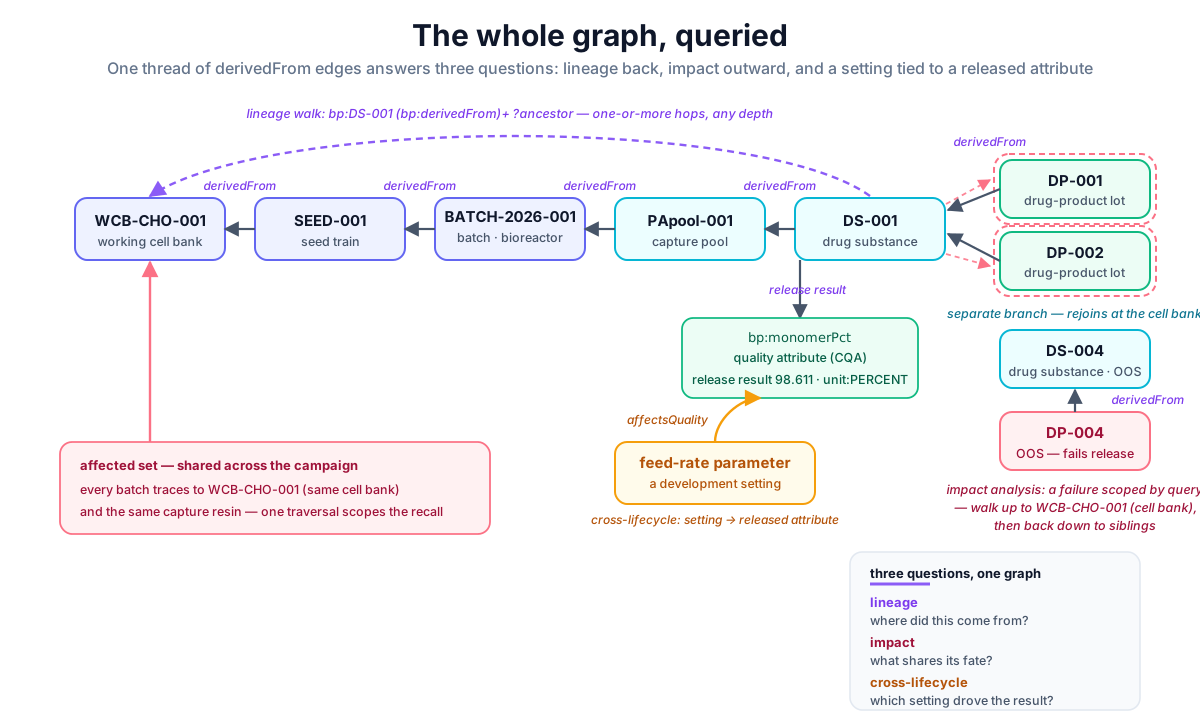 The whole graph, queried: a property path walks lineage back to the cell bank, an impact query scopes a failure across siblings and shared resources, and a cross-lifecycle link ties a process parameter to a released attribute — the three questions the entire book was built to make answerable.
Original diagram by the authors, created with AI assistance.
The whole graph, queried: a property path walks lineage back to the cell bank, an impact query scopes a failure across siblings and shared resources, and a cross-lifecycle link ties a process parameter to a released attribute — the three questions the entire book was built to make answerable.
Original diagram by the authors, created with AI assistance.
The cross-lifecycle query: from a setting to a released attribute
The third class is the one only this book's modeling makes possible, because it crosses the seams between development, manufacturing, and release. Which process parameter drove this lot's monomer purity? walks from the affectsQuality relationships established in development, through the realized parameters of this specific run, to the release result on the drug substance — a path that crosses from a development study to a plant sensor to a QC verdict, three systems that in a fragmented plant speak different dialects. A first taste joins lineage to quality in one statement: walk (bp:derivedFrom)+ forward from DS-001 to the originating bioreactor batch that carries the monomer percentage, and read it.
# Lineage AND quality in one query: walk derivedFrom FORWARD from DS-001 to the
# originating bioreactor batch that carries the monomer %, and read it. The path
# uses + (one-or-more hops), so it lands on the ancestor BATCH-2026-001.
PREFIX bp: <https://example.org/bioproc#>
SELECT ?batch ?monomer WHERE {
  bp:DS-001 (bp:derivedFrom)+ ?batch .
  ?batch bp:monomerPct ?monomer .
}
validate.py returns the originating batch's SEC monomer purity — the same 98.611 % the typed-value chapter carries as a QUDT unit:PERCENT quantity so it can never be misread as a fraction:
lineage+CQA (originating batch): {'BATCH-2026-001': 98.611}
The full cross-lifecycle walk is now a loadable query in its own right — queries/cross-lifecycle.rq — and it spans all three seams in one statement: it starts at a critical process parameter, follows its affectsQuality link from development, finds the run that realized that parameter as a setpoint, steps to the batch the run output, and walks derivedFrom forward to the released drug-substance lot carrying the result:
# From a CPP, through its affectsQuality link, to the run that REALIZED it,
# to the batch it output, forward down derivedFrom to the released DS lot.
PREFIX bp: <https://example.org/bioproc#>
SELECT ?parameter ?attribute ?lot WHERE {
  ?parameter bp:affectsQuality ?attribute .
  ?setting   bp:parameterType  ?parameter .
  ?phase     bp:realizesParameter ?setting .
  ?run       bp:hasPhase ?phase ;
             bp:hasOutput ?batch .
  ?lot       bp:derivedFrom+ ?batch ;
             bp:monomerPct ?m ;
             a bp:DrugSubstance .
}
validate.py runs it over the loaded graph and lands the feed-rate CPP on the released lot it ultimately shaped:
cross-lifecycle CPP -> realized run -> release lot: [('FeedRate', 'MonomerPct-CQA', 'DS-001'), ...]
That is the single query the whole book was building toward: a development-era affectsQuality assertion (bp:FeedRate bp:affectsQuality bp:MonomerPct-CQA), the realized setting on this run (bp:RPS-feedrate-CCP001, the feed rate's actual setpoint in the production phase), and the QC verdict on DS-001, joined across three systems that a fragmented plant keeps in three dialects. The digital thread is what lets that question be asked at all, and it is the literal realization of the digital-thread-and-twin vision the data book described and the knowledge graph the open-source book ran: semantic links — the ontology and its edges — as the connective tissue that provides traceability across the entire lifecycle [2].
 One query, unpacked: a SPARQL property path expresses "however deep," returns the full ancestry and the originating release result, and is the exact statement the open-source companion executes — the digital thread as a question, not a project.
Original diagram by the authors, created with AI assistance.
One query, unpacked: a SPARQL property path expresses "however deep," returns the full ancestry and the originating release result, and is the exact statement the open-source companion executes — the digital thread as a question, not a project.
Original diagram by the authors, created with AI assistance.
The unsolved part: a derived thread is only as true as its last load
The digital thread is exhilarating to query and dangerous to trust blindly, and the danger is structural. The graph is a derived view — its triples are copied from the relational records, historians, LIMS, and systems that are the actual sources of truth. So unless the load is validated, complete, and re-run under change control, the graph can silently drift from the systems it claims to mirror: a column the loader does not map, a source edit made after the last load, a system the integration never reached — each leaves the thread asserting something the source no longer says, or never said. A traversal that looks authoritative can be quietly incomplete, and the most confident-looking query result is the most dangerous when its edges are stale. The open-source chapter's discipline is the only answer: treat the load as a validated job, reconcile the triple count against the source, and re-run on a known trigger — the dull plumbing that keeps the thread honest.
The deeper limit is the one distribution exposed: the thread is ironclad inside the factory and a fragile federation beyond it. The cross-lifecycle query that spans development, manufacturing, and release works because one organization controls those systems; the moment the thread reaches distributors, pharmacies, and the supply chain, it depends on other parties' graphs and their willingness to share, in their identifiers, with no one able to mandate the whole. So the honest standard for the digital thread is precise: it genuinely converts weeks of cross-referencing into one-line queries over the edges you have loaded and the systems you control — a real, large advance — while being a derived, drift-prone view that must be governed, and a within-walls guarantee that thins to cooperation past the loading dock. The thread is the book's triumph and the clearest case for the governance and FAIR-in-practice disciplines that follow.
Why it matters
The digital thread is the answer to the question the whole trilogy opened with — why manage, connect, and model the data at all? Because a process modeled as knowledge can be interrogated: traced, impact-analyzed, and cross-questioned across its entire lifecycle, in queries instead of archaeology. Every modeling decision in this book — the upper spine, the typed values, the faithful derivedFrom edges, the SHACL gate — exists to make these three query classes trustworthy. Get the edges right and the thread turns a deviation into a query and a recall into a scoped traversal; get them wrong or trust them stale and the thread becomes a confident liar. This chapter is where the model pays out, and where its single greatest risk — drift in a derived view — is named.
From the wire to the graph
The newest way to consume this thread is to let a person ask it a question in plain English. Which process parameter drove DS-001's monomer purity? is exactly the cross-lifecycle walk above — and the emerging GraphRAG pattern wraps that walk so a language model answers by traversing the bp: graph rather than guessing. The retrieval step is a real SPARQL query over property paths — bp:affectsQuality, bp:realizesParameter, bp:derivedFrom+ — so the model's answer is grounded in the exact edges it walked, and it can cite them: FeedRate → MonomerPct-CQA → DS-001, with Temperature the second parameter the same query returns, since both carry an affectsQuality edge to MonomerPct-CQA. The graph supplies the citation; the model only narrates it.
Be precise about what is real here. The retrieval query is the loadable queries/cross-lifecycle.rq, run by validate.py over the loaded graph. The GraphRAG embedding-and-prompt layer that sits on top is illustrative — it is not in the committed dataset, where only the SPARQL traversal it would ground on is real. On real platforms the same derivedFrom path is a Palantir Foundry object link or a Neo4j Cypher traversal; Roche's BIKG and Novartis' data42 are enterprise-graph instances of this pattern, but R&D-side, not yet at the GMP floor.
# From a CPP, through its affectsQuality link, to the run that REALIZED it,
# to the batch it output, forward down derivedFrom to the released DS lot.
PREFIX bp: <https://example.org/bioproc#>
SELECT ?parameter ?attribute ?lot WHERE {
  ?parameter bp:affectsQuality ?attribute .
  ?setting   bp:parameterType  ?parameter .
  ?phase     bp:realizesParameter ?setting .
  ?run       bp:hasPhase ?phase ;
             bp:hasOutput ?batch .
  ?lot       bp:derivedFrom+ ?batch ;
             bp:monomerPct ?m ;
             a bp:DrugSubstance .
}
This is why a later chapter treats ontologies as the ground truth for AI: the graph is what keeps the answer honest.
In the real world
Commercial vendors sell this as a "manufacturing knowledge graph," "digital thread," or "contextualized data fabric," and the digital-thread idea — semantic links as lifecycle-spanning connective tissue — is established in the smart-manufacturing literature and the broader digital-twin field [1][2][3]. The open-source book proves the core in tested, laptop-runnable code: load the CSVs, build the RDF, walk the lineage with a property path, gate it with SHACL. What separates a demo from a production thread is exactly this chapter's unsolved part — the validated, drift-controlled load and the cross-organizational federation — which is engineering and governance work, not a missing query. The query was never the hard part; keeping the graph it runs over true is. The enterprise-knowledge-graph chapter inventories the real ones — Roche, AstraZeneca, Novartis, Novo Nordisk — and finds the very pattern this section warns of: the production graphs live in R&D and FAIR cataloging, and on the public evidence have not yet reached the GMP floor where the thread matters most.
Key terms
- Digital thread — the continuous, traceable chain of linked records spanning the product lifecycle; here, the assembled graph of all the book's edges.
- Lineage walk — the query reconstructing everything a lot derives from, expressed as a SPARQL property path
(derivedFrom)+of arbitrary depth. - Impact analysis — the inverse, outward query scoping which lots share a failing lot's fate (siblings, cell bank, shared consumables) by traversal.
- Cross-lifecycle query — a question crossing development, manufacturing, and release seams (parameter → realized run → release result), made possible by the shared model.
- Derived view / drift — the graph's triples are copied from source systems, so without a validated, change-controlled, reconciled load it can silently diverge from the truth it claims to mirror.
- Federation — the cross-organizational continuation of the thread beyond the factory, dependent on other parties' graphs and data sharing rather than one owner's control.
Where this leads
We have the thread and the queries that justify it — and the warning that a derived graph drifts unless it is governed. The next chapter, Governing the Model: Versioning, Change Control, and Ontology Stewardship, takes that warning head-on: how an ontology and its loads are versioned, change-controlled, and stewarded so the model stays true over a regulated product's long life — turning the graph from a clever artifact into a maintained, trustworthy system.