Polishing: removing the last impurities
📍 Where we are: Stop 15 of 21 — the antibody is captured and virus-safe, so now we hunt down the very last impurities before the final safety checks.
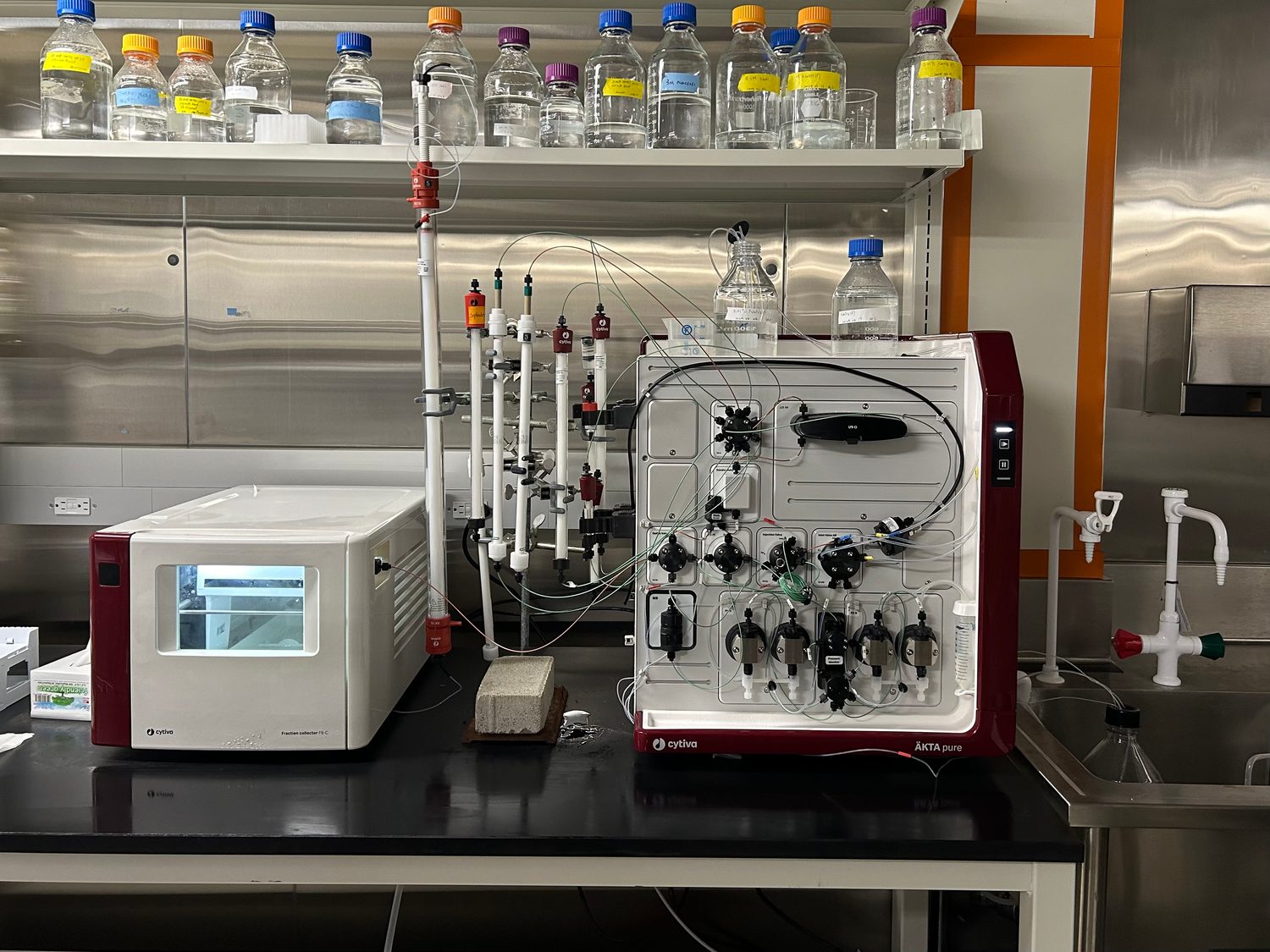 A benchtop FPLC chromatography system with resin-packed columns. Polishing runs on hardware like this — a finer, second round of chromatography that clears the last impurities before the drug substance is made.
Benchtop ÄKTA pure FPLC chromatography system. Image by TheBartgry, CC0, via Wikimedia Commons.
A benchtop FPLC chromatography system with resin-packed columns. Polishing runs on hardware like this — a finer, second round of chromatography that clears the last impurities before the drug substance is made.
Benchtop ÄKTA pure FPLC chromatography system. Image by TheBartgry, CC0, via Wikimedia Commons.
After capture, the antibody is mostly pure. But "mostly" is not good enough for a medicine that goes straight into a person's bloodstream. Polishing is the cleanup stage that chases out the final traces of unwanted material, taking the product from roughly 95% pure to better than 98% — and pushing the most dangerous leftovers down to a few parts per million. It is the difference between "clean enough for the lab bench" and "clean enough to inject into a sick person."
Imagine washing a car. The first rough wash blasts off the big mud — that was capture. Polishing is the final detailing: the careful wax and buff that makes the car showroom-perfect. Or picture sifting flour twice. The first sift removes the obvious lumps; the second, finer sift catches the tiny specks you would never want to find in a wedding cake. Polishing is that second, much finer sift — except the "specks" can make a patient sick, so it has to be nearly perfect.
What this chapter covers
We will start with the unwelcome guests still riding along after capture — aggregates, host cell proteins, residual DNA, and a trace of the capture material itself — and what each one can do to a patient. Then we will open up the central tool of polishing: ion exchange chromatography, the trick of sorting molecules by their electrical charge, and its cleverer cousin, mixed-mode resin. We will see the two opposite ways to run a polishing column, the real numbers and named products that engineers reach for, the strict regulatory limits these steps must hit, and finally how the modern, intensified factories run polishing as a continuous flow rather than one batch at a time.
What actually happens
Even after a beautifully run capture step, a handful of unwelcome guests are still mixed in with the antibody [2]:
- Aggregates — antibodies that have clumped together into pairs, trios, or larger tangles. Our medicine is supposed to be single, separate molecules. Clumps look "foreign" to the body and can trigger a harmful immune reaction — sometimes one that turns the patient's defenses against the drug, or even against their own tissue.
- Host cell proteins (HCPs) — leftover proteins made by the CHO cells, the living hamster-ovary cells that act as the factory growing the antibody. Thousands of different HCPs exist, and even tiny amounts can cause inflammation or spoil the drug over time.
- Residual DNA — tiny fragments of genetic material from those same cells.
- Leached Protein A — a small amount of the capture material that broke loose during the capture step. Protein A is a sticky bacterial protein (originally from Staphylococcus aureus) used as the "magnet" that grabs antibodies during capture; a fraction of it always sheds off the column and rides along with the product, so it has to be cleared downstream [3].
A quick word on that last one, because it is a common point of confusion. Protein A removal is a two-part job. Capture is designed to grab and release the antibody, but it is not a dedicated Protein A removal step — some ligand always leaches, and clearing that leached Protein A down to a safe level is one of polishing's specific assignments [3]. In other words: capture creates the leached-Protein-A problem, and polishing solves it.
So how many extra columns does polishing add? There is no single answer, and it is worth being precise because beginners often assume there is a fixed recipe. The classic platform process pioneered for monoclonal antibodies adds one or two polishing columns after capture — most commonly two, but a well-behaved antibody can sometimes be finished with just one, and a difficult one may need a short cascade of more [1]. The number is chosen per molecule, based on which impurities turn out to be hardest to remove for that particular antibody.
Each of those columns is a chromatography column. Chromatography simply means flowing the liquid through a tube packed with millions of tiny porous beads, collectively called the resin, where some molecules stick and others flow on by. The workhorse of polishing is ion exchange chromatography, which sorts molecules by their electrical charge.
Here is the part the simple version glosses over. Whether a protein carries a net positive or negative charge depends on the pH of the liquid around it, and on the protein's own isoelectric point (pI) — the pH at which it is electrically neutral. Below its pI a protein is net positive; above its pI it is net negative. Most therapeutic antibodies have a fairly high pI (often around 8 to 9), so at the mildly acidic-to-neutral working pH used in polishing — typically somewhere between 5 and 8 — the antibody itself usually carries a net positive charge.
Ion exchange comes in two complementary flavors:
- Cation exchange (CEX) — the beads carry a fixed negative charge, so they grab positively charged molecules. At a working pH below the antibody's pI, the antibody is positive and binds; many impurities behave differently, so they wash away.
- Anion exchange (AEX) — the mirror image. The beads carry a fixed positive charge and grab negatively charged molecules. AEX is superb at scrubbing out DNA and many HCPs, which tend to be strongly negative.
Worked example: suppose our mAb (monoclonal antibody — our product) has a pI of 8.5 and we run CEX at pH 5.5. Because 5.5 is below 8.5, the antibody is net positive and binds the negative CEX beads; a host cell protein with a pI of 5.0 is net negative at pH 5.5 and washes straight through. Trace it the other way for AEX flow-through at pH 7.5: the antibody is still positive and sails past, while acidic HCP and DNA are negative and stick. That one comparison — product charge versus impurity charge at the chosen pH — is the whole logic of an ion-exchange polish.
Some processes use mixed-mode resin, beads engineered to separate by charge and by stickiness (hydrophobic attraction) at the same time. Exploiting two surface properties at once gives these resins unusually sharp selectivity, which makes them excellent at peeling apart things that are hard to separate by charge alone — especially aggregates and stubborn HCPs [4]. Think of a sieve with two talents: it judges each molecule on two qualities instead of one.
Anatomy of a polishing resin bead: charge layers and selectivity
It helps to slow down and look at a single bead as an object with a fixed identity, because everything polishing does follows from a handful of its properties. A cation-exchange bead carries a fixed negative ligand chemically bonded to its surface — that charge does not move. By simple Coulombic (electrostatic) attraction it grabs whatever in the liquid carries the opposite charge: positively charged molecules. At the working pH of polishing, the antibody is net positive (it sits below its pI of roughly 8 to 9), so the product itself binds while many impurities, charged differently, do not. An anion-exchange bead is the same idea flipped: a fixed positive ligand that grabs the negatives — superb on DNA and acidic HCPs — while the positive antibody flows past. A mixed-mode bead adds a second lever, hydrophobic stickiness, layered on top of charge, which is what gives it its sharp selectivity on the hard cases.
The bead's other defining numbers are its binding capacity (how much protein a liter of packed resin can hold, typically 40 to 120 g/L) and its release lever — the change in the liquid that makes a bound molecule let go. Raising salt (sodium chloride, NaCl) shields the charges and loosens the grip; shifting pH toward the molecule's pI fades its net charge to the same effect. The identity card below collects these properties for one CEX bead and shows which lever clears which unwelcome guest.
 The polishing resin bead as a property card: a fixed charge, a binding mechanism, a capacity, and a release lever — and a selectivity map of which mode (CEX, AEX, or mixed-mode) clears which impurity.
Original diagram by the authors, created with AI assistance.
The polishing resin bead as a property card: a fixed charge, a binding mechanism, a capacity, and a release lever — and a selectivity map of which mode (CEX, AEX, or mixed-mode) clears which impurity.
Original diagram by the authors, created with AI assistance.
The hero diagram below zooms back out to the whole column: the same bead chemistry, now packed into a bed with the feed entering, impurities trapped, and product collected as a UV peak.
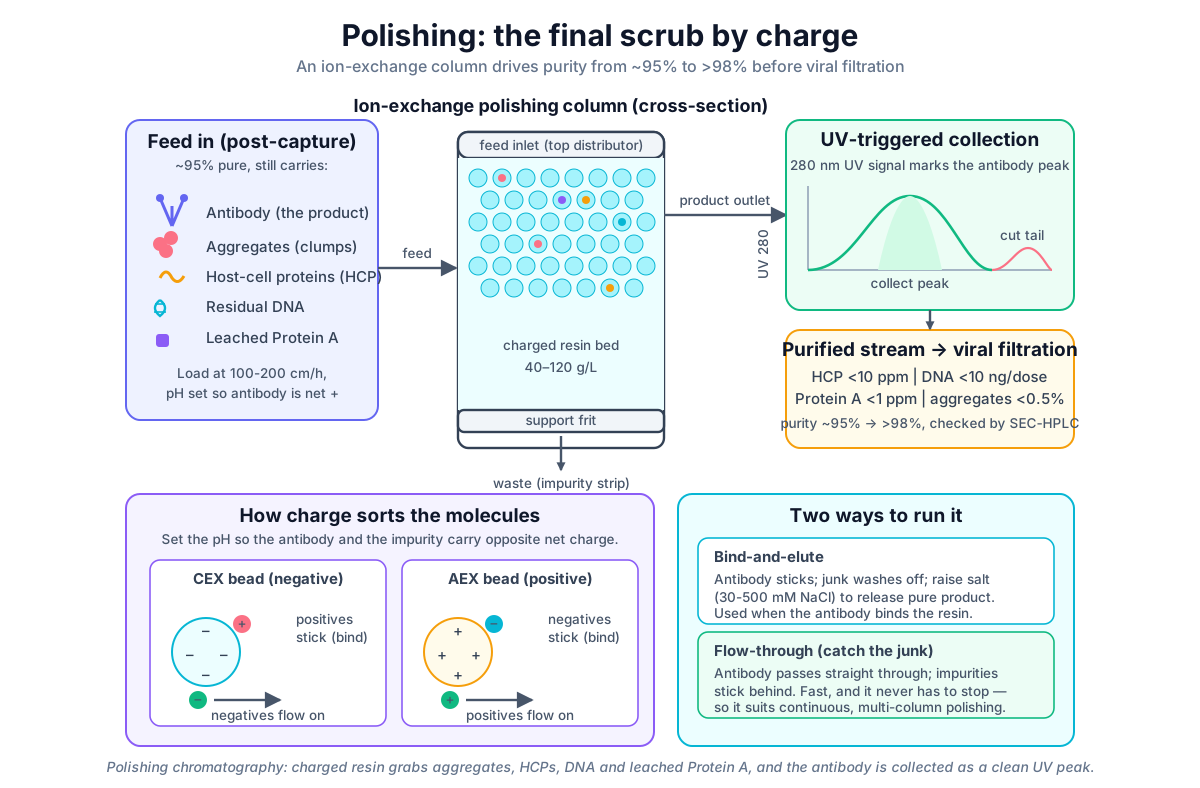 Polishing chromatography column: antibody (Y-shape) and impurities (HCP, aggregates, DNA, and leached Protein A) enter the resin bed. Ion-exchange beads bind impurities or antibody depending on pH and salt; product is collected as a peak elution.
Original diagram by the authors, created with AI assistance.
Polishing chromatography column: antibody (Y-shape) and impurities (HCP, aggregates, DNA, and leached Protein A) enter the resin bed. Ion-exchange beads bind impurities or antibody depending on pH and salt; product is collected as a peak elution.
Original diagram by the authors, created with AI assistance.
Two ways to run a column
Bind-and-elute vs flow-through, and when to use each
There are two opposite strategies for running a polishing column, and the choice is a clever one [2]:
- Bind-and-elute — the antibody sticks to the resin while the junk washes away; then we change the liquid to release (elute) the now-pure antibody. This is how capture works too. On a CEX polishing column, the release is usually done with a salt step or gradient — gradually raising the salt concentration (sodium chloride, NaCl) to loosen the antibody's electrostatic grip. Typical elutions sweep across roughly 30 to 500 mM NaCl, with the exact window tuned to the separation needed.
- Flow-through — the exact reverse. The pure antibody flows straight through and out the bottom, while the impurities are the ones that stick behind. It is fast, and it is a neat inversion of the usual logic: instead of catching the thing you want, you catch the things you don't want and let your product walk out the front door. AEX polishing is very often run this way, because DNA and acidic HCPs bind hard while the positively charged antibody sails past.
A practical note on adoption: flow-through polishing is genuinely standard in commercial antibody manufacturing today — it is not just a research curiosity — and it happens to suit continuous processing especially well, a point we return to below. Engineers mix and match these modes and column types, in whatever order scrubs out the impurities that are hardest for that specific antibody. The recipe is configurable, not carved in stone.
The two-column train below shows the most common shape: a CEX bind-and-elute followed by an AEX or mixed-mode flow-through, taking the feed from roughly 95% pure to better than 98%.

Designing the polishing train
Polishing-train design: which columns and in what order
Choosing the polishing train is a design decision, not a lookup. A CEX bind-and-elute step is a very common first polish, because the antibody's net-positive charge makes it the easy thing to bind, and that one step already strips a good fraction of the aggregates and basic HCPs — but it is one common pattern, not a law: many modern platforms instead lead with an AEX flow-through (sometimes paired with activated carbon), or run a single flow-through polish end to end, consistent with the configurable-not-carved-in-stone theme above. The governing principle is orthogonality: a good train pairs steps that separate on different physicochemical properties — charge, size, hydrophobicity — so each step clears what the others miss and impurity clearance multiplies rather than overlaps.
What comes next is decided by which impurity is still too high after the first step. If residual DNA or acidic HCP leads, an AEX flow-through column is the natural answer — the antibody never binds, so it is fast and tankless. Crucially, AEX flow-through is not just a charge-sign argument: it is run at a defined low load conductivity (conductivity is just a meter-reading of how much salt is dissolved in the liquid — more salt, higher conductivity) and a slightly higher load pH, chosen so the product stays unbound and passes while DNA and acidic HCP bind. Let the load conductivity drift up and the antibody itself can begin to bind and break through — which is exactly the failure mode the breakthrough section returns to.
If aggregates or stubborn HCPs lead, a mixed-mode column, with its two-lever selectivity, is the better tool. And a genuinely well-behaved antibody may already meet every limit after the first column, in which case the train stops at one; a difficult one may need a short cascade of more. The order matters too: engineers generally sequence the steps so each column inherits a cleaner feed than the last.
This decision branches from the same starting feed that left capture chromatography and passed through low-pH viral inactivation. The tree below lays out the choice.
 Designing the polishing train: a CEX first step, then a branch chosen by the hardest remaining impurity, converging on a product clean enough for viral filtration. The train is configured per molecule, not fixed by recipe.
Original diagram by the authors, created with AI assistance.
Designing the polishing train: a CEX first step, then a branch chosen by the hardest remaining impurity, converging on a product clean enough for viral filtration. The train is configured per molecule, not fixed by recipe.
Original diagram by the authors, created with AI assistance.
The real numbers behind it
Ion exchange by the numbers: pH, charge, capacity, flow velocity
Polishing is not a vague "clean it more" step — it runs on specifications. A pilot- or production-scale polishing column packs a resin bed measured in liters (often tens of liters, and far larger at full commercial scale). The liquid is pushed through at a linear flow velocity — picture the speed the liquid front travels down the column — of roughly 100 to 200 cm/h, a pace that balances throughput against giving molecules time to find their binding partners. Recall the bead's binding capacity — how much protein a liter of beads can hold — now put to a working number: it typically lands somewhere around 40 to 120 grams per liter, depending on the resin and the molecule. But the levers an engineer actually sets are load density (grams of product loaded per liter of resin) and residence time (minutes the feed dwells in the bed). For a flow-through polish the resin is deliberately loaded well below that maximum capacity, leaving impurity-binding headroom — under-loading on purpose is the safety margin against breakthrough.
The collection window — deciding exactly when to start and stop catching the purified product as it elutes — is defined by watching ultraviolet (UV) absorbance at the column outlet. Proteins absorb UV light strongly at 280 nm, so a rising 280 nm signal marks the antibody peak; a second channel at 260 nm — the absorbance maximum of nucleic acids — helps flag DNA contamination, with the A260/A280 ratio serving as the actual diagnostic (a protein-pure stream sits near 0.6, while rising DNA pushes the ratio up). At GMP (Good Manufacturing Practice) scale an automated system collects fractions when the UV peak crosses set thresholds, capturing the pure heart of the peak and diverting the impure leading and trailing edges to waste. That UV trace is not only a physical signal — it is the first place this purification step becomes data. Each peak, threshold, and fraction boundary is a reading from an inline detector, the kind of instrument and sensor that the data companion book treats as the birthplace of a manufacturing record. Every one of those readings is also a timestamped, tagged data-point that joins the batch's growing data shadow — the digital twin-record that accumulates alongside the physical product — which the data book follows in the data shadow. And because the start/stop cut is a judgment made on a live, moving trace, it is a natural place for a soft sensor — a model that predicts a hard-to-measure quantity (here, the product purity inside the peak) from easy live signals — to recommend the pooling boundary; the ML companion builds exactly that kind of trajectory model for this column in its polishing chromatography chapter.
Two practical numbers govern how well a column is packed and stays packed. A freshly packed bed is qualified by its HETP (height equivalent to a theoretical plate) — a packing-quality yardstick where a smaller number means sharper, more efficient peaks — together with an asymmetry (peak-shape) check; both must sit inside set limits before the column is released for production. This also explains why scale-up is never just "use a bigger column": when a polishing step is transferred from development to a manufacturing site, the separation's resolution (how cleanly two peaks pull apart) has to be re-verified at the new scale and on the new hardware, because bed height, flow distribution, and packing all shift — a step that looks identical on paper can resolve impurities differently in the plant.
Between runs, reusable columns have to be cleaned, and this is tightly controlled. Stainless-steel BioProcess-style columns are regenerated by clean-in-place (CIP) — validated acid and base washes followed by water rinses, with documented hold times and a conductivity endpoint that proves the rinse is complete — and can then be reused tens to hundreds of times. Single-use polishing modules avoid CIP and the risk of carrying contamination from one batch to the next, but cost more per run; the trade-off is exactly the kind of engineering decision a manufacturing team weighs molecule by molecule.
Why it matters
The regulatory targets and how columns hit them
This is the step that turns "good enough for the lab" into "safe to inject." If aggregates slip through, a patient's immune system may attack the medicine — or, in the worst case, be tricked into attacking the body's own tissue. If host cell proteins or DNA remain above safe levels, they can cause inflammation, allergic reactions, or slow degradation of the drug.
So regulators require that each impurity be controlled to a justified, product-specific limit, and polishing is where the numbers are driven down to meet them. For host cell protein, ICH Q6B sets no published numeric ceiling — the limit is set per product and justified by process and safety data — but the common industry benchmark lands below about 100 ppm, and in practice a well-polished antibody comes out at under 10 ppm; residual DNA below roughly 10 ng per dose (the long-standing WHO/regulatory guideline), measured by qPCR — and modern risk-based thinking weighs DNA fragment size as well as mass, since AEX shears and binds long DNA and sub-200-base-pair fragments carry far less oncogenicity/infectivity risk; and leached Protein A below about 1 ppm, measured by ELISA [5].
HCP itself is quantified by a multi-analyte ELISA reported in ppm relative to product. Soluble aggregates, which may sit around 2 to 5% after the earlier steps, must be brought down to under 0.5%, verified by size-exclusion chromatography (SEC-HPLC) — an analytical method that sorts molecules by size and so can count how much "clumped" material remains. If a batch misses these targets, it can be reprocessed if possible, or discarded entirely — a very expensive failure. None of these limits are optional: under U.S. rules, no lot of a biologic may be released until it has passed its conformity testing [6], and the acceptance criteria themselves are justified per product following the international standard for biotech product specifications, ICH Q6B — which mandates that impurities be controlled to justified limits rather than fixing a single number for every molecule [5]. Get polishing right, and what flows out is ready for its final safety screen, viral filtration.
| Impurity | Polishing target | How measured | Notes |
|---|---|---|---|
| Aggregates | under 0.5% | SEC-HPLC | down from 2–5% after capture |
| Host cell protein (HCP) | product-specific limit; commonly under 100 ppm | multi-analyte ELISA | industry benchmark, not a fixed ICH Q6B number; a well-polished mAb reaches under 10 ppm |
| Residual DNA | under ~10 ng per dose | qPCR | the long-standing WHO/regulatory guideline |
| Leached Protein A | under ~1 ppm | ELISA | capture sheds it; polishing clears it |
Those acceptance numbers do not live on the shop floor; they live in the quality system. The result of each polishing batch — the assay values for HCP, DNA, aggregate, and leached Protein A — is recorded, compared against the registered specification, and dispositioned in the plant's information systems, which is where a chromatogram becomes a pass/fail decision a regulator can audit. The relationships sketched in this chapter are also the kind a formal model can type explicitly: this polished pool is derived from the captured feed, it runs on a named CEX or AEX column, and that column is a kind of ion-exchange resin. Naming those edges — derivedFrom, runsOn, is-a — is what lets a graph trace a vial all the way back to its cell bank; the ontology companion makes them precise in relations and genealogy and classes and taxonomy.
When polishing is overwhelmed: aggregates and HCP breakthrough
Polishing can fail, and the most instructive failures are the ones that arrive invisibly from an earlier step. The classic example involves aggregates. The low-pH viral inactivation step that precedes polishing holds the antibody at pH 3 to 4, and both that acid hold and the buffers used to neutralize it can induce new aggregates that were not in the feed when the process was designed [9]. If a process developer sizes the polishing columns against the aggregate load measured before viral inactivation, the real burden reaching the column can be higher than planned — and aggregates can break through into the product, missing the under-0.5% target. The lesson, learned the hard way across the industry, is to measure the aggregate load where polishing actually sees it, and to leave margin.
A parallel failure mode is HCP breakthrough when a mixed-mode column loses selectivity. Mixed-mode resins owe their sharpness to a delicate balance of charge and hydrophobic interaction; fouling over many cycles, or a small drift in load pH or conductivity, can blunt that balance and let a subset of HCPs co-elute with the product [4]. Because the regulatory standard for these impurities is set by ICH Q6B [5] and there is no allowance for "close enough," a batch that breaks through has to be reprocessed or discarded. Both failure modes underline the same point: polishing is only as good as the assumptions behind its design, and those assumptions have to match the feed the column truly receives.
In the real world
Polishing is dominated by a handful of named suppliers whose resins together cover most of the industry's platforms. Cytiva offers Capto-family resins — for example Capto S for cation exchange and Capto adhere for mixed-mode work. Tosoh supplies its TSKgel and Toyopearl lines and Merck (MilliporeSigma) offers its Fractogel EMD resins for high-throughput separations, while Purolite rounds out the field with its polishing resins. A process developer choosing a polishing train is, in practice, choosing among these catalogs and matching a resin's chemistry to the impurity that is hardest to shift.
From batch to continuous: multi-column polishing
The standard commercial setup runs these columns in batches — one column-load at a time. With a single column you load it, wash it, elute it, then clean it before you can start again, which means the column is actually working only about a third of the time. The modern, intensified alternative is continuous, multi-column polishing. By running two or three columns in parallel and staggering their cycles — each load–wash–elute cycle taking on the order of a couple of hours — one column can be eluting while the next is already loading. That lifts column utilization from roughly 33% toward 60 to 80%, shrinking both the resin needed and the footprint [7]. Researchers have demonstrated fully continuous, integrated polishing trains — a cation-exchange bind-and-elute step feeding straight into a mixed-mode flow-through step — all coordinated automatically by simulated-moving-bed control systems such as BioSMB [8]. Flow-through polishing fits this style naturally, because the product never has to stop and wait in a tank between steps. The open-source companion book works through exactly this control problem — staggered cycles, automated fraction collection, and the historian records behind them — in its downstream chromatography chapter, where the same column logic becomes running code.
A grounding note, so the picture stays honest. Continuous polishing is an emerging direction, not yet the everyday production norm. For the vast majority of approved antibody medicines on the market today, polishing still happens the classic way: a column or two, run in batches, one load at a time.
Key terms
- Polishing — the final chromatography steps that remove the last impurities after capture, taking purity from roughly 95% to better than 98%.
- Aggregate — clumped-together antibody molecules that can trigger an immune reaction; reduced from ~2–5% to under 0.5% during polishing.
- Host cell protein (HCP) — leftover protein from the CHO production cells; cleared to well below 100 ppm (often under 10 ppm).
- Ion exchange chromatography — a method that separates molecules by their net electrical charge.
- Cation exchange (CEX) — negatively charged resin that binds positively charged molecules.
- Anion exchange (AEX) — positively charged resin that binds negatively charged molecules; very effective on DNA and acidic HCPs.
- Mixed-mode resin — beads that separate by both charge and hydrophobic stickiness, giving high selectivity for aggregates and HCPs.
- Bind-and-elute — mode where the antibody sticks to the resin, then is released as pure product (often with a rising salt step).
- Flow-through — mode where the antibody flows past while impurities stick behind.
- Leached Protein A — a trace of the capture ligand that sheds during capture and must be cleared (to below ~1 ppm) during polishing.
- Isoelectric point (pI) — the pH at which a protein carries no net charge; it is positive below its pI and negative above it.
- Linear flow velocity — the speed the liquid travels down a column, typically 100–200 cm/h in polishing.
- Clean-in-place (CIP) — validated acid/base washing that lets a reusable column be cleaned and re-used many times.
- Size-exclusion chromatography (SEC-HPLC) — an analytical method that sorts molecules by size, used to measure how much aggregate remains.
- Binding capacity — how much protein a liter of packed resin can hold before it is full; typically 40 to 120 g/L in polishing.
- Coulombic attraction — the simple electrostatic pull between opposite charges that drives ion-exchange binding.
- Breakthrough — when an impurity (or product) the column was meant to retain instead escapes into the collected stream, usually because the load exceeded capacity or selectivity drifted.
- HETP — height equivalent to a theoretical plate; a packing-quality measure where a smaller value means a more efficient column with sharper peaks.
- Soft sensor — a model that predicts a hard-to-measure quantity (such as in-peak purity) from easy live signals, here used to recommend the pooling cut.
In short
- What polishing removes: the last aggregates, host cell proteins, residual DNA, and leached Protein A — driven to product-specific limits (commonly HCP under 100 ppm, DNA under ~10 ng/dose, leached Protein A under ~1 ppm, aggregates under 0.5%).
- Two run modes: bind-and-elute (product sticks, then elutes — usually a salt step on CEX) and flow-through (product passes, impurities stick — the usual mode for AEX), assembled into an orthogonal train so each step clears what the others miss.
- The purity it achieves: roughly 95% pure in, better than 98% pure out — clean enough to hand off to the final viral-safety screen.
Where this leads
The antibody is now almost perfectly pure, but "almost pure" still is not "proven virus-safe." The next chapter, viral filtration, covers the final physical safety screen — pushing the polished antibody through a membrane with pores so fine that even the smallest viruses are caught while the antibody slips through — the last barrier before the product is concentrated, formulated, and filled into vials.