The main event: the production bioreactor
📍 Where we are: Stop 11 of 21 — the cells move into the big tank and start brewing medicine in earnest.
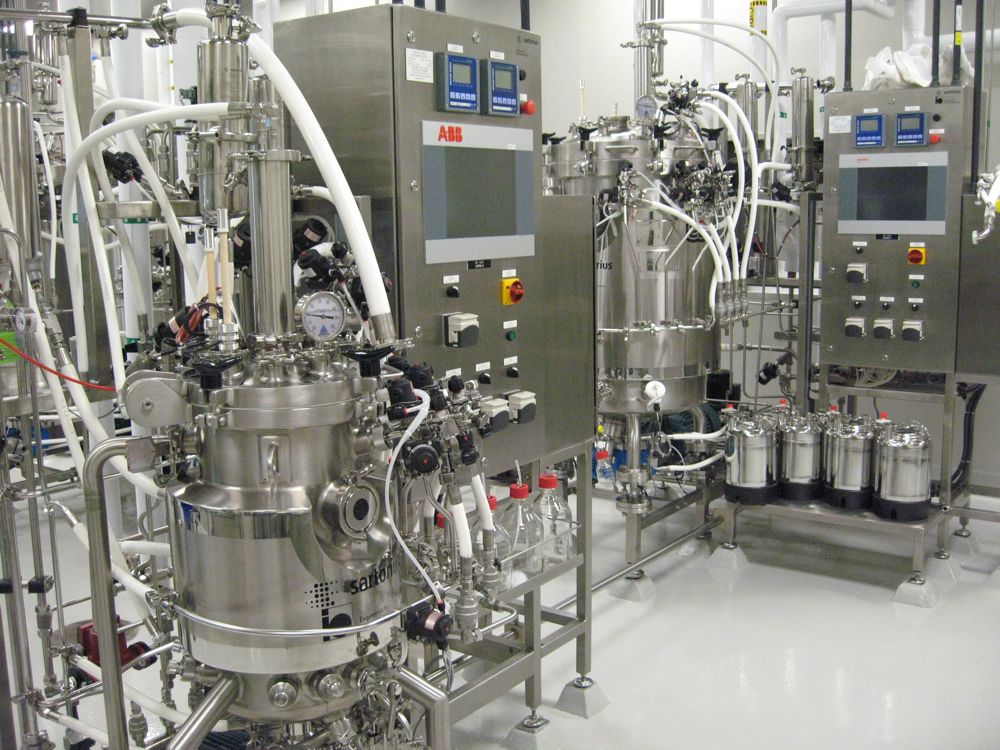 Stainless-steel bioreactors with their control cabinets. Sensors feed the controllers, which hold temperature, pH, dissolved oxygen, and agitation steady while the cells grow.
Stainless-steel bioreactors. Image by RickLawless, CC BY 3.0, via Wikimedia Commons.
Stainless-steel bioreactors with their control cabinets. Sensors feed the controllers, which hold temperature, pH, dissolved oxygen, and agitation steady while the cells grow.
Stainless-steel bioreactors. Image by RickLawless, CC BY 3.0, via Wikimedia Commons.
This is the heart of the upstream part of making a biologic — a medicine made by living cells. The small starter culture from the seed train is poured into one large tank, where billions of cells grow and quietly release antibody (a Y-shaped protein the immune system uses) into the liquid around them. From here on, everything is tuned so the cells stay happy and busy, hour after hour, day after day.
Think of a brewery. To make beer, you give yeast a warm tank, sugar to eat, and just the right conditions, and it brews for you. Here we do the same thing — but our cells brew medicine instead of beer. Keep the tank cozy and well-fed, watch it like a hawk, and the cells pump out antibody for days.
What this chapter covers
We will open the lid on the production bioreactor: what it is, the handful of conditions that must be held rock-steady, and the clever feedback loop that holds them there. We will meet the real machines plants actually buy and the numbers they run at. We will compare the two ways to operate the tank — the dominant fed-batch approach and the modern, intensified perfusion approach — and see why oxygen, of all things, is often the bottleneck. Finally we will look at how the whole run is watched in real time and logged into a legal record, because in this industry a batch you cannot prove is a batch you cannot sell.
What actually happens
The production bioreactor is a large vessel — often a polished stainless-steel tank or a giant single-use plastic bag — that can hold anywhere from a few hundred liters up to about 2,000 liters for a single-use bag, while fixed stainless-steel tanks scale to 10,000–25,000 liters at production scale. Inside, the goal is simple to state and hard to do: keep the cells in a near-perfect environment so they multiply and make as much antibody as possible.
The cells are fussy. To keep them thriving, sensors watch the tank and a controller automatically holds each condition at its setpoint (the target value):
- Temperature is held near 37 °C — the same warmth as the human body, because these cells came from a mammal, almost always an engineered Chinese hamster ovary (CHO) cell line (the industry's standard host, chosen because it folds and decorates human-style antibodies correctly), not the patient's own cells. Many processes deliberately drop it a degree or two later in the run to slow growth and push the cells toward making product.
- pH (how acidic or basic the liquid is) is kept steady in a narrow band, typically around 6.8 to 7.2, by adding a little carbon dioxide gas to lower it or a base to raise it. Outside that band the cells get stressed and sloppy.
- Dissolved oxygen (DO) — the oxygen mixed into the liquid — is topped up constantly, because cells breathe just like we do. Plants usually hold DO somewhere in the 30 to 80 percent range, measured as a percentage of air saturation — where 100 percent is as much oxygen as the liquid could hold if left fully exposed to air; too little starves the cells, and too much can be its own kind of stress.
- A gentle stirrer turns at roughly 50 to 150 revolutions per minute, slow enough not to bruise the delicate cells but fast enough to keep everything evenly mixed and the oxygen well distributed.
- Nutrient feeds — concentrated food, mostly sugars and amino acids — are added on a schedule, because hungry cells stop making medicine.
As the cells work, the amount of antibody in the liquid climbs. We score that yield as the titer: grams of antibody per liter. Titer is the headline number because it is the simplest lever on cost — a higher titer means more medicine from the same tank, the same media, and the same two weeks of labor, so it is one of the primary drivers of process economy (alongside how productive each individual cell is — its specific productivity — and how long the cells stay alive, their viability) [1]. Modern fed-batch monoclonal-antibody (mAb) processes commonly reach titers in the range of 2 to 8 grams per liter — with high-performing platforms reaching around 10 g/L — at cell densities of roughly 5 to 20 million cells per milliliter by the time of harvest. Titer rises with both of these together: more living cells, each making more antibody for longer, is what builds the grams-per-liter total.
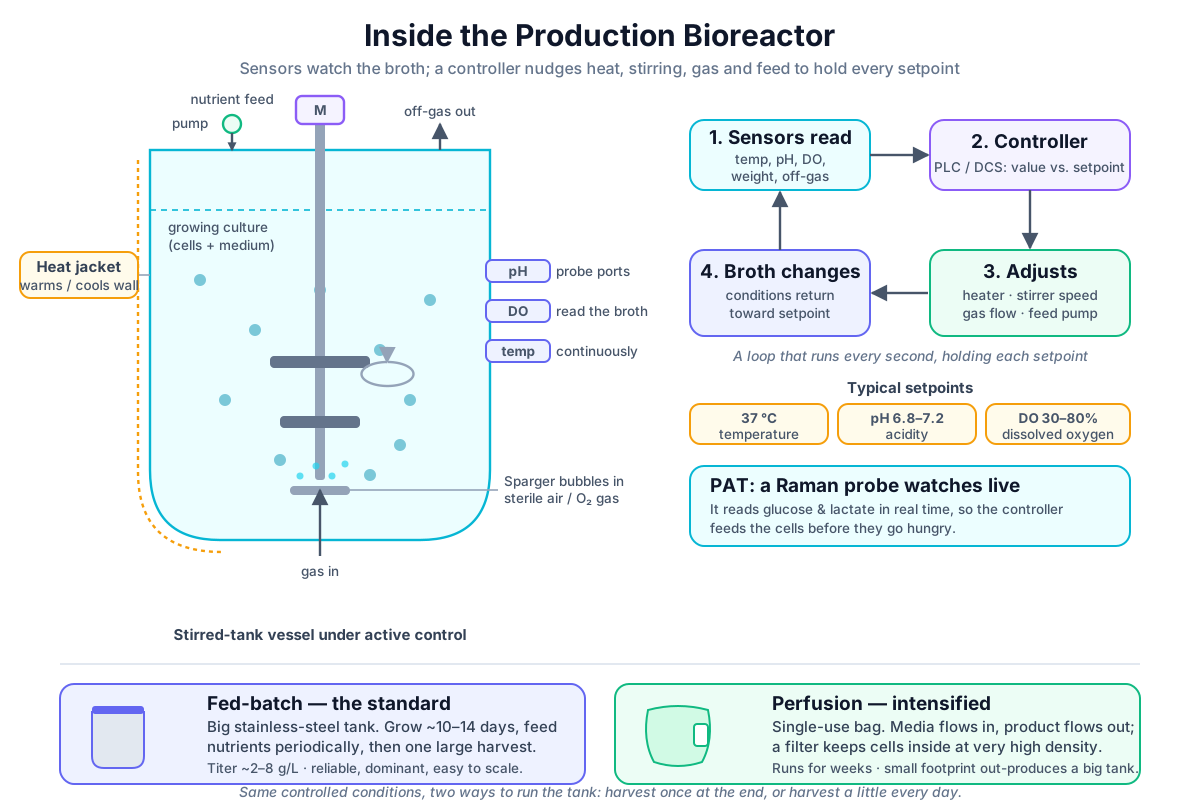 A production bioreactor cross-section with integrated control loop: sensors feed the controller, which adjusts heater, agitation, and feed pumps to hold setpoints. Inset compares stainless-steel stirred-tank (fed-batch) to single-use bag (perfusion).
Original diagram by the authors, created with AI assistance.
A production bioreactor cross-section with integrated control loop: sensors feed the controller, which adjusts heater, agitation, and feed pumps to hold setpoints. Inset compares stainless-steel stirred-tank (fed-batch) to single-use bag (perfusion).
Original diagram by the authors, created with AI assistance.
How the tank holds its conditions
The feedback control architecture: sensors, setpoints, actuators
None of those conditions hold themselves. Each sensor — a dissolved-oxygen probe, a pH electrode, a temperature sensor — reports its reading many times a second to a controller, usually a PLC (programmable logic controller) or DCS (distributed control system). The controller compares the reading to the setpoint and nudges the right actuator: open the oxygen sparger (the gas-injecting ring at the tank bottom) a little, warm the jacket, dose a splash of base, speed up the feed pump. Dissolved oxygen in particular is rarely one knob but a cascade — the controller first stirs harder and sparges more air, then, as oxygen demand climbs late in the run when viable-cell density (the count of living cells per volume) peaks, enriches the sparge gas with pure oxygen; this is why DO is the hardest loop to hold and why pure-O₂ sparging is standard at production scale. This is a classic feedback loop, and it runs untiringly for the whole campaign so a human does not have to stand there turning valves.

The vocabulary of that loop is worth fixing precisely, because it is the same vocabulary you will meet again the moment this physical process starts producing data. The setpoint (SP) is the target you ask for; the process value (PV) is what the probe actually reads back right now; the gap between them is the error the controller works to close; and the actuator is the muscle — a valve, a pump, a heating jacket — that the controller moves to shrink that error. Hold those four words in mind and almost every line on a bioreactor trend chart becomes legible.
Anatomy of one control loop
A single production bioreactor is not running one feedback loop but several at once, each pairing a probe with an actuator. It is worth laying them side by side, because the same five-row structure — temperature, pH, dissolved oxygen, agitation, and nutrient feed — recurs in every tank you will ever stand in front of.
 Each row is one physical feedback loop — a probe measuring a process value, a controller comparing it to a setpoint, and an actuator correcting the broth. This is the physical control loop, not yet a record: the PV here is a needle on a wall, distinct from the six-field data-point it becomes one layer up in the data view of the same reading and from the concrete sensor-table row it becomes in the open-source implementation.
Original diagram by the authors, created with AI assistance.
Each row is one physical feedback loop — a probe measuring a process value, a controller comparing it to a setpoint, and an actuator correcting the broth. This is the physical control loop, not yet a record: the PV here is a needle on a wall, distinct from the six-field data-point it becomes one layer up in the data view of the same reading and from the concrete sensor-table row it becomes in the open-source implementation.
Original diagram by the authors, created with AI assistance.
That hand-off is the whole spine of this trilogy. The probe in the figure is a piece of hardware bolted to a port; the PV it produces is a physical fact about the broth at one instant. The companion books pick that exact value up and carry it forward — first as a born data-point with units, quality, and a timestamp, then as a row you can query in a database. Here, though, it is still purely physical: a measurement that steers a valve.
Notice, too, that the wiring of this loop is already a set of typed relationships, not just parts in a box: this DO probe measures dissolved oxygen, this sparger actuates the DO loop, this loop runs-on bioreactor BR-101, and every reading it emits is derived-from that one vessel. Those verbs — measures, actuates, runs-on, derived-from — are exactly the labelled edges the ontology book turns into a queryable graph, so that "which actuator corrects DO on BR-101?" becomes one lookup rather than tribal knowledge; the grammar of such typed links is the subject of relations and genealogy, and the way a probe is-a sensor and a bioreactor is-a vessel is the taxonomy built in classes and taxonomy.
Temperature and metabolism: the 37 °C envelope and late-run cooling
Temperature is the gentlest loop to hold but one of the most consequential to choose. The jacket — a sheath of warm or chilled water wrapped around the vessel wall — trims the broth to within a few tenths of a degree of 37 °C, the body temperature the cells evolved in. Many processes then stage a deliberate temperature shift a few days in, typically dropping to around 30–33 °C to slow division and tip the cells' metabolism away from growth and toward making antibody. Its timing relative to the growth-to-production transition is what matters: shift too early and you cap peak cell density and titer, too late and you forfeit the viability and quality benefit. The cooler, less frantic culture often holds viability longer and predictably alters the product-quality profile — galactosylation of the antibody's sugar chains shifts with it. Those sugar chains are the small carbohydrate trees the cell attaches to the finished antibody (its glycosylation), and their exact shape affects how long the drug lasts and how well it works in a patient — which is why the shift, and its timing, are treated as process levers rather than housekeeping.
Oxygen delivery and kLa: the scale-up bottleneck
The single hardest thing to keep up with is oxygen. Cells consume it fast, and oxygen is stubbornly slow to dissolve from a gas bubble into water. How quickly it crosses that boundary is captured by a number called the volumetric mass-transfer coefficient, written kLa — essentially the tank's oxygen-delivery horsepower, quoted per hour, where a higher number means the tank can move oxygen into the liquid faster [2]. You raise kLa by making smaller bubbles (a finer sparger, the perforated ring that injects gas at the bottom) and by stirring faster, which shears bubbles apart and sweeps fresh liquid past them. The catch is that mammalian cells are fragile, so you cannot simply crank the stirrer; the art is delivering enough oxygen while keeping shear gentle. As tanks get bigger this gets harder, because a large vessel mixes less uniformly than a small one — pockets can go briefly oxygen-poor before fresh liquid arrives. Getting this balance right is most of what "scale-up" really means, and it is why the gentle, low-density cultures of the seed train cannot simply be poured into a bigger vessel and trusted to behave the same way — the full discipline of moving a process from small to large vessels is the subject of tech transfer and scale-up.
pH homeostasis and nutrient management
pH drifts in two directions over a run, and the controller answers each. Early on, as cells respire, dissolved CO₂ tends to push the broth acidic; later, as the culture consumes lactate and other acids, pH can creep upward. The controller corrects downward by sparging in a little extra CO₂ gas and upward by dosing a metered splash of base. Sparging cuts both ways, though: the same gas flow that delivers oxygen also strips dissolved CO₂ out of the broth, and at large scale, where mixing is poor, dissolved CO₂ (pCO₂) can instead accumulate to levels that suppress growth and shift glycosylation — a classic scale-up failure mode that is hard to reproduce in a small vessel. The intense sparging also whips up foam, so a metered dose of antifoam is added to keep it down, because a foam head damages cells at the bursting bubbles and fouls the headspace probes.
The pH-up creep late in the run is itself a health signal: it tracks the metabolic shift from net lactate production to net lactate consumption. Lactate is the acidic waste cells dump into the broth when they burn sugar fast during early, frantic growth; as the culture matures and growth slows, healthy cells switch to consuming that lactate back as a fuel, so the switch from making it to eating it is one of the single most-watched indicators that a culture is mature, efficient, and productive. Sitting alongside that loop is nutrient management: concentrated feeds of glucose and amino acids are added on a schedule (or, increasingly, on demand), each addition logged by weight from a balance under the feed bottle. Starve the cells and they stop making product; overfeed them and waste metabolites like lactate and ammonia accumulate and stress the culture. There is a further hidden ceiling on feeding — osmolality, a measure of how much salt and dissolved matter is packed into the broth: concentrated bolus feeds (single large doses) and base additions raise that salt and solute load, and past a point the resulting osmotic stress — water drawn out of the cells by the over-concentrated liquid around them — caps growth and shifts product quality, which is why concentrated, balanced feeds and on-demand feeding exist. The two loops are coupled, because feeding changes metabolism and metabolism changes pH.
Two ways to run the tank
So far: sensors read a process value, and a controller closes the error to a setpoint by moving actuators. Now the bigger choice — how you feed the whole tank and when you harvest it. There are two main modes for operating the production bioreactor, and the choice shapes the entire plant around it.

Fed-batch operation and titer kinetics
Fed-batch is the standard commercial approach and, paired with Protein A capture downstream, the baseline platform for almost every approved mAb. The cells grow for roughly 10 to 14 days. Every so often you pour in concentrated nutrients to keep them fed (that periodic feeding is what "fed-batch" means), the titer slowly builds, and at the end you collect everything in one big harvest. It is simple, reliable, well understood by regulators, and by far the most common. Run length varies with the cell line and product — some campaigns are shorter, some stretch toward three weeks — but 10 to 14 days is the representative window [3]. The titer curve has a characteristic shape: it lags while the cells are busy multiplying, then climbs steeply once the culture is dense and shifts toward production, and finally flattens as cells age and begin to die. Reading that curve in real time — knowing whether today's slope is on track — is exactly what the logged PV stream from the control loops makes possible.
Perfusion mode and intensified cell density
Perfusion is the modern, intensified approach. Fresh media flows in and spent media plus dissolved product flow out continuously, while a cell-retention device keeps the cells inside the tank. That retention device is a separate piece of equipment, and it is what makes perfusion possible — most often a hollow-fiber filter run in alternating-tangential-flow (ATF) or tangential-flow (TFF) mode — two ways of recirculating broth tangentially, sweeping it sideways across the membrane face rather than pushing it straight through, so the sweeping flow continually scours off the layer of cells that would otherwise clog the pores — sometimes an acoustic separator or a compact centrifuge. ATF, whose pump reverses direction on each stroke, is generally favoured because the flow reversal sheds the cake (the built-up layer of cells and debris) that fouls (clogs and coats) the fibres, and is gentler on the cells; even so, filter fouling and gradual loss of product through the membrane over a long run are perfusion's real operational Achilles' heel, which is why acoustic and centrifugal retention exist as alternatives. Because waste is washed away constantly and food never runs out, the cells reach extraordinary density — viable-cell concentrations of 50 to 100 million cells per milliliter and beyond, several times what fed-batch can sustain [4]. The fresh media typically exchanges roughly one to two whole tank volumes per day (a media residence time of roughly half a day to a day), and the culture keeps producing for 20 to 30 days or longer, churning out on the order of 0.5 to 2 grams of antibody per liter per day. That daily rate is easy to misread against fed-batch's 2 to 8 g/L final titer, so it is worth being explicit: that is a volumetric productivity, and integrated over a 20-to-30-day run the harvested mass per liter of reactor far exceeds a single fed-batch harvest. A smaller perfusion tank can out-produce a much larger fed-batch one, which is the whole economic argument for process intensification [1].
It is worth being precise here: perfusion is the operating mode (continuous feed and bleed — fresh media flows in while a small slip-stream of cell-containing broth, the bleed, is continuously withdrawn to hold cell density steady), and the filter or acoustic unit is the mechanism that keeps the cells from washing out with the spent media. They are two different things that go together.
Why it matters
This tank is where the medicine is actually created, so the conditions inside decide both how much you get and whether it is safe to use. If the oxygen runs low, the temperature drifts, or a feed is missed, the cells slow down, stop, or even start dying. Dying cells spill their contents — including enzymes and DNA — into the liquid, adding impurities that the later cleanup steps must scrub out. Worse, stress can subtly change the antibody itself, altering the sugar chains attached to it or its potency — how well the drug works in a patient.
Design space (ICH Q8/Q9)
This is why the controlled ranges are not chosen by guesswork. Under the Quality-by-Design framework of ICH Q8(R2) (a guideline from the International Council for Harmonisation, the body whose rules regulators worldwide adopt), manufacturers map out a design space: the multidimensional region of temperature, pH, dissolved oxygen, and feed rate within which the process is proven to deliver product that meets specification — the pre-set acceptance limits the batch must pass to be released [5]. Staying inside that envelope is what makes one batch look like the next. Deciding which parameters matter most — which ones are the true critical process parameters — the settings whose drift would hurt a quality attribute (a measurable property the product must hit to be safe and effective, such as its sugar chains or potency) — is done with the structured risk assessment laid out in ICH Q9(R1), so that the tightest controls land where the product is most sensitive [6]. The published A-Mab case study, an industry teaching example, walks through exactly this logic for a model antibody: link each bioreactor parameter to the quality attributes it can affect, then build the control strategy around it [3]. Hold the setpoints inside the design space, and you get a high titer of consistent, high-quality medicine, batch after batch.
A design space is not taken on trust; it is qualified. Before a tank makes sellable product, the equipment is checked out through installation, operational, and performance qualification (IQ/OQ/PQ) — proving in turn that it was installed correctly, runs across its specified range, and reproducibly makes in-spec batches — and the at-scale process is rehearsed in engineering runs (practice batches that test the steps, not for sale) before the GMP process-performance qualification runs that demonstrate reproducibility, often probing worst-case conditions at the edges of the operating ranges. That whole proving discipline — the FDA process-validation lifecycle of design, qualification, and continued verification — is the subject of tech transfer and scale-up.
In the real world
Walk into a working upstream suite and you will see equipment from a short list of familiar names. Stainless-steel and single-use stirred tanks from Sartorius (the BIOSTAT STR line), Cytiva (Xcellerex XDR), and Thermo Fisher (HyPerforma single-use bioreactors, or S.U.B.) cover the single-use production range from about 50 liters up to 2,000 liters — with fixed stainless-steel production tanks scaling well beyond that — while smaller development-scale systems like the Eppendorf BioBLU run from roughly half a liter to 50 liters for process development. The move toward single-use plastic vessels — a sterile bag you install, run once, and discard — has reshaped the industry, because it removes the slow, validation-heavy cleaning and sterilization of fixed stainless steel and lets a plant switch products in days rather than weeks.
Most approved biologics today are still made in large tanks running fed-batch — proven, dominant, and easy for regulators to assess. The direction of travel, though, is toward continuous, intensified processing: single-use perfusion bioreactors paired with continuous downstream capture.
PAT in practice: Raman probes and soft sensors
Either way, modern plants increasingly lean on PAT — Process Analytical Technology, a framework the FDA laid out in 2004 to encourage building quality understanding directly into the process rather than testing it in afterward [7]. In practice that means a stack of in-line instruments: the dissolved-oxygen probe and pH electrode already mentioned, a balance under the feed bottle that logs every gram added by weight, and — increasingly — a Raman spectroscopy probe. The Raman probe shines laser light into the broth and reads back, in real time and without removing a sample, the levels of glucose and lactate and even an estimate of how many cells are alive; this in-line measurement of multiple culture parameters has been demonstrated at the 500-liter scale [8]. Fed into a soft sensor — a model that infers a hard-to-measure quantity like viable-cell density from the easy-to-measure ones — those readings let the system feed the cells before they ever go hungry. The instruments themselves, and how the readings they emit are born as data, are the subject of the data view of bioreactor sensing, while how such a model is actually built, validated, and run is the subject of the soft-sensor chapter and, with full ML rigor, the ML view of the production bioreactor.
All of this is also a legal record. A cluster of standards governs that record. The control recipe is structured according to the ISA-88 batch-control standard (a common grammar for how a recipe is written and executed), and the PLC or DCS captures the as-executed run — every temperature reading, every setpoint, every feed addition with its timestamp — into the electronic batch record. Because that record is the evidence the medicine was made correctly, it must satisfy 21 CFR Part 11 (the FDA rule that electronic records and signatures are trustworthy) — and, in the EU, the equivalent EU Annex 11 — while the equipment and the production process itself must meet the design and operation requirements of 21 CFR Part 211, Subpart F (the cGMP — current Good Manufacturing Practice — rule for production and process controls). In this industry, the data trail is as much a deliverable as the antibody. The codes that govern the run cluster together; you do not need to memorize them, only what each one guarantees:
| Standard | What it guarantees |
|---|---|
| ISA-88 | a common grammar for how a control recipe is written and run |
| 21 CFR Part 11 / EU Annex 11 | electronic records and e-signatures are trustworthy (US and EU) |
| 21 CFR Part 211, Subpart F | the cGMP (current Good Manufacturing Practice) rules for production and process controls |
| ICH Q8(R2) | the Quality-by-Design design space |
| ICH Q9(R1) | the structured risk assessment that picks the critical parameters |
When a probe lies: drift and deadband data loss
There is a quiet way for all of this to fail that no alarm catches. A pH electrode is a consumable: its glass membrane ages, and over a long run its readings can drift — the PV the controller trusts slowly diverges from the true pH in the broth. The controller, doing exactly its job, holds the displayed value on setpoint, which means it is now driving the real culture off setpoint while the trend chart looks perfectly flat. A late-run excursion can be unfolding in the tank even as the screen says all is well.
The record can hide it a second way. To save storage and tame noise, historians (the time-series databases that archive every reading) and control systems routinely log by exception with a deadband (often called a compression or swinging-door setting): a new value is only written when it moves more than some threshold from the last stored one. Set that deadband too wide and a slow, real excursion gets compressed away — the very samples that would have shown the rise are never recorded, so on the trend the batch looks in-control when it was not. The reading was taken; the truth of it never reached the record.
This is squarely a data-integrity problem, not just an instrument problem. Recognized guidance is explicit that records must be complete and that data must be accurate — two of the ALCOA+ attributes (the checklist of qualities — Attributable, Legible, Contemporaneous, Original, Accurate, and more — that good-practice data is judged against) — and the WHO data-integrity guidance singles out audit-trail completeness and the perils of configurable data thresholds as exactly the kind of thing inspectors probe [9]. And because the deadband itself is a software setting that decides what reaches the record, the system that stores it is in scope for computerized-system validation (CSV) — and, increasingly, for the FDA's risk-based computer-software assurance (CSA) approach, which concentrates testing effort on exactly the high-risk configurations (like that compression setting) that can erase a real excursion. The defenses are physical and procedural: scheduled probe recalibration and a redundant offline pH check, deadbands set tight enough that a genuine excursion cannot slip through, and an audit trail that captures the recalibration event itself. When the downstream data systems flag a suspect reading — the day-7 excursion that earns a quality flag in the open-source implementation's bioreactor data — the root cause often traces back to exactly this physical reality of a probe that quietly lied. The broader discipline of judging whether a record can be trusted is the subject of the data-integrity chapter.
Key terms
- Production bioreactor — the large tank where cells grow and secrete the antibody.
- Setpoint — the target value a controller holds a condition at, such as 37 °C.
- Dissolved oxygen (DO) — oxygen mixed into the liquid so the cells can breathe, held as a percentage of air saturation.
- Titer — grams of antibody per liter; the yield scorecard.
- Fed-batch — grow for about 10 to 14 days, feed periodically, harvest once; the baseline platform.
- Perfusion — fresh media in and product out continuously, with cells kept inside for weeks.
- Single-use — a disposable plastic-bag reactor installed and discarded, instead of a fixed stainless-steel tank.
- PAT — Process Analytical Technology: in-line sensors like Raman probes that monitor the culture in real time.
- Bioreactor — any controlled vessel for growing cells; the production bioreactor is the largest in the train.
- kLa (volumetric mass-transfer coefficient) — a measure of how fast oxygen moves from gas bubbles into the liquid.
- Sparger — the perforated ring at the bottom of the tank that injects gas to oxygenate and mix the culture.
- Cell-retention device — the filter, acoustic separator, or centrifuge that holds cells inside during perfusion.
- Design space — the proven combination of operating ranges (temperature, pH, DO, feed) that reliably yields in-spec product, established under ICH Q8(R2) Quality-by-Design.
- ALCOA+ — the attributes good-practice data is judged against (Attributable, Legible, Contemporaneous, Original, Accurate, plus Complete, Consistent, Enduring, Available).
- Soft sensor — a model that infers a hard-to-measure value (like live-cell count) from easier measurements.
- Electronic batch record — the legally controlled digital log of everything that happened during the run.
- Process value (PV) — what a probe actually reads at a given instant, which the controller compares to the setpoint.
- Drift — a slow divergence of a sensor's reading from the true value as the probe ages, so the displayed PV is wrong.
- Deadband (compression) — a logging threshold that records a value only when it changes enough; set too wide, it can hide a real excursion.
- IQ/OQ/PQ — installation, operational, and performance qualification: the staged proof that equipment was installed right, runs across its range, and reproducibly makes in-spec batches.
- CSV / CSA — computerized-system validation, and the FDA's risk-based computer-software assurance refinement of it, which focuses testing on the highest-risk software configurations.
Where this leads
When the run ends — the fed-batch tank at harvest day, or the perfusion stream flowing steadily — we are left with a thick, cloudy soup of living and dying cells, debris, and our precious antibody dissolved among them. The next job is to separate the medicine from the mess. That is the work of harvest and clarification, the first step of the downstream journey.