The framework around everything: quality, rules, and data
📍 Where we are: The framework around everything — the rulebook, the referees, and the scoreboard that wrap the entire journey from cell to cure, and hold it all together.
 Operators watch live process data from a control room. The whole framework of this chapter — the rules, the oversight, and the data trail that proves every batch — lives in monitoring and records like these.
Operators in a plant control room. Image by PEO ACWA, CC BY 2.0, via Wikimedia Commons.
Operators watch live process data from a control room. The whole framework of this chapter — the rules, the oversight, and the data trail that proves every batch — lives in monitoring and records like these.
Operators in a plant control room. Image by PEO ACWA, CC BY 2.0, via Wikimedia Commons.
You have now followed a molecule the whole way — from target to discovery, through the cell line, the bioreactor, purification, fill-finish, and out the door in distribution. This chapter is the scaffold that made every one of those steps legally a medicine. Every step you have read about happens inside an invisible scaffolding. It has three parts: a rulebook for how medicines must be made, a long approval journey watched over by official referees, and a giant trail of data that proves every claim. None of it ever touches the antibody directly. Yet without it, the medicine could never reach a patient — and that is not an exaggeration. A flawless batch with broken paperwork stays locked in the warehouse forever.
Think of a championship game. There is a rulebook everyone must follow, referees who check that you followed it, and a scoreboard that records exactly what happened. The rulebook keeps play fair, the referees keep it honest, and the scoreboard keeps it provable. Making a biologic needs all three — every single time, for every single batch.
What this chapter covers
We will walk through the three systems that surround everything else in this book. First, the quality framework — the rulebook of cGMP and Quality by Design, and the named international guidelines (the ICH "Q" series) that spell it out. Second, the regulatory journey — the multi-year, multi-billion-dollar path from first human dose to approved product, with the people and laws that gate it. Third, the data backbone — how readings from sensors, lab machines, and software systems are stitched into one traceable record, why that stitching is genuinely hard, and how shared vocabularies are starting to fix it. By the end you will see how a business problem (getting a product approved and keeping it on the market) becomes, link by link, a guarantee of patient safety.
The rulebook: cGMP and Quality by Design
cGMP means current Good Manufacturing Practice — the legally enforced rules for how medicines must be made. The little "c" matters: the standard is not frozen in 1978 (when the U.S. cGMP regulations were first codified); it is whatever is current best practice today, which is why the bar keeps rising. cGMP covers cleanliness, staff training, equipment qualification, and above all documentation. Equipment qualification is itself a staged proof — installation, operational, and performance qualification (IQ/OQ/PQ): IQ confirms a tank and its sensors were installed as specified, OQ that they run across their ranges, and PQ that the line reproducibly makes in-spec product — and the software that records all of it is proven the same way through computerized-system validation (CSV), increasingly under the FDA's risk-focused computer-software-assurance (CSA) refinement that concentrates testing on the highest-risk functions. That whole proving discipline is the subject of tech transfer and scale-up; on this page it is enough to know that an unqualified instrument or system cannot generate a record an inspector will trust. The golden saying on every manufacturing floor is: if it isn't documented, it didn't happen — a principle the FDA itself reinforces in its data-integrity guidance [6].
Sitting on top of cGMP is a modern philosophy called Quality by Design (QbD). The old way was to make a batch and then test quality into it at the end — pass or fail. QbD flips that: you design quality in from the very start. This is not a slogan; it is written down in an international guideline called ICH Q8(R2): Pharmaceutical Development (current version, 2009; the "R2" means it is the second revision), produced by the International Council for Harmonisation (ICH), the body where regulators and industry from the U.S., Europe, and Japan agree on common standards [1].
QbD works through a chain of linked ideas:
- You start with the Quality Target Product Profile — a plain description of what the finished medicine must be: this dose, this purity, this way of being given to a patient.
- From that profile you identify the CQAs (Critical Quality Attributes) — the specific features that must be right for the drug to be safe and to work. For a monoclonal antibody these are concrete, measurable things, not vague hopes (more on the real numbers below) [1].
- For each CQA you find the CPPs (Critical Process Parameters) — the process settings, like temperature, pH, dissolved oxygen, and feed rate, that actually control it. These are the same setpoints chosen during process development and held by the production bioreactor's control loops. The landmark review by Rathore and Winkle laid out exactly how biologics manufacturers map CQAs to CPPs in practice [2].
- Together, the full set of CPPs, in-process checks, and final tests make up the control strategy — the complete plan that keeps every CQA on target, batch after batch. The one-line rule worth memorizing: a CQA is a property of the product you measure, while a CPP is a knob on the process you set; the control strategy is simply the wiring between them.
Viral safety belongs here too — the low-pH inactivation and virus filtration steps you met downstream are themselves validated control-strategy elements, each credited a log-reduction value (LRV) — a factor-of-ten scale, so an LRV of 4 means the step removes 99.99% (a 10,000-fold drop). Because two steps work by independent physical mechanisms their reductions multiply (10,000-fold then again 10,000-fold is 100-million-fold), which is exactly why their logs add.
The orthogonal logic uses steps that catch different virus types: the low-pH hold inactivates enveloped viruses (those wrapped in a fragile fatty membrane), while the virus filter physically sieves out small non-enveloped ones, so the total clearance is the sum of independent mechanisms and no class slips through.
Two more guidelines complete the family. ICH Q9 covers Quality Risk Management — a structured way to decide which attributes and parameters are truly "critical" rather than guessing [10]. And ICH Q10: Pharmaceutical Quality System wraps the whole product lifecycle, from early development through to discontinuation, into one continual-improvement system that ties cGMP, the control strategy, and ongoing monitoring together [3]. Q8, Q9, and Q10 are usually spoken of as a trio: design it well, manage the risk, and run a quality system around it for life.
QbD's biggest practical payoff is the design space (ICH Q8): a multidimensional region of input ranges, proven during development to assure quality, within which movement is not considered a change requiring regulatory pre-approval. In day-to-day operation a manufacturer runs inside a narrow normal operating range (NOR) but is licensed to move anywhere inside the wider proven acceptable range (PAR) that bounds the design space — so a justified pH or feed-rate adjustment becomes routine rather than a filing. That freedom is the single biggest lever QbD hands a plant, and it is earned only by the up-front characterization work.
What a real CQA list looks like
Beginners often imagine "quality" as something fuzzy. For an mAb it is anything but. A real CQA list reads like an exacting spec sheet, each item with an allowed range backed by a regulatory or compendial standard (compendial means from a compendium — the official drug-quality references published by the U.S. Pharmacopeia, USP, and its European counterpart, Ph. Eur.). Here is the spec sheet at a glance, with the annotated detail following underneath:
| CQA | What it is | Assay / method | How it is specified |
|---|---|---|---|
| Potency | does the antibody work | cell-based or binding bioassay | % vs reference (80–125% comparability band) |
| HMW aggregate | stuck-together protein | SEC | upper limit, a few % |
| Charge variants | acidic / basic species | icIEF / cIEF | window per species |
| Glycosylation | Fc sugar tree (afucosylation, high-mannose) | released-glycan / peptide map | % per glycoform |
| Host-cell impurities | HCP, residual DNA, leached Protein A | ELISA / qPCR | ppm, ng/dose |
| Endotoxin | pyrogenic cell-wall debris | LAL | EU, limit = K/M (calculated) |
- Potency — does the antibody do its job? Measured in a cell-based or binding bioassay against a reference standard. The 80–125% figure people quote is the conventional comparability/equivalence acceptance interval — a comparability study checks that two lots behave the same, for instance before and after a manufacturing change — and this is the band, whose width reflects how variable bioassays inherently are, used to judge whether two lots (or a pre- and post-change product) are equivalent. A product's registered release potency specification is set per product and is often different, sometimes tighter (e.g. 80–120%) or wider, depending on the assay; do not assume every mAb's potency spec is literally 80–125%.
- Purity / aggregates — the controlled attribute here is high-molecular-weight (HMW) aggregate (misshapen, stuck-together protein), measured by size-exclusion chromatography (SEC) and specified as an upper limit — typically not more than a few percent HMW. Monomer % is just the complement, so the ~95–99% monomer you often see is a useful illustration, not a universal limit: the registered spec is fixed per product from stability data. Fragments (low-molecular-weight, LMW) are tracked the same way.
- Charge variants — acidic and basic species (from deamidation, C-terminal lysine, and the like), resolved by imaged capillary isoelectric focusing (icIEF) or cIEF — which sort protein forms by their electric charge — and each held within a defined window, because charge shifts can change how the antibody distributes and clears.
- Glycosylation — the sugar tree on the Fc (the antibody's stem region, the part immune cells grab onto), measured by released-glycan or peptide-map methods. It matters functionally: removing one sugar unit (fucose) — high afucosylation — lets immune cells grip harder and kill the target cell more effectively (ADCC, antibody-dependent cell-mediated cytotoxicity, an effector-killing mechanism), while a different, immature sugar form (high-mannose) is removed from the bloodstream faster (faster clearance). %G0F/%G1F and %afucosylation are simply the percentages of each sugar form, so they are tracked targets, not cosmetic detail.
- Host-cell impurities — host-cell protein (HCP), reported in parts per million (ppm) by ELISA (an antibody-based assay that counts a specific protein); residual host-cell DNA, in nanograms per dose by qPCR (a DNA-copying test that counts DNA); and leached Protein A from the capture resin. Each is a downstream-clearance CQA — the reason the purification train exists.
- Endotoxin — bacterial cell-wall debris that triggers fever (it is pyrogenic, i.e. fever-inducing), dangerous in any drug injected rather than swallowed (a parenteral). It is counted in endotoxin units (EU), a potency measure, and assayed by LAL (Limulus Amebocyte Lysate, a clotting test that detects endotoxin). Crucially, the limit is calculated, not fixed: for a parenteral drug it is the threshold pyrogenic dose K/M, where K = 5 EU/kg per hour for an injected (IV, intravenous) drug and M is the maximum human dose in mg/kg per hour. The "per kg per hour" cancels top and bottom — (EU/kg/hr) ÷ (mg/kg/hr) leaves EU/mg — so the limit lands in EU per mg of product. For a high-dose mAb the per-mg figure can work out to well under 1 EU/mg, but that number is a consequence of the dose, not a generic specification to quote.
These limits are not invented per company; they align with U.S. cGMP regulations in 21 CFR Part 211 and with USP and Ph. Eur. monographs, so that "in spec" means the same thing to a manufacturer, an inspector, and a hospital pharmacist [1].
Each of these measurements does not just pass or fail — it is born as data. The moment an SEC run or an LAL assay produces a number, that number, with its unit, method, instrument, and timestamp, becomes a tagged point in the batch's growing data shadow — the companion data-management book traces exactly where each such measurement is born and how the shadow accumulates (where data is born, the data shadow). And the link between a CQA and the CPP that controls it is more than prose: it is a typed relationship — "this setpoint controls this attribute" — the kind of edge a formal ontology makes machine-readable, so a query can walk from a charge-variant result back to the pH parameter that governed it (classes and taxonomy, relations and genealogy).
Anatomy of a control-strategy recipe parameter: fields, versioning, audit trail
It helps to stop treating a CPP as a number and look at what a single one actually is once it is written into the recipe. A control-strategy parameter is never a bare setpoint. It is an identity card: the value, its unit, the validated range it is allowed to move within, and a wrapper of metadata that says who set it, when it takes effect, and why it was chosen. Strip any of that away and the number means nothing to an inspector.
 A control-strategy CPP stored as a full record: the value carries its unit and validated range, a metadata wrapper says who changed it and why, an effective-dated window says when it applied, and a hash link binds the change to the history before it.
Original diagram by the authors, created with AI assistance.
A control-strategy CPP stored as a full record: the value carries its unit and validated range, a metadata wrapper says who changed it and why, an effective-dated window says when it applied, and a hash link binds the change to the history before it.
Original diagram by the authors, created with AI assistance.
The most important fields are the ones beginners never think about. valid_from and valid_to are how the record handles change: a setpoint is never overwritten in place. When the pH target moves, the old version is closed (its valid_to stops at the effective instant) and a new version is opened alongside it. Both rows survive. That is what lets a reviewer ask "which pH setpoint governed the batch that started on 5 January?" and get the value that was true then, not the value that is true now. The metadata — changed_by, the QA approved_by e-signature, the reason — is the audit trail: every controlled change carries a named person and a documented justification, never an anonymous edit. This exact record is the physical-recipe twin of the data-point that data-management captures in its data-integrity chapter and that the open-source book implements as a literal s88.recipe_parameter row in its change-management chapter.
How CPP changes are captured: from deviation to approval to audit entry
A change to a control-strategy parameter does not just happen; it travels a defined path, and the whole point of the path is that nothing is edited quietly. The lifecycle below shows the seven moves, each of which leaves a trace.

It begins with a trigger — either a planned improvement (a better feed strategy found in development) or a deviation, an observed departure from the expected process. That trigger becomes a written change request with a tracking number, stating the proposed new value, its range, and the reason. Nothing changes the live recipe until the request clears approval: a named, accountable person — in practice the quality unit — applies an electronic signature. Only then is the new version written, closing the old row and opening the new. The act of writing it fires an audit entry, time-stamped and never editable, recording who, when, and why. That entry is hash-linked to the entries before it. And finally, at batch-release review, each batch is judged against the version of the recipe that actually governed it — not whatever the recipe says today.
The hash chain that proves attribution: prev_hash and row_hash
The audit trail is only as trustworthy as its resistance to quiet edits. A plain log that anyone with database access could rewrite proves nothing. The technical answer is a hash chain. Each audit entry stores two values: prev_hash, a copy of the digest — a short fixed-length fingerprint of the data, here produced by the standard SHA-256 algorithm — of the entry before it, and row_hash, a fresh digest computed over this entry's content together with that previous hash — conceptually row_hash = SHA-256(prev_hash + value + who + when + why). Because every entry folds in the one before it, the entries form a chain. Delete an entry, reorder two of them, or quietly rewrite a setpoint, and the stored links stop lining up: the next entry's prev_hash no longer matches the prior entry's row_hash, and the break points straight at the tampered record. This is the mechanism that turns "attributable" from a promise into something a reviewer can test. The open-source book's chapter on data integrity in code builds and verifies exactly this chain over a real audit-log table.
Measuring quality as it happens
Waiting until the end to test is slow. Traditional batch release testing can hold a finished lot in quarantine for two to four weeks while samples travel to labs and results come back. The FDA's 2004 PAT Guidance — Process Analytical Technology — explicitly encouraged a better way: build understanding and measurement into the running process, so quality is verified as it is created rather than discovered weeks later [4].
A fair warning about the phrase "real time," because it is easy to oversell. Different sensors run at very different speeds. An at-line HPLC (a chromatography instrument that separates and quantifies molecules) may still take 15–30 minutes per sample. Optical probes such as Raman or UV-Vis spectroscopy are much faster, often giving a reading within 1–5 minutes — though strictly the probe returns a spectrum that a calibrated soft-sensor model turns into the quality reading; how such a model is built, validated, and run for real-time steering is the ML view of the production bioreactor and QC and release. Trusting that model under GMP needs its own discipline — proving it generalizes (cross-validation, a defined applicability domain so it flags inputs it was never trained on) and keeping it honest as the process drifts (monitoring and controlled retraining); the ML book treats those as models and validation and MLOps and lifecycle. So "real time" here means fast enough to steer the process before it drifts out of range — not instantaneous. The figure below shows why this speed matters more and more as processes change shape.
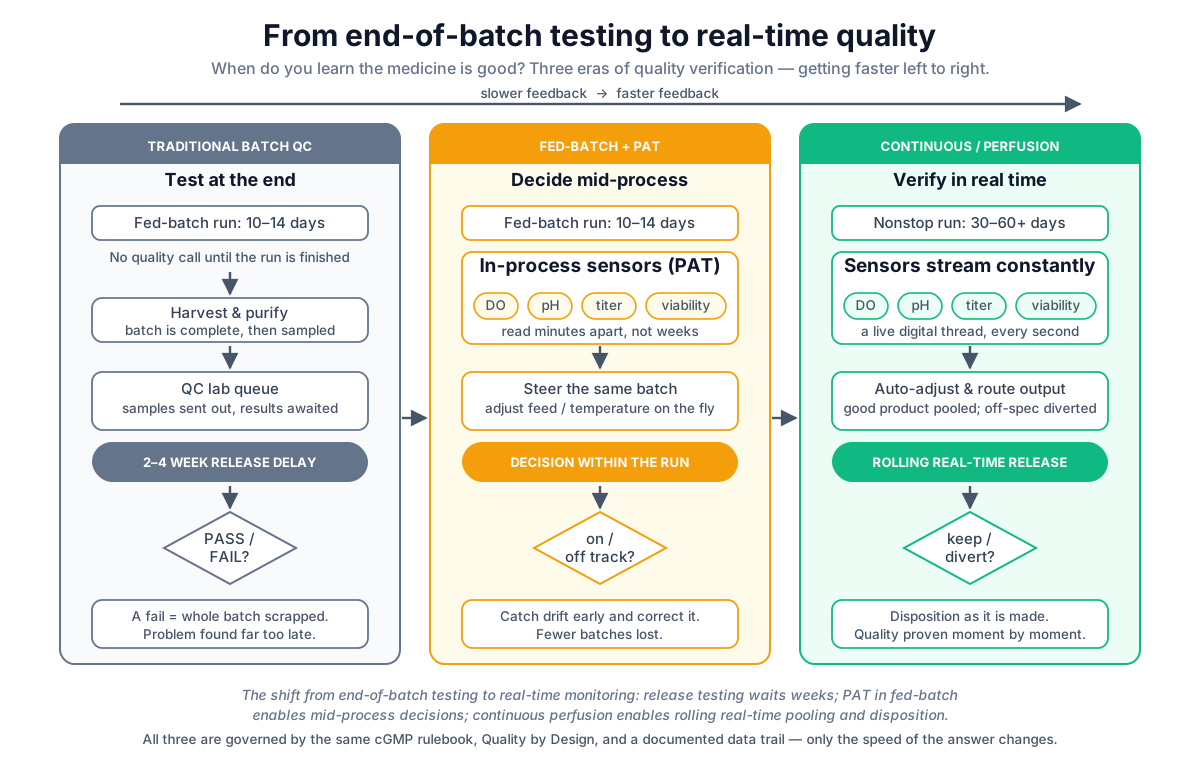 The shift from end-of-batch testing to real-time quality monitoring: traditional release testing waits weeks; PAT in fed-batch enables mid-process decisions; continuous perfusion enables rolling real-time pooling and disposition.
Original diagram by the authors, created with AI assistance.
The shift from end-of-batch testing to real-time quality monitoring: traditional release testing waits weeks; PAT in fed-batch enables mid-process decisions; continuous perfusion enables rolling real-time pooling and disposition.
Original diagram by the authors, created with AI assistance.
This shift is most urgent for the modern, continuous / intensified processes introduced earlier in the book — perfusion bioreactors feeding multi-column (periodic counter-current, PCC) capture. The dominant, approved-product way of making mAbs is still fed-batch culture with Protein A capture, whose 10–14 day runs you can pause and test between clear batch boundaries. But in a continuous perfusion process that never stops — a single run can stretch 20–40 days or longer — there is no neat "end of batch" to wait for. Quality has to be watched and decided on the fly, pooling and releasing material in rolling windows — which is impossible without fast, in-line measurement.
The referees: the regulatory journey
A medicine cannot simply be put on sale. It must earn approval along a long, parallel path that runs the entire time the manufacturing work is being figured out.

The IND (Investigational New Drug application) is permission from the regulator to give the drug to humans for the very first time. Then come three clinical trial phases: Phase 1 checks basic safety in a small group, Phase 2 asks whether it actually treats the disease, and Phase 3 confirms that in a large, often multi-thousand-person trial. Only after all three can a company file a BLA (Biologics License Application) in the United States or a MAA (Marketing Authorisation Application) in the European Union. An agency — the FDA in the U.S., the EMA in Europe — reviews the entire dossier and, if convinced, approves it.
Two honest numbers put the stakes in perspective. First, time: once a BLA is filed, the FDA's standard review target is roughly ten months, and a priority review for an important medicine is closer to six months — but that is only the final review. The full road from discovery through clinical trials commonly runs well over a decade. Second, money: the most-cited economic study estimates the capitalized cost of bringing a new drug to approval at around $2.6 billion (in 2013 dollars), once you account for the many candidates that fail along the way [8]. That price tag is the real reason manufacturing must be right the first time: a contamination or a deviation is not just one ruined batch, it can stall a program that cost billions and that patients are waiting on.
Who actually signs off
Approval is granted to a product, but each batch still needs a human to take legal responsibility for releasing it. In the European system this is the Qualified Person (QP) — a specifically named, legally accountable individual who must personally certify that each batch was made and tested in compliance before it can be sold. In the U.S., the equivalent accountability lives in the quality unit defined by 21 CFR 211.22, which gives the quality control unit the authority and duty to approve or reject every batch. Worth noting for beginners: the exact title varies by region — Japan, China, and others use their own designated roles — so "Qualified Person" is a real and powerful job, but not a single universal global title. In modern continuous and intensified plants, that single sign-off increasingly becomes a team of specialized quality roles supported by automated systems, because there is far too much rolling data for one person to review by hand.
The scoreboard: data and the digital thread
Every step in this book generates mountains of data: bioreactor sensors logging temperature, pH, and oxygen every few seconds; electronic batch records; chromatography traces; release-test results. The dream is a digital thread — one connected, traceable record that links all of it, so you can ask a powerful question like "which culture conditions produced the highest-potency batches?" and actually find the answer.
Here is the honest part, and the one most explainers gloss over: the digital thread is more goal than finished reality in most plants today. The reason is mundane but stubborn. The systems that hold the data were never designed to talk to each other:
- The process historian — the database that stores sensor readings, such as AVEVA PI (the historian formerly known as OSIsoft PI), Aspen InfoPlus.21, or a Siemens historian — might log a parameter as
TIC101.PV(the process value,.PV, of temperature controller 101). - The MES (Manufacturing Execution System) — the software that runs and records the recipe — might call the same thing
Bioreactor_Temp. - The LIMS (Laboratory Information Management System) — which stores lab results — might label it
TEMP_C, and even disagree on whether the unit is Celsius or Fahrenheit.
Same physical temperature, three names, sometimes mismatched units. Multiply that across thousands of parameters and several partner companies, and the "single connected story" snaps into disconnected fragments. This is why integrating a new system has historically meant months of engineers manually mapping one vendor's vocabulary onto another's.
The fix is standardization plus shared meaning. On the standards side, the ISA-95 model gives a common way to structure manufacturing data, and the ISPE Baseline Guide Volume 8: Pharma 4.0 (2023) provides the digital-maturity framework the industry is converging on to make integration repeatable rather than artisanal [7]. Standardization also has a wire-level half: open interoperability protocols such as OPC UA (a vendor-neutral standard for moving live process data off the floor) and B2MML (an XML form of the ISA-95 model for exchanging batch and production records) let systems hand each other data in an agreed shape rather than a proprietary one. Where this story turns into an actual running stack — which database holds the historian rows, how the recipe parameters land as concrete table rows — is the subject of the open-source companion's reference architecture. On the meaning side comes the newer idea of an ontology — a formally agreed vocabulary that defines what each term actually means, so software can connect data by understanding rather than guesswork.
Part 11 and Annex 11: how recipe parameters satisfy the requirements
And critically, none of this matters if the underlying records cannot be trusted. That is the job of data-integrity rules. In the U.S., 21 CFR Part 11 sets the criteria for trustworthy electronic records and electronic signatures — secure audit trails, time-stamped changes, controlled access [5]. Europe's equivalent expectations live in EMA Annex 11 on computerized systems; the two overlap heavily but differ in emphasis, for example in exactly how audit trails and electronic signatures must be implemented and reviewed. Underneath both sits the industry shorthand ALCOA — data should be Attributable, Legible, Contemporaneous, Original, and Accurate — which the FDA's 2018 data-integrity guidance spells out in plain question-and-answer form, and which later guidance extends to ALCOA+ by adding Complete, Consistent, Enduring, and Available (worked through in full in the sister data-management chapter) [6].
It is worth seeing how the recipe-parameter record above maps onto these rules line by line, because the abstract requirements become very concrete. Attributable is the changed_by field — a named person, never a shared login. The QA electronic signature on the approval is the Part 11 §11.50/§11.70 requirement that a signature be bound to its record and identify the signer. Contemporaneous is the time-stamped audit entry written the moment the change is made. Original is preserved by never overwriting: the superseded 6.95 row stays. And the secure, computer-generated, time-stamped audit trail that Part 11 §11.10(e) demands is exactly the chained log. The same field-by-field mapping is what data-management's Part 11 / Annex 11 chapter works through from the data side, and what the open-source book turns into running, testable controls in its open-source Part 11 chapter.
Integrity by design: technical controls vs behavioral controls
A useful distinction underlies all of this. Some controls are technical — enforced by the system itself, with no opportunity for a human to skip them. The hash chain is technical: you cannot quietly delete an entry without breaking the links. Append-only versioning is technical: the database refuses to overwrite a setpoint in place. Other controls are behavioral — they depend on people following a procedure: an analyst remembering to write a reason, a supervisor remembering to review the audit trail before release. Behavioral controls are necessary but fragile; technical controls are the ones an inspector trusts, because they hold even when nobody is watching. The maturity of a quality system is largely the story of moving controls from the behavioral column to the technical one — designing integrity in, exactly as Quality by Design designs quality in.
Real-world failure: testing into compliance and the deviation death-spiral
The clearest way to understand why all this machinery exists is to watch it fail. Consider a slow, undocumented drift: a pH probe ages and reads consistently low, so the control loop adds base and pushes the real pH above the recipe setpoint without anyone changing the recipe. (GMP requires probes to be calibrated against certified buffers at defined intervals, and that verification is exactly what should catch this — so the scenario only bites if the drift develops within a run or the calibration check is itself skipped or rubber-stamped.) The setpoint on file still says 7.05; the process is actually running at 7.20. Each individual batch result still scrapes inside specification, so each is released — and here the trap closes. When an out-of-specification result finally appears, the temptation is to test into compliance: retest, find a "lab error," and pass. The deviation-management literature names this pattern; structured frameworks for handling deviations exist precisely because the informal alternative is to explain each anomaly away one at a time until the deviation log itself becomes a work of fiction [9]. A Form 483 — the written list of deficiencies an FDA inspector issues after a facility inspection — repeatedly cites this failure mode: recipe and process parameters drifting from their documented values, deviations closed without genuine root-cause analysis, audit trails that were never reviewed [6].
This is the deviation death-spiral: undocumented drift makes the next deviation harder to interpret, which makes the next one harder still, until no record can be trusted and the whole batch history is suspect. The control-strategy record defeats it structurally. Because the setpoint is versioned and the equipment that holds it is calibrated and logged, drift shows up as a documented change request or a flagged deviation rather than a silent slide. The hash-chained audit trail means a "lab error" cannot be quietly inserted after the fact. Integrity by design is, in the end, what keeps the deviation log honest.
Connecting the three books: a CPP from cell design to data audit to code schema
It is worth pausing to see the thread this book shares with its two companions, because a single CPP is the same object viewed three ways. In this book it is a physical decision: process development chooses pH 7.05 to hold a charge-variant CQA, and the production bioreactor's control loop physically maintains it. In the data-management book it becomes a data-point: a versioned, attributable record moving through a lifecycle governed by ALCOA and Part 11 / Annex 11. In the open-source book it becomes running code: a literal s88.recipe_parameter row whose valid_from/valid_to window is enforced by the database in the change-management chapter, and whose every change is hash-chained in the data-integrity-in-code chapter. Physical artifact, then data-point, then concrete schema row — the same setpoint, traceable end to end.
Before the closing argument, the whole framework in three lines:
- The rulebook (cGMP + QbD) says design quality in — define the CQAs, find the CPPs that control them, and write a control strategy.
- The referees (the IND-to-BLA journey, the QP and quality unit) gate it batch by batch, with a named human taking legal responsibility for every release.
- The scoreboard (Part 11 / Annex 11, ALCOA, the hash-chained audit trail) proves it with tamper-evident records that hold even when nobody is watching.
Why it matters
If this framework fails, everything else is worthless. An antibody can be molecularly perfect, but if the documentation is missing or untrustworthy, regulators will not release the batch — and an unreleased batch never reaches a patient. The rules exist because patients cannot inspect a medicine themselves; they have to trust that it was made correctly, every single time. Quality by Design and a strong control strategy are how that trust is earned: you build safety in, prove it with reliable data, and then let an accountable human or quality unit sign it off — rather than crossing your fingers that a final test catches a problem. The framework is, in the end, the machinery that turns a company's business risk into a patient's safety.
In the real world
Because data ties the whole journey together, modern bioprocessing is becoming a data discipline as much as a biology one. The fragmentation problem above is exactly the frontier that the industry has taken up. In 2024, the Open Applications Group (OAGi) and partners announced an effort to build open-source biopharmaceutical manufacturing ontologies, built on the Industrial Ontologies Foundry (IOF) and aligned with the ISA-88/ISA-95 standards (ISA-88 for how batch recipes are structured, ISA-95 for how manufacturing and business systems exchange data), and coordinated through a community council. The goal is to give parameters shared semantics so that a temperature reading from one company's historian means the same thing in another company's MES — turning months of manual mapping into a far faster, reusable connection.
It is worth being precise here, because it is easy to overstate. These ontologies and the integration work around them are an active, partly-still-building effort, not a finished plug-and-play product sitting in every plant. The honest picture is a field actively assembling the standards (ISA-95, Pharma 4.0), the shared meaning (the IOF biopharma manufacturing ontologies), and the trust layer (Part 11, Annex 11, ALCOA) that a true real-time digital thread will need — precisely because the continuous, intensified processes on the horizon cannot run safely without it. The fourth book, Ontologies for Biopharmaceutical Manufacturing, works this layer in full — how a formal ontology is built, reused from IOF/BFO, and queried.
Key terms
- cGMP — current Good Manufacturing Practice; the legally enforced, ever-rising rules for how medicines must be made.
- Quality by Design — building quality into the process from the start instead of testing it in at the end; codified in ICH Q8.
- CQA (Critical Quality Attribute) — a measurable feature of the product, such as potency or purity, that must be right for patient safety.
- CPP (Critical Process Parameter) — a process setting (temperature, pH, feed rate) that must stay in range to control a CQA.
- Control strategy — the full plan of CPPs, in-process checks, and tests that keeps every CQA on target.
- PAT (Process Analytical Technology) — measuring the process fast enough to steer it as it runs, rather than waiting weeks for end-of-batch results.
- IQ/OQ/PQ — installation, operational, and performance qualification: the staged proof that equipment was installed right, runs across its range, and reproducibly makes in-spec product.
- CSV / CSA — computerized-system validation, and the FDA's risk-based computer-software-assurance refinement of it that concentrates testing on the highest-risk software functions.
- Data shadow — the growing set of tagged data points (each value with its unit, method, instrument, and timestamp) that a batch leaves behind as every step is measured.
- OPC UA / B2MML — open interoperability standards for moving live process data and exchanging ISA-95 batch records in an agreed, vendor-neutral shape.
- IND — Investigational New Drug application; the regulator's permission to begin human trials.
- Clinical trials — Phase 1 (safety), Phase 2 (does it work), Phase 3 (large confirmation).
- BLA / MAA — the formal applications to license and sell a biologic in the U.S. or Europe.
- FDA / EMA — the U.S. and European agencies that review and approve medicines.
- Digital thread — one connected, traceable record linking all the data from every step; today more goal than finished reality.
- Ontology — a formally agreed vocabulary defining what each term means, so systems share meaning, not just raw numbers; built and queried in full in the fourth book, Ontologies for Biopharmaceutical Manufacturing.
- ICH Q8 / Q9 / Q10 — the international guideline trio for pharmaceutical development, quality risk management, and the pharmaceutical quality system.
- Qualified Person (QP) — in the EU, the named, legally accountable individual who certifies each batch before release; the U.S. equivalent authority sits in the quality unit under 21 CFR 211.22.
- Historian / MES / LIMS — the process-data database, the recipe-execution software, and the lab-results system whose different vocabularies must be reconciled.
- 21 CFR Part 11 / EMA Annex 11 — the U.S. and EU rules for trustworthy electronic records, audit trails, and electronic signatures.
- ALCOA — data-integrity shorthand: Attributable, Legible, Contemporaneous, Original, Accurate.
- Change control — the formal path a parameter change must travel: a tracked request, a documented reason, and a signed approval before the live recipe is altered.
- Deviation — an observed departure from the expected process or its documented parameters; must be investigated and resolved, never quietly explained away.
- Audit trail / hash chain — the time-stamped, append-only record of every change, made tamper-evident by linking each entry's
row_hashto the previous entry's hash so any deletion or edit breaks the chain. - Effective dating (
valid_from/valid_to) — versioning a setpoint by closing the old record and opening a new one, so each batch can always be read against the recipe version that actually governed it.
Where this leads
That completes the framework — and, with it, the journey from a single idea to a vial in a patient's hands. One last resource remains. The Glossary gathers every key term from every chapter into one place, so you can look up any word that ever puzzled you and find it in plain language. Turn the page, and keep it nearby.