Waking up the cells: the seed train
📍 Where we are: Stop 10 of 21 — the recipe has been scaled up on paper; now we wake a single frozen vial of cells and grow them until there are enough to start a real batch.
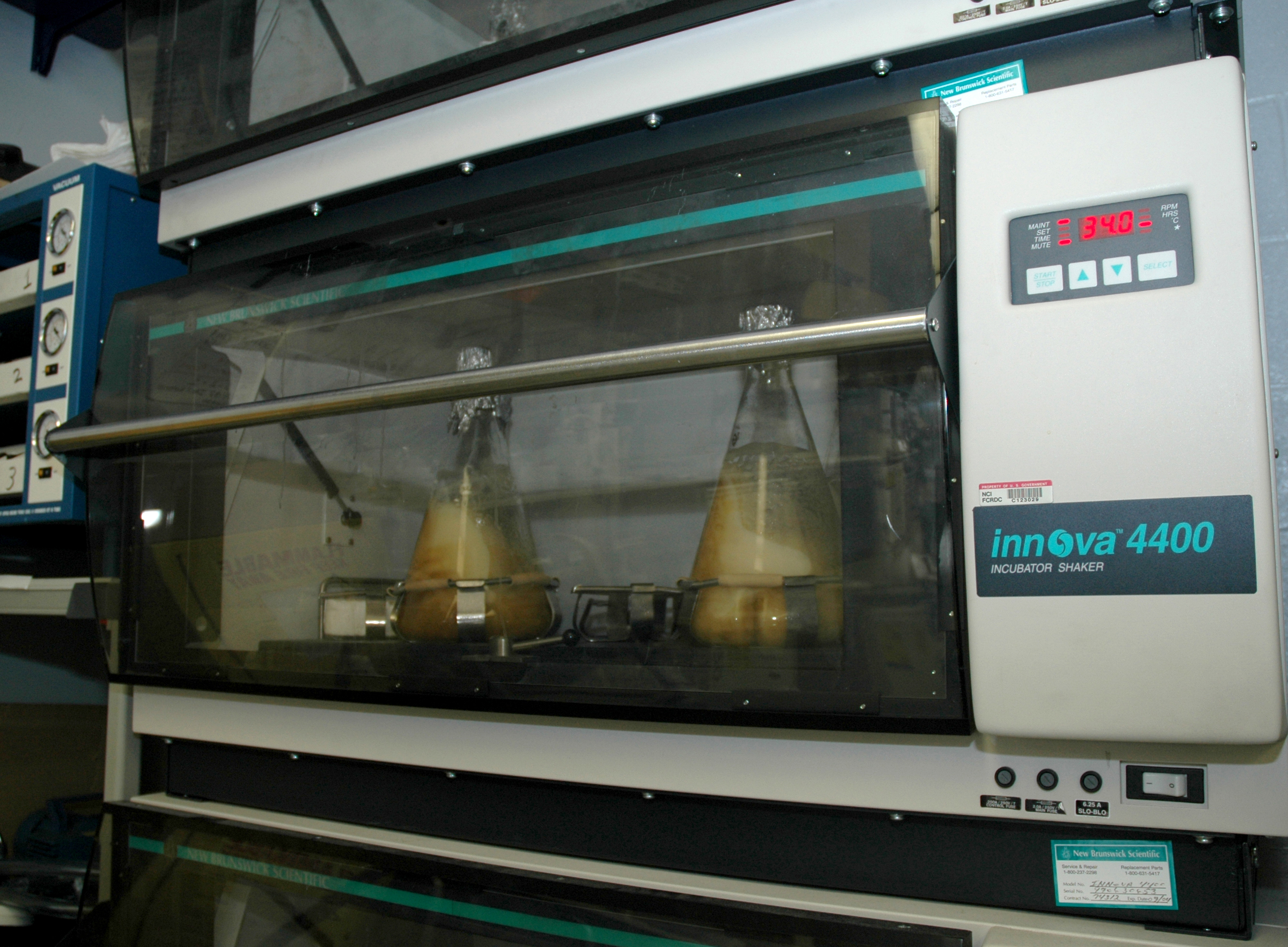 Early seed-train expansion: Erlenmeyer shake flasks of cell culture mounted on an orbital incubator shaker, whose gentle rotary motion keeps the cells suspended and well-aerated as they grow.
Culture flasks in an incubator shaker. Image by Diane A. Reid (National Cancer Institute), public domain, via Wikimedia Commons.
Early seed-train expansion: Erlenmeyer shake flasks of cell culture mounted on an orbital incubator shaker, whose gentle rotary motion keeps the cells suspended and well-aerated as they grow.
Culture flasks in an incubator shaker. Image by Diane A. Reid (National Cancer Institute), public domain, via Wikimedia Commons.
Making a batch of medicine starts with thawing a single tiny frozen vial of cells. That vial holds far too few cells to fill a factory-sized tank, so we grow them step by step, moving the culture into bigger and bigger vessels until we have a small ocean of healthy cells. This staged growth is called the seed train.
Think of a sourdough starter. You begin with a spoonful in a small jar. You feed it, and once it is bubbly and full, you tip it into a bigger bowl and feed it again. You keep moving it to larger bowls until you have enough to bake many loaves. The seed train does the same thing with living cells — feed, grow, move up a size, repeat — until there are enough to fill the big tank. The difference is that every single transfer has to be done in a way that lets in not one stray speck of contamination.
What this chapter covers
We will follow one frozen vial from the deep freezer all the way to the door of the production bioreactor. You will see how few cells we actually start with, how they are coaxed up through shake flasks, rocking bags, and stainless seed tanks, and roughly how long each rung of the ladder takes. We will look closely at the two things that can quietly ruin everything — microbial contamination and "passage drift" — and at the tests, cleanrooms, and named equipment that industry uses to keep them at bay. Finally, we will see how a modern perfusion seed train packs far more cells into the same time.
What actually happens
The cells we use are usually CHO cells (Chinese hamster ovary cells) — the tiny living factories engineered earlier to make our monoclonal antibody (mAb), the protein medicine. They have been frozen in a Working Cell Bank (WCB): a liquid-nitrogen freezer full of hundreds of identical backup vials, each one a faithful copy of the same characterized cell line built during cell-line development. One vial starts one campaign.
From vial to viability: the thaw, then scaling by doubling
That starting vial is genuinely tiny. A typical WCB vial holds only 1–2 mL of cell suspension at roughly 10–20 million cells per mL (1–2×10⁷, since ×10⁷ means ten million; high-density banks freeze far higher still), so the whole vial contains on the order of 10–40 million cells — a volume smaller than a sip of water, suspended in dimethyl sulfoxide (DMSO), the usual cryoprotectant, which keeps ice crystals from shredding the cells while frozen. From that sip, the seed train must build the tens of billions of cells needed to fill a production tank.
The seed train usually goes like this:
- Thaw one vial. A scientist lifts a single frozen vial from the WCB and warms it rapidly — typically a 37 °C water bath or dry warmer for roughly 1–2 minutes, just until the ice melts. Speed matters in both directions: a slow thaw lets damaging ice re-form, but leaving the cells sitting in DMSO at room temperature too long is itself toxic, so the thawed cells are promptly diluted into warm, nutrient-rich liquid — the culture medium — to wash the DMSO away, and a sample is checked under a microscope. Industry usually wants post-thaw viability above about 85% (viability being the percentage of cells that are still alive) before the train continues; a sickly thaw is the first thing that derails a campaign.
- Shake flasks. The cells go into a small flask — often a 125 mL or 500 mL Corning disposable vented bottle with, say, 30–100 mL of working volume — kept on an orbital shaker inside a warm, humidified incubator (typically 37 °C with controlled carbon-dioxide to hold the pH — the measure of how acidic or alkaline the liquid is — steady; carbon dioxide dissolves in the medium to form a mild acid, so the incubator's CO₂ level is tuned to keep the culture in the cells' preferred near-neutral range). The gentle rotary swirl keeps the cells suspended and well-aerated. There they divide and double.
- Move up a size (passaging). Once the medium is crowded with cells, the culture is split into a larger vessel with fresh medium. This transfer is called passaging. The split is not arbitrary: each stage is seeded to a minimum density of about 0.2–0.5 million cells per mL, grown to a few million per mL, then transferred at roughly a 5–10× volume step — and that ratio, repeated, is what sets how many rungs a train needs from vial to the last seed stage (the N-1, defined in step 6 below). Each passage gives the cells more room and more food, and the team carefully records the passage number every time — for a reason we will come to.
- Wave bag bioreactor. Next the culture often moves into a rocking "wave" bag — a sealed, pre-sterilized single-use plastic bag, such as a Cytiva (formerly GE Healthcare) WAVE rocking bioreactor or a Pall Allegro XRS rocking-bag system, holding a few liters. Instead of a stirrer, the whole platform rocks back and forth, so a wave breaks across the liquid surface and folds in oxygen without the harsh shear of an impeller — shear being the tearing fluid force a fast-spinning blade puts on the fragile cells, which (unlike bacteria or plant cells) have no protective cell wall, so a gentle rocking wave is kinder to them than a stirrer. Single-use bags also mean no giant tank to clean and re-sterilize between batches.
- Seed bioreactors. Then come one or more seed bioreactors — bench- and pilot-scale stirred tanks (for example Eppendorf / New Brunswick or Applikon systems, often running 2 L up to 10–20 L), each bigger than the last. The shift from flasks and wave bags to sparged, stirred tanks is driven by oxygen: surface aeration alone suffices at low density and volume, but as cell density and working volume climb, surface gas exchange can no longer meet the culture's oxygen demand, so the process moves to actively sparged (gas bubbled up through the liquid via a submerged sparger to deliver oxygen), agitated tanks. These tanks actively control temperature, dissolved oxygen, and pH with probes and feedback loops, so the cells stay in their comfort zone and keep multiplying densely.
- Inoculate the production reactor. When the final seed culture is dense enough, it is used to inoculate — to seed — the big production bioreactor (the main event), where the medicine is actually made in bulk. The last seed stage before production is often called the N-1 reactor, because it is one step below (N minus one) the production "N" tank.
Throughout all of this, every transfer must be aseptic — done so that no stray microbe gets in. Connections are made inside a sterile space, through sealed single-use tubing, or with sterile tube welders that fuse two lines together without ever opening them to room air.
 The seed train physically progresses from a 1–2 mL frozen vial (WCB) through shake flasks (125–500 mL), wave bioreactors (2–5 L), and seed bioreactors (10–20 L) over 4–7 days in fed-batch mode. Each step maintains aseptic conditions and controlled parameters (temperature, pH, dissolved oxygen) to protect cell viability and purity.
Original diagram by the authors, created with AI assistance.
The seed train physically progresses from a 1–2 mL frozen vial (WCB) through shake flasks (125–500 mL), wave bioreactors (2–5 L), and seed bioreactors (10–20 L) over 4–7 days in fed-batch mode. Each step maintains aseptic conditions and controlled parameters (temperature, pH, dissolved oxygen) to protect cell viability and purity.
Original diagram by the authors, created with AI assistance.

How long it takes, and how fast the cells grow
A common shorthand is that "CHO cells double roughly every day." That is close, but the honest number is a range: in a healthy fed-batch seed culture, CHO cells typically double every 20–30 hours, depending on the clone, the medium, and the temperature; a well-fed perfusion culture can push that toward 18–24 hours. Doubling time also is not constant — cells lag for a day or so right after thaw, then speed up, then slow again as the medium crowds.
Because each rung roughly multiplies the cell count, a fed-batch seed train typically takes about 4–7 days from thaw to a dense N-1 culture of 5–10 million cells per mL (fed-batch means nutrients are topped up but nothing is removed, so the culture fills and is then harvested).
Note that this is the N-1 culture density, not the density inside the production tank at the instant of seeding: for a standard fed-batch the N-1 culture is diluted into the big tank to a production seeding density of roughly 0.3–1 million cells per mL; only intensified, high-inoculum processes seed the production tank at several million per mL. To put the climb in numbers: turning the 10–40 million cells in one vial into the tens-to-hundreds of billions in a dense N-1 culture is about 11–12 doublings (the production tank is then seeded by diluting this culture, and the cells finish multiplying inside it) — and because the whole population doubles in parallel each ~24 h (not one cell at a time, and starting from tens of millions of cells already), those 11–12 doublings unfold across just 4–7 calendar days, which is why 4–7 days is the floor. (A perfusion seed train, which we will meet below, runs longer — often 10–14 days — but ends far denser.)
The N-1 stage: achieving inoculum density
The last seed bioreactor — the N-1 — has one job: hand the production tank a culture that is dense enough, healthy enough, and at the right stage of growth to take off immediately. Drop too few cells into a 2,000 L tank and they sit in a long lag, exposed and slow; arrive at the right viable cell density (VCD) and the production reactor starts fast and productive. So before the seed is ever pumped across, an operator pulls a sample and measures it against a set of release gates — typically a viability of 90–95% or higher, a target VCD for transfer, and, crucially, a growth-phase check that the cells are still in exponential (not stationary) growth — that is, still actively dividing and multiplying fast, rather than having plateaued as the medium crowds — judged from the recent doubling-time or VCD trend rather than a single point. Cells handed over while still dividing hit the ground running in the next tank, which is why exponential growth is the state you want at the moment of transfer. Those gates are paired with the production tank's seeding-density spec, so a passing N-1 culture is one that can be diluted to the right inoculation density and take off immediately. That gate stands between the seed train and the production bioreactor.
That gating measurement is also where the seed train's physical artifact — a flask of living cells — first becomes a data artifact. The number an operator writes down is never just "8.4." It is wrapped in an identity: which seed vessel, which campaign, what passage, how old the culture is, and exactly when the sample was drawn. The next subsection unpacks that record.
Anatomy of an N-1 inoculum measurement
When the N-1 sample is read, the result is recorded as a small structured record — an identity card, not a bare number. It pins the viable cell density and viability, the passage number (so the culture is provably inside its qualified window), the culture age in hours since thaw (which fixes where the sample sits on the growth curve), and the sampling timestamp. Crucially, it also carries the batch-genealogy links that tie this seed back to the exact WCB vial it came from and forward to the production batch it will inoculate.
 One N-1 release measurement is a structured record: density and viability and passage and age are judged together against an inoculation target, e-signed, and linked both backward to the source WCB vial and forward to the production batch it seeds.
Original diagram by the authors, created with AI assistance.
One N-1 release measurement is a structured record: density and viability and passage and age are judged together against an inoculation target, e-signed, and linked both backward to the source WCB vial and forward to the production batch it seeds.
Original diagram by the authors, created with AI assistance.
This is the seed train's first hand-off into the data world. The companion data volume follows exactly this point — where a data point is born at the moment of measurement, how that single field joins the batch's growing data shadow (the complete digital twin of records a physical lot leaves behind), and the full lifecycle of that data point as it is reviewed, released, and archived. The open-source volume then shows the concrete code and schema for a seed-train offline sample — the actual table row that stores this VCD, viability, and genealogy link.
Those genealogy links are worth naming carefully, because they are not just text on a form. Seed inoculates production batch, culture derived-from WCB vial, N-1 is-a seed bioreactor — each is a typed relationship, a labelled link of a known kind between two named things, rather than a loose note. Recorded that way, the chain of lots becomes a graph a computer can walk and query — "show me every batch descended from this vial" — instead of a folder a person must leaf through. The ontology volume formalizes exactly these labelled edges and the genealogy spine they form in relations and genealogy, and the way each thing here is sorted into a kind — a vial is-a cell-bank container, an N-1 is-a seed bioreactor — in classes and taxonomy.
And because the release gate above turns on a growth-phase judgement read from a VCD trend — not a single fixed threshold — it is a natural home for a soft sensor: a model that infers a hard-to-measure quantity from easy ones, here predicting viable cell density or flagging a contamination risk from the routine probe traces, so the N-1 call leans on a trend rather than one noisy reading. Building, validating, and running such a model is the subject of the ML volume's own seed-train chapter, with the general method in models and validation.
Why it matters
The seed train builds the biomass — the total mass of living cells — that the rest of the process depends on. Skip a step, and the jump in size is too big: a thin scatter of cells dropped into a huge tank grows too slowly, drifts out of its healthy range, and the batch stalls before it ever makes much antibody.
Contamination: the silent killer (bacteria vs CHO growth rates)
The biggest danger, though, is contamination, and it is worth doing the arithmetic to feel why. Bacteria grow far faster than CHO cells. Many common laboratory and environmental contaminants — fast-growing Gram-positive cocci, Bacillus species, E. coli under ideal aerobic conditions — can double in roughly 20 minutes, while our CHO cells take the better part of a day. Real-world contaminants in a cleanroom rarely hit that textbook 20-minute pace, but even at a relaxed once-an-hour, the gap is enormous. As a rough illustration: if a single bacterium slips into a culture and doubles every 20 minutes, in 48 hours it would in principle out-number the CHO cells many thousands of times over — the medium would turn cloudy and acidic long before that, the pH and oxygen sensors would swing, and the culture would be poisoned. One unnoticed microbe can therefore overwhelm and ruin an entire seed culture in a day or two.
That is why aseptic technique and sterility are treated as sacred. A spoiled seed train means days of work and a vial of irreplaceable cells thrown away — and, far worse, if a contaminant slipped through undetected, an unsafe medicine moving downstream. Healthy, clean, fast-growing cells here set up everything that follows.
Passage number and genetic stability: why it matters, how it is tracked
There is a second, quieter risk: passage drift. CHO cell lines are not perfectly stable. Every time the cells divide, there is a tiny chance of a genetic or epigenetic change, and over many generations these can accumulate until the population subtly shifts — sometimes making less antibody (lower titer, the concentration of product in the broth) or a slightly altered product. For that reason most CHO lines are kept within a validated window, commonly on the order of 30–50 passages end to end — but that range is a rule of thumb, not a law: the actual in-use limit is fixed per product by a cell-line stability and limit-of-in-vitro-cell-age study (in vitro meaning in the lab vessel, outside a living organism) under ICH Q5D and Q5B, and can land lower or higher. The passage number is tracked at every transfer so a culture is never grown past its qualified limit [7]. This is one more reason the WCB matters: each new campaign starts fresh from a low-passage frozen vial, so drift never gets a chance to creep across batches.
In the real world
Behind the friendly shake flasks sits a wall of standards, tests, and controlled rooms.
Aseptic discipline: cleanrooms, sterility, mycoplasma
Where the work happens. Seed-train operations are carried out in classified cleanrooms — typically ISO 7 or ISO 8 air-cleanliness grades — under BSL-1 or BSL-2 biosafety conditions depending on the cell line and any agents used. The two scales run in opposite directions, which is easy to misread:
| Grade | Scale | What it means |
|---|---|---|
| ISO 7 | air cleanliness | cleaner — fewer airborne particles allowed (the lower the ISO number, the cleaner the air; the fill-finish suite is cleaner still, at ISO 5) |
| ISO 8 | air cleanliness | clean, but more particles allowed than ISO 7 |
| BSL-1 | biosafety | lowest containment — the agent poses minimal risk |
| BSL-2 | biosafety | one step up — a moderate-risk agent handled with extra containment (the higher the BSL number, the more hazardous the organism and the tighter the containment) |
| The rooms are monitored every working day: operators take active and passive air samples (active = a pump draws a measured volume of air through a sampler; passive = a culture plate is left open to catch whatever settles out of the air), surface swabs, and particle counts to prove the environment stayed clean, following the principles laid out in USP — the United States Pharmacopeia, the official U.S. compendium of drug-quality standards — general chapter <1116> and the FDA's aseptic-processing guidance for sterile drug products produced by aseptic processing [2]. All of this is documented in the batch record, the controlled, traceable account of every step, in line with the cGMP — current Good Manufacturing Practice, the legally binding rules that guarantee every batch is made the same safe way — recordkeeping requirements of 21 CFR Part 211, Subpart J — part of the Code of Federal Regulations, the FDA's legally binding U.S. rules [3]. |
What the cells must pass before they are trusted. The WCB itself is not used until it has been thoroughly characterized. Under ICH Q5D — a guideline from the International Council for Harmonisation, the body that aligns drug rules across the US, EU and Japan — the international guideline on cell substrates, a cell bank is screened for identity, purity, sterility, mycoplasma, and adventitious (unwanted, accidental) viral agents before it is released to make product [1]. The tests are real and slow, which shapes the whole schedule:
- Sterility testing follows the 14-day method of USP <71>, growing any stray microbe in nutrient broth for two weeks before the culture can be called sterile [5].
- Mycoplasma testing uses the culture and indicator-cell methods of USP <63> (a modern PCR screen can give a preliminary answer in 1–3 days, while the full compendial (official pharmacopeia-specified) culture method takes weeks) [4].
- Endotoxin (a fever-causing toxin shed from the outer wall of certain bacteria, harmful to patients even after the bacteria themselves are killed) and post-thaw viability (that >85% threshold) round out the in-process checks.
Mycoplasma deserves special fear. These are the smallest free-living bacteria, they have no cell wall (so they slip through some sterilizing filters and shrug off many antibiotics), and they cause no cloudiness — a contaminated culture can look perfectly healthy while the mycoplasma quietly distorts the cells' behavior and product. A foundational review by Drexler and Uphoff catalogued just how common and how invisible mycoplasma contamination of cell cultures can be, which is exactly why dedicated, sensitive testing is mandatory rather than relying on the eye [6]. Because the gold-standard sterility result lags 14 days behind a culture that may move in 5, manufacturers manage the gap with rapid in-process methods (PCR, Gram stains on samples), a clean history of prior lots, and full release testing of the cell bank before any of its vials are ever thawed.
The modern path: perfusion seed trains and cell-retention
The modern, intensified path. In a standard commercial process, the seed train ends by filling one large stainless-steel or single-use production bioreactor for a fed-batch run, and fed-batch still makes the great majority of approved mAbs today. But the emerging direction is intensification. In continuous and intensified processing, the N-1 seed stage is run in perfusion — fresh medium flows in continuously while spent medium is drawn off through a cell-retention device, so waste never piles up and the cells keep dividing to extraordinary density. Systems built for this include Sartorius ambr perfusion mini-bioreactors for development and benchtop perfusion vessels using acoustic or filter-based cell retention — a filter whose pores let the spent liquid pass out while holding the larger cells back inside the vessel — most commonly alternating tangential flow (ATF) or tangential flow filtration (TFF) modules, where the culture is swept along the filter surface so the cells stay behind while clarified spent medium permeates through. With waste continuously removed, these intensified seeds can reach cell densities of 50–100 million cells per mL, several-fold higher than the 5–10 million typical of a fed-batch seed. A real industrial case from Pohlscheidt and colleagues ran N-1 perfusion at the 3,000 L scale specifically to push inoculation density high enough that the production tank starts fuller and reaches harvest faster [8]. A denser seed lets the production reactor start ahead, run more productively, and squeeze more medicine out of a smaller footprint.
 Fed-batch peaks near 5–10 million cells per mL in 4–7 days with repeated passages, while a perfusion N-1 runs longer and climbs past 20 million cells per mL because cell retention keeps dividing cells in the vessel as spent medium is drawn off; viability stays high in both.
Original diagram by the authors, created with AI assistance.
Fed-batch peaks near 5–10 million cells per mL in 4–7 days with repeated passages, while a perfusion N-1 runs longer and climbs past 20 million cells per mL because cell retention keeps dividing cells in the vessel as spent medium is drawn off; viability stays high in both.
Original diagram by the authors, created with AI assistance.
When the seed train fails: contamination, drift, and the data-integrity gap
When a seed train goes wrong, it usually fails in one of three big ways — and all three expose how much the process leans on trustworthy records rather than the naked eye. (The everyday deviations a process engineer fights are quieter still: poor post-thaw recovery and a long lag from a bad freeze or sluggish thaw; cell clumping in suspension, fought with anti-clumping agents and Pluronic F-68 (a surfactant additive that shields cells from the same shear force) for shear protection; and pH or osmolality (the concentration of dissolved salts and nutrients, which sets how water moves in and out of the cells) drift from the wrong incubator carbon-dioxide setpoint or mis-prepared medium.)
The first is frank contamination. A fast-growing bacterium betrays itself within a day — cloudy broth, a crashing pH, swinging dissolved-oxygen sensors — and the lot is scrapped. Painful, but at least it is visible. The second, and far more insidious, is mycoplasma. Because these wall-less bacteria leave the culture looking perfectly healthy while quietly distorting the cells' metabolism and product, a contaminated seed can sail straight into a production tank if testing is skipped or misread — exactly the common, cross-contaminating, invisible failure the Drexler and Uphoff review catalogs (see above) [6].
The third failure is the quiet structural one: a data-integrity gap in how the seed train is tracked. Two of the train's most important facts — the passage number and the culture age — are easy to record by hand and easy to get subtly wrong. If passages are mis-counted across a long campaign, a culture can drift past its qualified window without anyone noticing until titer or product quality slips; this is exactly the CHO instability that the fickle CHO review documents [7]. And because the gold-standard sterility result lags the culture, the timing is brutal: ICH Q5D and the compendial USP <71> sterility method take 14 days to confirm a result for a culture that may have already moved into production after 5 [1] [5]. A seed train run on paper passage logs and handwritten timestamps therefore carries a structural risk — a transcription slip or a back-dated entry can hide a drifting or out-of-window culture. Regulators treat exactly this kind of recordkeeping weakness as a serious deficiency: a large share of cGMP warning letters cite documentation and data-integrity failures rather than the chemistry itself, which is why the 21 CFR Part 211, Subpart J recordkeeping rules apply with full force to every passage and every sample [3]. The remedy is not heroics but discipline plus tooling: rapid in-process methods (PCR, Gram stains) to close the 14-day gap, full release testing of the cell bank before any vial is thawed, and contemporaneous, attributable, tamper-evident records of every passage and measurement — the same ALCOA principles — that every record be Attributable, Legible, Contemporaneous, Original, and Accurate — the data and open-source volumes build into the lifecycle of every data point. When the passage log and that N-1 release record go electronic — and today they do — they fall under 21 CFR Part 11, the FDA rule that makes an electronic record and the operator's electronic signature on the release decision legally trustworthy, complete with an audit trail of who changed what and when; and the software that holds them must itself be qualified, the risk-based CSV-to-CSA (Computer Software Assurance) shift the data book unpacks in validating computerized systems.
To recap the three: frank contamination is loud and caught in a day; mycoplasma is silent and caught only by deliberate testing; and the data-integrity gap is silent and caught only by disciplined, tamper-evident records. The seed train's real product is therefore not just a dense, healthy culture but a trustworthy record of that culture — which is exactly the hand-off the production bioreactor inherits next.
Key terms
- Seed train — the staged growth of cells from one thawed vial up to enough to fill the production reactor.
- Working Cell Bank (WCB) — the freezer stock of identical, characterized vials, one of which starts each batch.
- Passaging — transferring a crowded culture into a larger vessel with fresh medium; each transfer is counted as a passage.
- Wave bag bioreactor — a sealed single-use plastic bag that rocks to mix and oxygenate cells gently, without an impeller.
- Seed bioreactor — a controlled tank that grows the culture to the size needed before production; the last one is the N-1 reactor.
- Biomass — the total amount of living cells grown.
- Inoculate — to seed a fresh vessel with cells from the previous step.
- Aseptic — done so that no unwanted microbe can get in.
- Sterility — the state of being completely free of living microbes.
- Passage number — the running count of how many times a culture has been split; tracked to keep cells within their stable window.
- Viable cell density (VCD) — the number of living cells per millilitre; the key release measure for whether a seed is dense enough to inoculate.
- Culture age — the hours elapsed since the vial was thawed; fixes where a sample sits on the growth curve.
- Batch genealogy — the chain of links tracing a culture back to its source WCB vial and forward to the production batch it inoculates.
- Typed relationship — a labelled link of a known kind (inoculates, derived-from, is-a) between two named things, which lets the chain of lots be queried as a graph rather than read by hand.
- Soft sensor — a model that infers a hard-to-measure quantity (such as viable cell density or contamination risk) from easy-to-measure signals like routine probe traces.
- Titer — the concentration of antibody product in the culture broth.
- Perfusion — continuously feeding fresh medium and removing spent medium while retaining cells, allowing very high cell densities.
- N-1 reactor — the seed bioreactor one step below the production tank, used to make the final dense inoculum.
- cGMP (current Good Manufacturing Practice) — the legally binding rules requiring controlled, documented, traceable conditions for every step.
- Mycoplasma — the smallest wall-less bacteria; a stealthy contaminant that leaves cultures looking healthy, so it must be tested for specifically.
- Cleanroom (ISO 7 / ISO 8) — a room with strictly controlled, monitored air cleanliness where aseptic work is performed; the lower the ISO number, the cleaner the air (so ISO 7 is cleaner than ISO 8).
- Biosafety level (BSL-1 / BSL-2) — a containment rating for the organism being handled; the higher the number, the more hazardous the agent and the tighter the containment required.
Where this leads
The seed train ends the moment that final, dense seed culture is pumped into the big tank. In the next chapter, the production bioreactor, we step inside that main event — the giant controlled tank where the patiently grown cells finally do their real job and pour out the antibody medicine in bulk.