It starts with a target
📍 Where we are: Stop 4 of 21 · Discovery & Development begins — before any cell or factory, we choose what the medicine should attack and write down exactly what it must do.
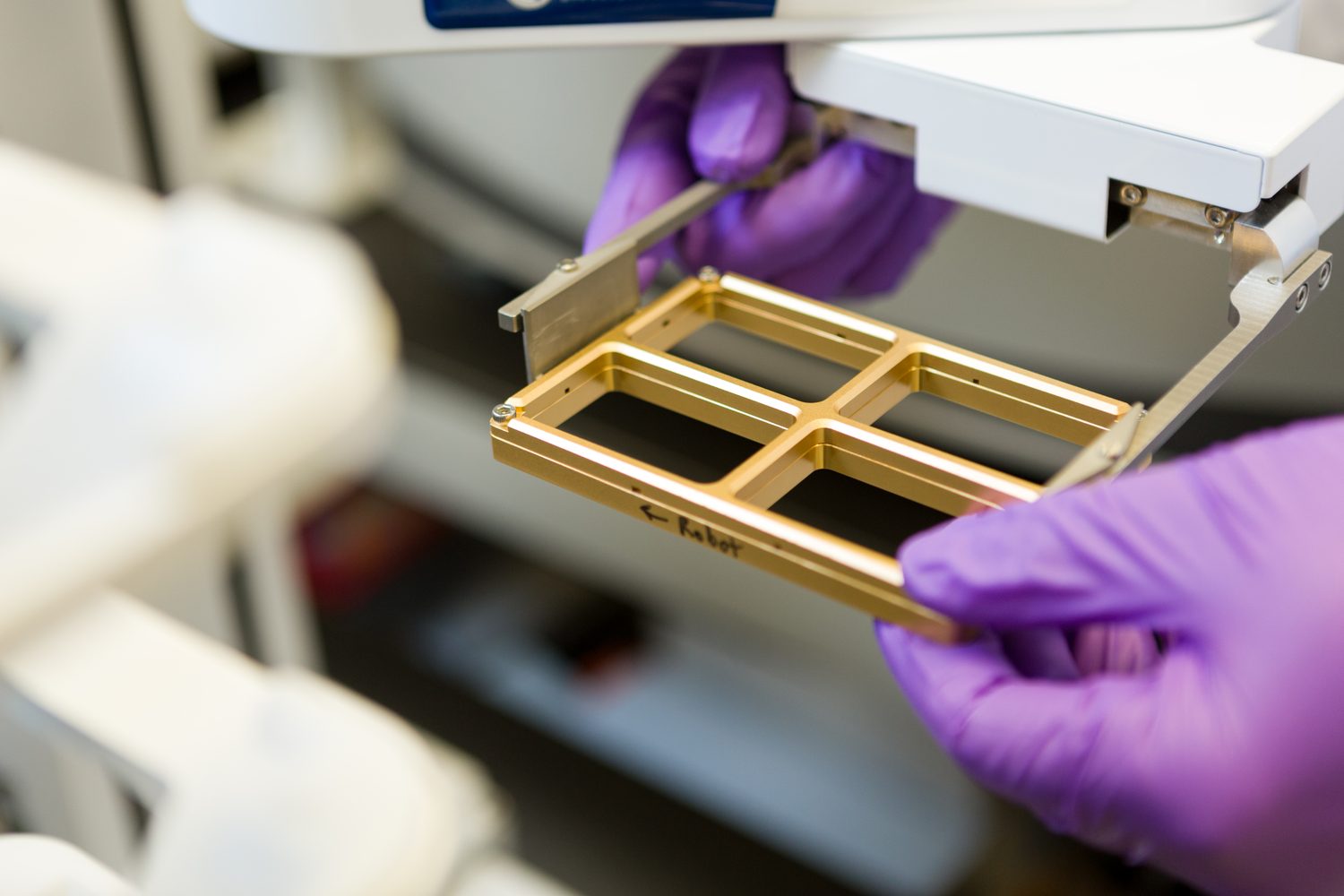 Automated screening equipment in a drug-discovery laboratory. Long before any factory runs, work like this decides what the medicine must do — the target it grabs and the product concept built around it.
Automated drug-screening equipment. Image by the National Center for Advancing Translational Sciences, public domain, via Wikimedia Commons.
Automated screening equipment in a drug-discovery laboratory. Long before any factory runs, work like this decides what the medicine must do — the target it grabs and the product concept built around it.
Automated drug-screening equipment. Image by the National Center for Advancing Translational Sciences, public domain, via Wikimedia Commons.
Every biologic medicine begins long before a single cell is grown. It begins with a disease and a question: what, exactly, is going wrong inside the body, and what could we grab onto to fix it? That "something to grab onto" is called the target.
Think of building a house. Nobody pours concrete on day one. First an architect draws a blueprint, and everyone agrees on it: how many rooms, where the door goes, what it is for. Only then do builders start. In medicine, choosing the target and writing the wish-list for the drug is that blueprint. Get the blueprint wrong, and the most beautiful house is still the wrong house.
What this chapter covers
This is the chapter where a medicine is first imagined on paper. We'll walk three decisions that happen before any antibody exists: finding a target (the molecule in the body to aim at), validating it (proving that hitting it actually helps), and writing the Target Product Profile (TPP) — the official wish-list that fixes the dose, the route, the shelf life, and the quality bar. We'll ground each step in real antibodies you may have heard of, real timelines and costs, and the named lab tools that find targets. Then we'll show the most important idea in the whole guide: that this paper wish-list quietly decides how big the bioreactors must be, how the antibody is purified, and how it travels to a patient. Everything in the rest of the book is, in a sense, the factory built to satisfy the profile written here.
What actually happens
A biologic is a medicine made from living cells — usually a protein (a tiny biological machine the body builds from instructions in your genes, the coded recipes stored in your DNA that tell cells which proteins to make). The most common kind is a monoclonal antibody (mAb): a Y-shaped protein designed to stick to one specific thing, and one thing only. To design it, scientists first decide what it should stick to.
The three decisions: target ID, validation, TPP writing
- Target identification. Researchers study a disease and look for a target — usually a specific protein in the body that drives the disease. The classic example is breast cancer: in 1987 a landmark study showed that a protein called HER2 is over-produced in a fraction of aggressive breast tumors and that this excess tracks with worse survival, marking HER2 as both a cause of the disease and a thing worth aiming at [1]. That insight became trastuzumab (Herceptin), an antibody that latches onto HER2. A second famous example is TNF-alpha, an inflammation-signaling protein that runs out of control in rheumatoid arthritis; the antibody infliximab (Remicade) was built to mop it up. Find the protein doing the damage, and you have found something to aim at — and the field publishes a running scoreboard of which targets and antibodies are advancing each year, so newcomers can see what is working [3].
- Target validation. Finding a suspect is not the same as proving guilt. Validation means showing that hitting this target actually helps — that blocking the protein slows the tumor or calms the inflammation, and does not break something the body needs. This is a structured, evidence-building exercise, not a hunch: published frameworks lay out how to weigh the genetic evidence, the druggability, and the safety of a target before a company commits real money to it [2]. In practice, preclinical validation often runs on the order of a few years and costs in the low single-digit millions per serious candidate (an illustrative ballpark — the real timeline and cost vary enormously by program), because the team must test the idea in cell assays, in mouse xenograft models (human tumors grown in mice), and with target-engagement biomarkers that prove the drug is reaching and binding the target. Get this wrong, and the failure surfaces years later in a clinical trial that costs a thousand times more.
- Writing the Target Product Profile (TPP). With a validated target, the team writes a Target Product Profile (TPP) — the official wish-list, or "spec sheet," for the future drug. This is not an informal note; it is a recognized regulatory planning tool. The U.S. FDA describes the TPP explicitly as a strategic document that states the intended indication, population, dose, route, and labeling goals up front and then guides the entire development program [4]. Its quality-focused twin, the Quality Target Product Profile (QTPP), is defined in international guidance (ICH Q8(R2) — guidance from the International Council for Harmonisation, the body that aligns drug rules across the US, EU, and Japan) as the starting point from which a product's critical quality attributes and manufacturing design space are derived [5]. In other words, the profile is agreed up front by design, and it guides every decision for years.
How do teams find and rank targets in the first place? Modern target identification leans on a toolbox of proteomics and systems-biology methods: SILAC and TMT mass spectrometry (mass spectrometry weighs molecules to identify and count them; these two methods measure how much of each protein a diseased cell makes), RNA-seq (which reads which genes are switched on), and CRISPR screens (which switch genes off one by one to see which ones the disease needs). The flood of measurements these methods produce is exactly where machine-learning models now help rank candidate targets rather than eyeball them one at a time; how an ML model prioritizes targets and indications at this concept stage — and where drug-discovery AI ends and manufacturing concern begins — is the subject of the ML book's companion chapter, target and concept, learned. Candidates are cross-checked against public knowledge bases — UniProt for protein facts, DrugBank for what has already been drugged, BioGRID and pathway maps like KEGG and Reactome for how proteins wire together. The shortlist of "watch" antibodies and their targets each year is itself tracked in the literature — the running scoreboard noted above [3]. Notice that even these informal cross-references already form typed relationships — "this antibody targets that protein," "this protein participates in that pathway." When a plant later writes its records down formally, those phrases become named ontology edges that let a computer follow the lineage from target to molecule to batch; the ontology book makes the relationships and the is-a hierarchies explicit in relations and genealogy and classes and taxonomy.
Anatomy of a TPP: the wish-list as a layered spec
The TPP then turns the chosen target into concrete, numeric promises:
- Which disease and which patients? (Children? Adults? People who tried other drugs first?)
- How is it given? Dripped slowly into a vein in a clinic (an IV infusion), or a quick shot under the skin at home (a subcutaneous injection)? This single choice drives the concentration the formulation (the final liquid recipe the antibody is dissolved and stabilized in for injection) must reach. An IV bag can run dilute (roughly 1–25 mg/mL), but a subcutaneous shot can hold only about 1–2 mL by manual injection. To fit a full dose into that small volume, the antibody must reach 50–150 mg/mL — a much harder formulation problem. Here the wall is not just clumping but solution viscosity, which rises steeply above ~100 mg/mL and can exceed the practical injectability limit and clog the needle. Larger subcutaneous volumes are enabled by co-formulating with recombinant human hyaluronidase (rHuPH20), which transiently loosens the tissue under the skin to admit a bigger bolus.
- How often, and what dose? Once a week? Once a month? A higher or more frequent dose means more grams of antibody per patient per year, which ripples straight into how much the factory must make.
- How tightly must it bind, and how safe must it be? A TPP names a target binding affinity (often a dissociation constant, Kd, around 0.1–10 nM for a good therapeutic antibody) and an acceptable immunogenicity risk — the patient's own body naturally makes antibodies of its own, and it can make them against the drug (these are called anti-drug antibodies, or ADAs), so a TPP keeps ADA prevalence below roughly 5–10% so patients' immune systems don't neutralize the medicine. The "quality bar" also fixes concrete critical quality attributes (CQAs) the product must meet — the few measurable properties the product must hit at release, each with its own standard lab test:
| Quality attribute | What it is | Measured by | Typical target |
|---|---|---|---|
| Aggregate | antibody molecules clumped together into larger "high-molecular-weight" species | SEC (size-exclusion chromatography) | under ~5% |
| Host-cell protein (HCP) | leftover protein from the production cells | ELISA (an antibody-based detection test) | parts-per-million range |
| Residual host-cell DNA | leftover DNA from the production cells | qPCR (quantitative PCR) | nanograms per dose |
| Charge variants | slightly more-acidic or more-basic forms of the antibody | icIEF (imaged capillary isoelectric focusing) | controlled distribution |
| Glycan profile | the sugar chains attached to the antibody; low fucose ("afucosylation") makes the antibody better at recruiting immune cells to kill its target — it raises ADCC (antibody-dependent cell-mediated cytotoxicity) potency | HILIC-HPLC of released glycans | defined profile |
Each row of this table is not just a number on a page — it is a measurement waiting to be made. When the SEC, ELISA, or qPCR result above is recorded years later on a real batch, it becomes a time-stamped, traceable data point in that batch's data shadow (the digital record that grows alongside the physical product). How such a point is born and where it lives is the subject of the data book's where data is born and the data shadow; in an open-source plant it lands as a concrete row keyed to its batch and equipment, sketched in the reference architecture.
- How long must it stay good, and how cold? Its shelf life and storage: commonly 2–3 years at 2–8 °C (ordinary refrigeration), though some products are engineered to sit at room temperature or are freeze-dried (lyophilized) to last longer.
The figure below shows the TPP as exactly this kind of layered wish-list, with each row of the spec sheet pointing forward into a manufacturing consequence.
 The Target Product Profile (TPP) is a comprehensive wish-list that documents disease indication, patient demographics, dose and route, shelf-life and storage conditions, and quality/potency targets. Every parameter in the TPP cascades into manufacturing choices downstream.
Original diagram by the authors, created with AI assistance.
The Target Product Profile (TPP) is a comprehensive wish-list that documents disease indication, patient demographics, dose and route, shelf-life and storage conditions, and quality/potency targets. Every parameter in the TPP cascades into manufacturing choices downstream.
Original diagram by the authors, created with AI assistance.

Read more literally, the TPP is an identity card: a fixed set of rows, each holding one written promise and pointing at one manufacturing consequence. The card below lays the rows out as a spec sheet — indication, population, dose and route, concentration, the quality bar (binding affinity, immunogenicity, the release tests), and shelf life — so you can see at a glance how a single line of text on the left commits the factory on the right.
 The TPP read as an identity card: each row is a written promise, and the right-hand column is the manufacturing consequence it locks in — change any row and every consequence re-opens.
Original diagram by the authors, created with AI assistance.
The TPP read as an identity card: each row is a written promise, and the right-hand column is the manufacturing consequence it locks in — change any row and every consequence re-opens.
Original diagram by the authors, created with AI assistance.
Why it matters
How the TPP cascades: from paper to equipment
This is the most powerful step in the whole journey, precisely because it comes first. A clever antibody aimed at the wrong target is useless — like a perfectly built key for a lock that opens nothing. Years of work and a great deal of money can be lost chasing a target that turns out not to matter. Strong validation, done in the order the published frameworks recommend, is how teams avoid that heartbreak before it becomes a failed trial.
The TPP matters for patient safety and for everything downstream, and the link is mechanical, not poetic. Suppose the wish-list says "a shot patients give themselves at home." Now the antibody must be concentrated to 50–150 mg/mL to fit in a tiny volume, which makes it prone to clumping, so the purification train needs extra polishing steps (additional clean-up chromatography after the main capture step, to remove the clumps and other impurities the concentrated product carries) and the formulation needs more stability testing than a dilute IV product would. Flip the wish-list to "a low-dose weekly IV for a huge patient population," and the binding constraint disappears but a new one appears: the factory must now make an enormous mass of antibody, which pushes toward very large bioreactors. This is the dose-versus-scale trade-off at the heart of the whole plan. The arithmetic is worth running once: annual demand ≈ patients × dose × body weight × doses per year, so a 5 mg/kg dose given monthly to 100,000 patients of ~70 kg is about 5 × 70 × 12 × 100,000 ≈ 420 kg of antibody a year. Dividing that mass by a platform titer (the grams of antibody the cells produce per litre of culture — today a few grams per litre) times the recovery yield (the fraction of that antibody that survives purification, often around 70%) is what turns "a lot of protein" into a concrete number of bioreactor-litres, and thus into very large tanks. Decide it now, on paper, and the rest of the factory can be built to hit it. Discover it too late, and you may have to start over. The molecule that has to satisfy these numbers is engineered in the next chapter, Finding the antibody; the platform sized to make it is laid out in Designing the process.
These up-front promises also decide which tests the medicine will have to pass. Compendial standards — for example USP General Chapter <129>, the analytical procedures for recombinant therapeutic monoclonal antibodies — define the validated methods that measure an mAb's identity, purity, and potency [7]. The TPP's quality and potency targets are what tell the team which of those tests apply and how tight the acceptance limits must be. It is the same chain of logic that ICH Q8(R2) formalizes: the profile at the top cascades into the quality attributes, and the quality attributes cascade into the test methods and the manufacturing design space — the proven-safe ranges for things like pH, fill volume, and excipients (the inactive ingredients — buffers and stabilizers — mixed in alongside the antibody) that the process must live inside [5]. It helps to fix two terms here that recur throughout the book: a critical quality attribute (CQA) is a property of the product that must stay in range (aggregate percentage, glycan profile, charge variants), while a critical process parameter (CPP) is a process knob you turn — pH, dissolved oxygen, feed rate, temperature — to keep the CQAs in range. The CQAs and design space only sketched here are derived in operational detail in Designing the process.
In the real world
Dose-versus-scale: stainless vs single-use, fed-batch vs perfusion
The TPP quietly sets the ambition for the entire manufacturing plan, and it does so through real money and real equipment. A profile demanding very high doses, or huge numbers of patients, pushes a company to make a lot of protein. The standard answer today is large stainless-steel tanks run in fed-batch mode.
"Fed-batch" does not mean the cells are grown in many little batches. It means one single production run in which fresh nutrients are added on a schedule while the cells grow, and then the entire tank is harvested once at the end — the "batch" is the whole production cycle. Contrast this with perfusion, the continuous mode, where fresh medium flows in and product is drawn out steadily over weeks rather than waiting for a single harvest.
That fed-batch plus Protein A capture platform — Protein A being the resin that grabs antibodies in the first purification step — is the proven recipe behind most approved mAbs. Protein A works because it binds the conserved Fc region — the constant stem of the antibody's Y shape, nearly identical ("conserved") across IgG, the antibody class used for almost all mAb drugs — so because that stem is the same from one antibody to the next, a single resin and method serve almost any antibody — the source of "platform" economics. Its known pain points are exactly why the extra polishing steps exist: the low-pH elution — the acid wash used to release the antibody back off the resin — can drive aggregation (antibodies clumping together), and the resin's ligand (the Protein A molecule itself, attached to the beads) slowly leaches (sheds) into the product, so a downstream polishing train must clear both. The quality-by-design literature describes how a TPP's volume and dose projections drive these platform and scale choices [6].
The equipment choices are concrete, named, and expensive. The Protein A resin that defines the capture step comes from a handful of vendors — Cytiva, Repligen, and Purolite among them — and it costs thousands of dollars per liter, so a TPP that forces a large column is a real capital decision. The bioreactors come from suppliers like Pall, Eppendorf, and Getinge, and here the TPP shapes a strategic fork: a high-volume, long-lived product may justify fixed stainless-steel tanks (high up-front cost, long lead time, lowest cost per gram at scale), while an uncertain or lower-volume product favors single-use systems (flexible, faster to install, but higher cost per batch). The dose-and-volume numbers written in the profile are what tilt that decision one way or the other.
Whichever tank size the profile lands on, the process is not simply switched on at full scale. A recipe proven in small development reactors must be moved up to commercial vessels through scale-up and tech transfer — the disciplined hand-off in which the conditions that worked in the lab are reproduced, and demonstrated to still work, in the bigger tank. Before a commercial tank may make product for patients, the equipment itself is formally qualified in three stages — IQ/OQ/PQ (installation, operational, and performance qualification): proving it was installed correctly, runs as specified, and makes in-spec product run after run. The TPP's scale ambition is what sets how large that qualified line must be.
 One profile, two forks: the antibody mass a TPP demands tilts both the vessel (stainless versus single-use) and the production mode (fed-batch versus perfusion) before any equipment is bought.
Original diagram by the authors, created with AI assistance.
One profile, two forks: the antibody mass a TPP demands tilts both the vessel (stainless versus single-use) and the production mode (fed-batch versus perfusion) before any equipment is bought.
Original diagram by the authors, created with AI assistance.
All of this happens under cGMP — current Good Manufacturing Practice, the body of regulation (in the U.S., 21 CFR Part 211 — part of the Code of Federal Regulations — with parallel guidance from ICH and the European Medicines Agency, EMA) that requires every batch to be made safely, purely, and consistently. "Current" matters: the rules expect manufacturers to keep pace with evolving best practice, not just meet a frozen checklist. The TPP is where that quality ambition is first written down in measurable terms.
The route and stability lines of the TPP reach all the way to the loading dock. A subcutaneous product stored at 2–8 °C commits the company to a cold chain — refrigerated trucks, monitored warehouses, temperature loggers — which is widely cited as a large slice of a biologic's distribution cost, on the order of 15–20% of cost of goods (an illustrative ballpark, not a fixed figure). A team can spend more in development to engineer a room-temperature-stable or freeze-dried formulation — using stabilizers like polysorbate 80 and trehalose — and in exchange cut those field costs and reach hospitals without reliable refrigeration. That, too, is a TPP decision made years before the first patient.
Finally, the profile can point a product toward a different kind of factory altogether. A high-dose, large-market TPP is exactly the case where continuous, intensified manufacturing — perfusion bioreactors paired with multi-column continuous capture — becomes attractive, trading fixed-asset cost for a smaller footprint and higher productivity [8]. Fed-batch still dominates the antibodies on the market today, so the right way to hold this is: continuous is the rising direction, and a sufficiently ambitious TPP is one reason a team might choose to develop a product for it.
Real examples: Herceptin (HER2) and Remicade (TNF-alpha)
The two antibodies named at the top of this chapter show the cascade running in the real world. Trastuzumab (Herceptin) began as the HER2 insight of 1987 [1]: a profile aimed at HER2-positive breast cancer, dosed as an IV infusion, made at scale in stainless-steel fed-batch. Years later the same molecule was re-formulated for subcutaneous delivery — a deliberate route change that pushed the concentration far higher and added the spreading enzyme rHuPH20 (recombinant human hyaluronidase) so the larger volume could go under the skin. Infliximab (Remicade) followed the other branch: an anti-TNF-alpha antibody for chronic inflammatory disease, given as an IV infusion with a large, repeat-dose population behind it — exactly the high-mass profile that justifies big fed-batch tanks and a Protein A capture platform. Same logic, two different forks, both decided in the profile.
Failure modes: when the TPP changes mid-development
The cascade is powerful precisely because it runs one way: the profile at the top fixes everything below it. That is also its danger. If the TPP is rewritten mid-stream, every consequence it once locked in re-opens at once. The classic case is a dose-and-route change — moving from a high-dose IV infusion to a lower-dose subcutaneous injection late in development. On paper it is one edited line. In the factory it forces the formulation up from a dilute IV (roughly 1–25 mg/mL) to 50–150 mg/mL, which changes the polishing train, the buffer, the fill volume, the stability program, and the container — and, because the product and its specifications have moved, it triggers re-validation — here meaning proving all over again that the manufacturing process reliably makes in-spec product, a different sense from the target validation in step 2 — of the affected downstream platform rather than a quiet tweak.
Regulators treat exactly this kind of change as a formal, evidence-bearing event. The FDA's post-approval-change framework requires a manufacturer to assess and report how a change affects product quality before making it [9], and ICH Q12 builds the same expectation into the product lifecycle. The lesson for the TPP is blunt: a route or dose decision is cheap to write on day one and ruinously expensive to change on day one-thousand, which is why teams fight to get the profile right before any equipment is bought. The data trail that proves a change was assessed, justified, and approved is itself a regulated artifact, and it must be trustworthy by the same standards that govern any GMP record: the ALCOA+ principles (data must be Attributable, Legible, Contemporaneous, Original, and Accurate, plus complete, consistent, enduring, and available) and, for electronic records and signatures, 21 CFR Part 11. This guide keeps that data-integrity machinery in its own book — its lifecycle is traced in the lifecycle of a data point, and the move from old-style validation to risk-based computer software assurance (CSA) is the subject of from CSV to CSA.
Key terms
- Target — the specific thing in the body (usually a protein) that a drug is designed to act on.
- Target identification — finding the protein that drives a disease.
- Target validation — proving that hitting that target actually helps, with acceptable safety.
- Target Product Profile (TPP) — the agreed wish-list or spec sheet for the future drug: disease, patients, dose, route, shelf life, and quality targets.
- Quality Target Product Profile (QTPP) — the quality-focused twin of the TPP, defined in ICH Q8(R2); the starting point for a product's critical quality attributes and design space.
- Biologic — a medicine made by living cells, usually a protein.
- Monoclonal antibody (mAb) — a Y-shaped protein engineered to stick to one specific target.
- IV infusion — a drug given slowly into a vein. Subcutaneous injection — a shot given just under the skin.
- Binding affinity (Kd) — how tightly an antibody grips its target; for therapeutic mAbs often around 0.1–10 nM (smaller = tighter).
- Immunogenicity / anti-drug antibody (ADA) — the risk that a patient's immune system reacts to the medicine; TPPs aim to keep ADA prevalence low (often below ~5–10%).
- Fed-batch — one production run in which nutrients are fed on a schedule and the whole tank is harvested once at the end.
- Perfusion — the continuous mode where fresh medium flows in and product is drawn out steadily over weeks.
- Protein A — the resin used in the first capture step that grabs antibodies and clears most impurities in a single pass.
- cGMP (current Good Manufacturing Practice) — the regulations that keep every batch safe, pure, and consistent; "current" means keeping pace with best practice.
- Cold chain — the refrigerated logistics network that keeps a 2–8 °C product cold from factory to patient.
- Design space — the proven-safe ranges of process parameters within which the product stays consistent.
- Scale-up / tech transfer — moving a process proven in small development reactors up to large commercial vessels, and demonstrating it still makes the same product there.
- IQ/OQ/PQ — installation, operational, and performance qualification: the three formal stages that prove a piece of equipment was installed right, runs as specified, and makes in-spec product run after run before it may make product for patients.
- Data shadow — the growing digital record (measurements, results, decisions) that accompanies a physical batch; every release test in the TPP becomes a traceable point in it.
- ALCOA+ / 21 CFR Part 11 — the data-integrity standard for GMP records (Attributable, Legible, Contemporaneous, Original, Accurate, plus complete/consistent/enduring/available) and the rule governing electronic records and signatures.
- Dose-versus-scale trade-off — the choice the TPP forces between a binding-driven, concentrated formulation and a mass-driven, large-scale process; it tilts vessel type (stainless vs single-use) and mode (fed-batch vs perfusion).
- Post-approval change / re-validation — a change to an established profile (e.g. dose or route) that re-opens downstream choices and must be assessed, justified, and approved before it is made.
Where this leads
We now have a validated target and a Target Product Profile — a paper blueprint that already constrains the dose, the route, the purification, the storage, and even which factory might one day make the drug. But the antibody itself is still imaginary. The next chapter, Finding the antibody, is where that imaginary molecule becomes a real sequence: how scientists actually discover and engineer the specific antibody that will satisfy everything we just wrote down.