From the lab bench to the factory floor
📍 Where we are: Stop 9 of 21 — the recipe works in tiny flasks, and now we must make it work in giant tanks.
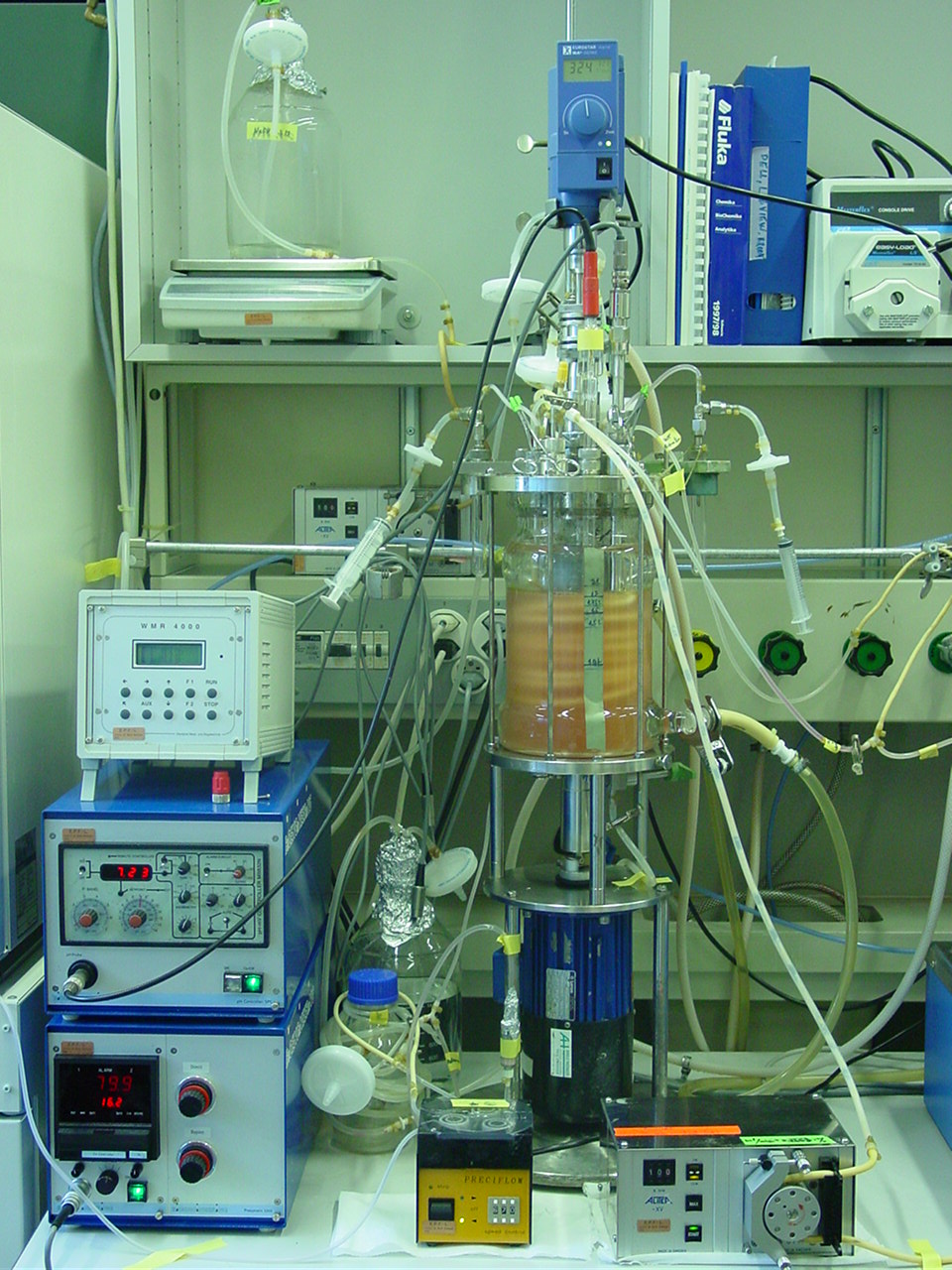 A recipe that works in a bench-scale bioreactor like this one must be re-engineered to run the same way in tanks hundreds of times larger. That translation is what scale-up and tech transfer are about.
Bench-scale bioreactor. Image by Jonas Schenk, public domain, via Wikimedia Commons.
A recipe that works in a bench-scale bioreactor like this one must be re-engineered to run the same way in tanks hundreds of times larger. That translation is what scale-up and tech transfer are about.
Bench-scale bioreactor. Image by Jonas Schenk, public domain, via Wikimedia Commons.
The scientists have a working recipe. They can grow the factory cells and make the antibody in small glass flasks. But a flask holds about 250 mL — less than a soda can. To make medicine for thousands of patients, we need tanks the size of a small car. Getting the recipe from tiny to huge is called scale-up, and handing it off to the factory is called tech transfer.
Imagine your grandmother's cookie recipe. It is perfect when she bakes one tray in her kitchen. Now a factory wants to make one million cookies a day, all tasting exactly like hers. You cannot just multiply every number by a million and hope. A giant oven heats differently. A huge mixer stirs differently. You have to re-engineer the whole recipe for the big machines — and write it down so precisely that a stranger in another city bakes the identical cookie.
What this chapter covers
This chapter walks through the two halves of getting a medicine out of the lab and into a real factory. First, scale-up: why a living cell experiences a giant tank completely differently from a flask, and the real physics — oxygen transfer, mixing, and shear — that engineers must re-balance. Then tech transfer: exactly what goes into the package the development team hands to manufacturing, and the regulatory rules that govern it. Along the way we meet the real equipment vendors, the numbers engineers actually track, the modern continuous/perfusion alternative to the classic batch approach, a cautionary failure story, and how every step ends up written down in a batch record. By the end you will understand why this single step decides whether a promising science project ever becomes a real, repeatable, safe product.
What actually happens
The living cells in a flask and in a giant tank face very different worlds. You cannot simply multiply the numbers, because three things change when the tank gets bigger [1]: how fast the broth mixes, how fast oxygen dissolves, and how hard the liquid tears at the cells. The first physics the process-development team must re-balance is oxygen.
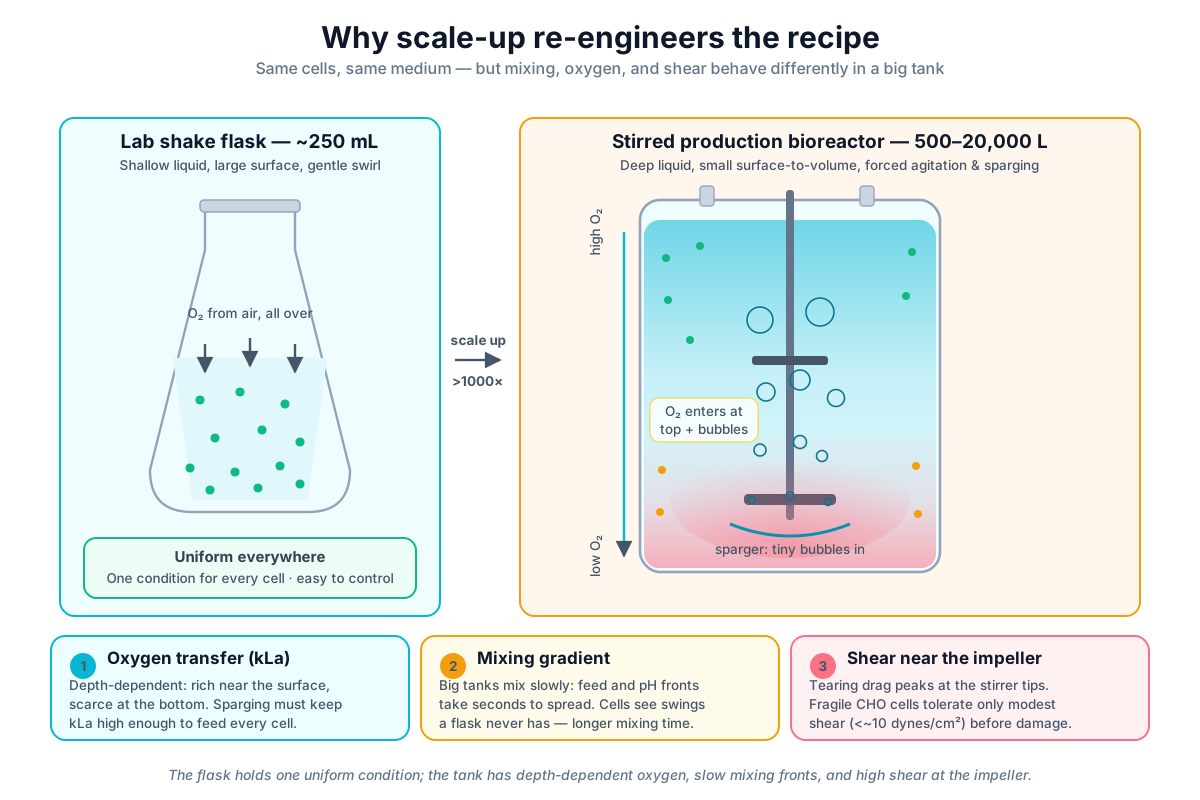 Scale-up challenges: oxygen, mixing, and shear. The left flask achieves uniform conditions; the large tank (right) has depth-dependent oxygen, slow mixing fronts, and high shear near the impeller.
Original diagram by the authors, created with AI assistance.
Scale-up challenges: oxygen, mixing, and shear. The left flask achieves uniform conditions; the large tank (right) has depth-dependent oxygen, slow mixing fronts, and high shear near the impeller.
Original diagram by the authors, created with AI assistance.
Oxygen transfer and the kLa challenge across scales
Cells breathe oxygen, just like we do. Engineers measure how fast a tank can dissolve oxygen into the liquid with a number called the volumetric oxygen transfer rate (kLa), given in units of "per hour" (h⁻¹) — a "per hour" rate because it describes how quickly oxygen enters the liquid (a higher number means a faster fill), not an amount. A big tank has far more liquid per litre of bubble surface — the same gas flow spread through much more broth creates proportionally less gas-liquid bubble area to feed each litre — so the same gentle bubbling that floods a flask with oxygen falls short at scale. Engineers must redesign the sparger (the gas inlet) and the impeller (the spinning blade that stirs the tank) to keep kLa high enough to feed every cell [1].
The catch is that kLa is not a fixed property of the recipe — it depends on the geometry of the specific vessel: how the gas is bubbled in, how small the bubbles are, and how much stirring power is applied per unit of liquid. The same culture that sees a kLa of 60 h⁻¹ in a small vessel can see far less in a tall production tank fed by the same gas flow, simply because the bubble interfacial area per litre collapses as the tank grows (the same gas flow, spread through far more broth, is a lower gas flow per litre — so the bubbles create much less gas-liquid surface to feed each litre). That is why kLa cannot be carried over on paper; it has to be re-measured and matched at every scale. Engineers measure it directly with a gas-out / gas-in dissolution test: strip the dissolved oxygen out of the broth (typically by sparging nitrogen), then re-aerate and watch how fast the dissolved-oxygen probe recovers — the shape of that recovery curve yields kLa.
A quick worked example makes "collapses" concrete. A 2 L vessel might hold 60 h⁻¹ at a given sparge rate; deliver the same gas flow into a 2,000 L tank and the kLa can fall to roughly a third of that, because that same gas flow now makes far less bubble surface per litre of broth. The fix is not more bubbling alone (that raises shear) but a re-engineered sparger and impeller that recover the lost transfer rate. The requirement itself comes from the cells: the oxygen uptake rate (OUR) equals the per-cell demand times the viable cell density (the number of living cells packed into each millilitre of broth), so the kLa you must supply scales with how dense and how hungry the culture is — which is exactly why high-density perfusion is even harder to aerate than fed-batch.
Supplying oxygen is only half the gas problem. As tanks grow, removing dissolved carbon dioxide becomes as hard as supplying O₂: the taller liquid column and lower specific gas flow strip CO₂ poorly, so dissolved CO₂ (pCO₂) accumulates — a problem that simply does not arise at flask scale. Elevated pCO₂ (the partial pressure of dissolved CO₂, measured in mmHg; often a concern above roughly 100 to 150 mmHg) depresses pH and can shift glycosylation (the pattern of sugar chains the cell attaches to the antibody — these sugars affect how the drug behaves and how fast the body clears it, so a changed pattern is a quality and safety concern), and the sparge and overlay strategies used to blow it off trade directly against shear. CO₂ stripping is therefore a co-equal scale-up constraint, not an afterthought to aeration.
Anatomy of a critical process parameter — the kLa setpoint
A scale-up parameter like kLa is never written in the package as a bare number. It is treated as a critical process parameter (CPP) — a setting the factory must hold in range because a measurable product property, a critical quality attribute (CQA) such as the titer (how much antibody is made) or the aggregate level (how much clumped antibody forms), depends on it (both terms are unpacked fully below). It is an engineered specification: a definition, a unit, a way to measure it, a setpoint with a tolerance band, evidence that it was matched in a scale-down model and re-verified at full scale, and — crucially — a link to the product quality it exists to protect. The card below dissects one such parameter.
 A critical process parameter such as kLa carries its units, measurement method, a setpoint with tolerance, and the CQA it safeguards — not just a number.
Original diagram by the authors, created with AI assistance.
A critical process parameter such as kLa carries its units, measurement method, a setpoint with tolerance, and the CQA it safeguards — not just a number.
Original diagram by the authors, created with AI assistance.
This is exactly the level of structure that lets a setpoint survive the journey from a 2 L bench vessel to a 2,000 L tank. The exact numbers on the card (a target near 60 h⁻¹ with a ±10 band) are illustrative; what is universal is the shape of the record. When this same parameter is later read live off the bioreactor, it becomes a tagged, timestamped data point — one entry in the batch's data shadow (the complete digital record a single batch leaves behind), the subject of automation and control data and where data is born in Book 2, and a concrete sensor reading wired up in the upstream bioreactor implementation in Book 3.
Mixing time, dead zones, and feed distribution
In a flask, every drop is the same. In a 2,000 L tank, fresh food and oxygen take longer to reach every cell. The time it takes to blend the whole vessel — the mixing time — stretches from a second or two in a flask to the order of tens of seconds in a well-designed production tank, so cells near the bottom can briefly sit in pockets that are low on food or high on waste. (Blend times running into minutes are themselves a warning sign of a poorly mixed vessel.) The engineering goal is to keep mixing time short relative to the timescale on which feed is added and consumed, so a nutrient bolus is dispersed before any cell sees an extreme. Stir too gently and some cells starve; stir too hard and you hurt them.
The problem is sharpest at the feed point. Concentrated nutrient is added at one spot on the headplate; if mixing is slow, a transient plume of high-osmolality (very concentrated — salty and sugary), high-pH liquid (cells need a narrow pH window, so a local spike is itself a stress) forms right where the feed lands before it disperses. Cells that pass through that plume experience a brief shock the flask never imposed. Engineers fight this with the impeller design and the feed location, and they study it in a scale-down model so the big-tank gradients are characterized — not discovered — on the GMP floor.
Shear forces and cell tolerance limits
Shear is the tearing drag a cell feels from fast-moving liquid and bursting bubbles. Mammalian cells like CHO have no protective cell wall, so they are delicate — they generally tolerate shear only up to roughly 10 dynes/cm² (a dyne per square centimetre is a tiny pressure-like measure of drag — 10 of them is a gentle stress, easily exceeded by aggressive stirring) before they start to suffer [2]. Push past that and cells rupture, spilling their contents and triggering protein clumping. The bigger and faster-stirred the tank, the trickier this balance.
Shear and oxygen pull in opposite directions, which is the heart of the scale-up bind: the fastest way to raise kLa is to sparge harder and stir faster, but both of those raise shear. A burst bubble at the liquid surface is one of the most damaging shear events a cell can meet: damage scales with the local energy-dissipation rate, and a bubble rupturing at the surface produces transient dissipation rates orders of magnitude above the gentle bulk flow. This is why essentially every CHO process adds Pluronic F-68 (poloxamer 188) to the medium — the surfactant coats cells and keeps them from attaching to bubbles, sharply cutting sparge-related death. So the engineer is always solving a constrained problem — enough oxygen, gentle enough handling — and the safe window narrows as the tank grows.
The scale-up ladder and empirical matching
Because mixing, oxygen, and shear all change with size, teams climb a ladder, testing the recipe at each rung before going bigger. At pilot scale — a mid-size demonstration plant — the team proves the recipe still works at, say, 50 to 200 L before risking a 2,000 L tank. The figure below lays out that ladder rung by rung.
 The scale-up ladder: each rung is re-proven before the next, with kLa, mixing time, and shear re-matched at every step (bands illustrative).
Original diagram by the authors, created with AI assistance.
The scale-up ladder: each rung is re-proven before the next, with kLa, mixing time, and shear re-matched at every step (bands illustrative).
Original diagram by the authors, created with AI assistance.
The key idea is empirical matching, not geometric scaling. You cannot simply make every dimension proportionally bigger and expect the physics to follow — the relationships between volume, surface, power, and transfer rate are non-linear. Instead, engineers pick a single quantity to hold constant across scales and tune the bigger vessel until it matches. There are three usual choices, and they conflict — you can only hold one constant at a time, which is exactly why scale-up is always a compromise rather than a formula:
| Hold this constant | Choose it when… | Typical band |
|---|---|---|
| Power per volume (P/V) — the default | you want to balance mixing and kLa together | ~20 to 250 W/m³ across mammalian processes |
| Impeller tip speed | shear is the limiting concern | matched to stay under the cell's shear tolerance |
| kLa | the culture is oxygen-limited | e.g. ~60 h⁻¹, matched directly |
The 20 to 250 W/m³ figure is a range across different processes, not a tolerance band on one process — different cultures settle at different points within it. The scale-down model runs the experiment in reverse: a small bioreactor is deliberately detuned to reproduce the gradients and shear of the production tank, so the large process can be studied cheaply and safely before any GMP material is at risk. That model is not just a convenience — it must be formally qualified (statistically shown to be representative of the at-scale process, per ICH Q11 and the A-Mab case study — a widely-cited, freely-published hypothetical mock-antibody dossier from the CMC Biotech Working Group that the industry uses as a worked Quality-by-Design teaching example, not a real product or a binding regulation) before its data can support the control strategy; a regulator will reject characterization data from an unqualified model. The same DoE data that defines the safe ranges can also train a soft sensor — a model that predicts a hard-to-measure quantity (like kLa or titer) from the cheap probes a tank already has — so that a parameter can be inferred or even optimized between scales rather than re-measured by hand. Book 5 develops exactly that idea in models that travel between scales.
The machines that do the work
Scale-up is not abstract — it runs on specific, named equipment. In the lab and pilot suite, controlled benchtop and pilot bioreactors such as the Sartorius Biostat and B. Braun (now Sartorius) Biostat B systems hold roughly 1 to 10 L and let scientists dial in temperature, pH, dissolved oxygen, and stir speed precisely. For gentle, seed-stage growth, rocking-motion bags like the Cytiva WAVE bioreactor (typically a few liters up to ~200 L) mix by gently rocking a bag rather than stirring, which keeps shear low. As volumes climb to production scale, teams use large stirred-tank bioreactors — either traditional stainless steel or single-use systems built around presterilized plastic bags from vendors such as Pall, Thermo Fisher, and Meissner, with working volumes that commonly run up to about 2,000 L per single-use bioreactor.
A key nuance: single-use equipment ships sterile, so it gives you clean primary containment (the sterile boundary that holds the culture in and keeps outside contamination out) without the chore of cleaning and revalidating a steel vessel between batches.
"Single-use means no validation." It does not. Every tubing connection, weld, and transfer step still has to be made with validated aseptic technique (a germ-free working method that keeps microbes out), and many process connections still rely on steam-in-place (SIP) sterilization of the junction (SIP steam-sterilizes a single connection or line; clean-in-place, CIP, is the separate operation that cleans a whole reusable vessel between batches). Single-use removes one kind of cleaning burden; it does not remove the need to prove that the assembly stays sterile.
How big is "big"? — the commercial scale
Most approved antibodies are made by fed-batch culture: cells grow in a closed tank and are periodically fed concentrated nutrients, then the whole batch is harvested at the end. A typical CHO-cell fed-batch run lasts about 12 to 21 days before harvest [3]. Commercial fed-batch tanks span a wide range — roughly 500 L to 20,000 L depending on the product's demand — rather than one fixed "standard" size; smaller-volume biologics may never need the biggest tanks, while blockbuster antibodies push toward the top of that range [3].
First the team does engineering runs: practice batches whose goal is to test the equipment and the steps, not to make sellable medicine. Mistakes here are cheap lessons. If engineering runs are the dress rehearsals, GMP runs are opening night — the first batch you could actually give a patient. Once the practice runs are smooth, they switch to GMP runs. These batches are made under cGMP (current Good Manufacturing Practice) — the strict, continually updated, written-down rules that guarantee every batch is safe, consistent, and identical. These cGMP batches make the real material used in clinical trials, the carefully controlled studies that test the medicine in volunteers.
The tech-transfer package: CPPs, CQAs, and control strategy
The other half of the job is tech transfer. The development team packages the entire validated process into a detailed dossier and hands it to the manufacturing site. A real tech transfer package is far more than a recipe card — it typically contains [5]:
- the critical process parameters (CPPs) — the settings (temperature, pH, dissolved oxygen, feed timing, stir speed) that must stay inside defined ranges, each with a setpoint ± tolerance;
- the critical quality attributes (CQAs) — the product properties (purity, aggregation, glycans — those sugar chains — potency) that those CPPs are there to protect;
- the control strategy that explicitly links each CPP to the CQA it safeguards, so the factory knows why every number matters;
- design of experiments (DoE) results — structured experiments that mapped how parameters interact and where the safe operating ranges lie;
- scale-down model data — small bioreactors deliberately tuned to mimic the big tank, used to study the large-scale process cheaply;
- and cleaning validation (CIP) — proof that clean-in-place procedures leave no residue between batches.
This is exactly the kind of structured, QbD-style package the canonical A-Mab industry case study lays out [5], and it is what regulators expect under ICH Q11, which defines how a biotech drug-substance process and its control strategy must be developed, documented, and justified when it is transferred [6]. Done well, the factory reproduces the process exactly, the very first time.
The one-sentence rule worth memorizing: a CPP is a knob you set (and must hold in range), while a CQA is a property of the product you measure — the control strategy is just the documented wiring from each knob to the quality it protects. Those knobs are concrete loops on the headplate. The dissolved-oxygen setpoint (commonly 30 to 40% of air saturation) is held by a cascade that first ramps agitation, then opens up sparge and oxygen enrichment; pH (typically about 6.8 to 7.2 for CHO) is pushed down by CO₂ sparge and up by base addition. The control strategy is the connective tissue: each CPP — kLa, dissolved-oxygen setpoint, pH, temperature, feed schedule, agitation — is mapped to the specific CQA it defends. That mapping is why a parameter earns the word "critical." Each of those "CPP protects CQA" links is also a typed relationship — a named, machine-readable edge of the kind Book 4 formalizes as the runs-on and derived-from genealogy of relations and genealogy over the classes and taxonomy of process and product. It is also what makes the whole process legible to data systems downstream: once the control strategy names a parameter and its limits, that parameter can be tagged, logged, and trended automatically — landing as a concrete row in the open-source reference architecture, which is the bridge into how this same information is contextualized and stored in Book 3's contextualization layer.
So far, we have seen the three physics constraints that make a big tank a different world from a flask — oxygen transfer (kLa), mixing time, and shear — and how a team climbs the scale-up ladder by holding one criterion constant at each rung. We have also seen what the development team actually hands over: a package of CPPs, CQAs, a control strategy linking them, DoE and qualified scale-down data, and cleaning validation, all governed by ICH Q11. With the physics and the paperwork in hand, the stakes come into focus.
Why it matters
If scale-up is rushed, the cells in the big tank behave differently from the flask. They might make less antibody, or make a slightly different antibody that the patient's body could react to. A weak tech transfer is just as dangerous: if a single parameter is written down wrong or left out, the factory batch can fail — wasting months and millions, or worse, putting an unsafe medicine on the path toward people.
When scale-up fails: a real-world deviation
Here is a concrete way it goes wrong. Suppose a scale-up team gets the impeller speed slightly too aggressive at 2,000 L, pushing shear above that ~10 dynes/cm² tolerance, or transfers cells that are the wrong age (an over-aged inoculum, which lengthens the lag phase before growth resumes). Either misstep can easily cost tens of percent of antibody titer — illustrative, not a measured constant — and spike the level of aggregates as stressed, lysed cells release their contents. (The two missteps act through different mechanisms — an over-aged inoculum lengthens the lag phase, while impeller shear lyses cells — so they are not interchangeable and would not produce the same magnitude of loss.) Fluid-mechanical cell damage of this kind is exactly what the shear-sensitivity literature characterizes [2].
Trace the failure mechanistically. Over-aggressive agitation does its damage in two ways at once: the high-velocity flow at the impeller tips exceeds the cell's shear tolerance, and the harder sparging needed to keep up with oxygen demand multiplies the bubble-burst events at the liquid surface — the single most lethal shear environment for a wall-less mammalian cell [2]. Lysed cells dump intracellular enzymes and host-cell protein into the broth; the released contents and the mechanical stress on surviving cells both drive the product to misfold and clump into aggregates. So a single mis-set parameter produces two compounding failures: less drug (lower titer, because fewer healthy cells are producing) and worse drug (more aggregate, a safety-relevant CQA). The same physics is documented across the published scale-up and shear-damage literature, which is precisely why fluid-mechanical cell damage is treated as a first-order design constraint rather than an afterthought [1][2]. The batch may have to be discarded — all from a parameter nobody re-validated at scale. This is the bridge where a promising science project becomes a real, repeatable, safe product, and why every number in the package is treated as load-bearing.
In the real world
The baseline commercial path scales a fed-batch culture up to a large stainless-steel or single-use tank — the production bioreactor where the cells spend their working lives — then captures the antibody with the Protein A platform — the standard first capture step that grabs the antibody out of the broth (see capture chromatography). Protein A resin (the porous solid beads packed into a column that selectively grab the antibody as broth flows past) is expensive but works because it binds antibodies with high specificity, and its dynamic binding capacity (DBC) — how much antibody a litre of resin can hold under flow — has climbed to roughly 40 to 80 g/L resin on modern media (first-generation resins held only 10 to 20 g/L). These resin numbers matter to tech transfer because the capture step has to be sized to the bigger tank's output: scaling the culture that big is genuinely hard, and so is matching the downstream column to it, which is why the ladder of engineering and cGMP runs exists [3].
Perfusion and continuous processing as intensity alternatives
A modern, emerging approach makes scale-up gentler through intensified and continuous processing. Instead of one enormous tank, facilities increasingly run smaller bioreactors continuously using perfusion: fresh medium flows in and spent medium (with product) flows out nonstop, while a tangential flow filtration (TFF) device retains the cells inside the vessel. Because waste is constantly swept away and product is harvested continuously, perfusion cultures reach far higher cell densities — roughly 50 to 100 × 10⁶ viable cells/mL, versus about 5 to 20 × 10⁶ cells/mL at the peak of a conventional fed-batch — so a much smaller vessel can match the output of a giant batch tank while smoothing out process variability [4]. A real industrial case study showed how adding an N-1 perfusion seed step (running the seed bioreactor one stage before the final production tank — call the production tank N, so the stage before it is "N minus 1" — in perfusion mode so cells reach high density before the production tank is inoculated) and intensified single-use processing substantially raised volumetric productivity (grams of antibody produced per litre of reactor per day) over the conventional fed-batch baseline [4]. But that intensity is not free: a perfusion run trades tank size for a cell-retention device (an ATF — alternating tangential flow — or TFF membrane) that slowly fouls (clogs with cells and debris) over a 30 to 60 day campaign, consumes far larger media volumes, and demands tighter steady-state control with more exposure to contamination over the long duration. Fed-batch still dominates approved mAbs today; continuous/intensified is the direction the field is moving.
Whichever path a process takes, cGMP demands that every step be documented in real time in a batch record. Operators record each parameter against its setpoint ± tolerance as the batch runs; if a value drifts outside its limit, that triggers a formal deviation — a logged, investigated event with a documented root cause and corrective action before the batch can be released. Those records are held to a data-integrity standard captured by the acronym ALCOA+ — every entry must be Attributable, Legible, Contemporaneous, Original, and Accurate (the "+" adds complete, consistent, enduring, and available). When the batch record is electronic — as it increasingly is — the system that holds it falls under 21 CFR Part 11 (the U.S. rule for electronic records and electronic signatures) and its EU counterpart Annex 11, and the software itself must be validated to show it does what it should. Book 2 covers all three in depth: data integrity and ALCOA+, Part 11 and Annex 11, and the modern shift from heavy computer system validation (CSV) to risk-based computer software assurance in validating computerized systems. The logic of those control limits traces straight back to the analytical assays defined in analytical and formulation: a parameter is "critical" precisely because a CQA measured by those tests depends on it. Proving the whole transferred process actually delivers consistent product follows the FDA Process Validation lifecycle, which is built in three stages — process design (working out the CPPs and control strategy — the tech-transfer package above), process qualification (the GMP runs that prove the at-scale process is reproducible), and continued process verification (ongoing batch-record trending so it stays in control) — and is anchored in the U.S. cGMP regulations (21 CFR Part 211) [7]. (The analytical assays those control limits depend on carry their own compendial anchor — they are validated under USP <1225> Validation of Compendial Procedures, which governs test-method validation, not process validation.)
Key terms
- Scale-up — re-engineering a process so it works in a much larger vessel, not just a small flask.
- Tech transfer — packaging a complete validated process and handing it to a manufacturing site to reproduce exactly.
- Tech transfer package — the dossier of CPPs, CQAs, control strategy, DoE results, scale-down data, and cleaning validation handed to manufacturing.
- Pilot scale — a mid-size demonstration step between the lab and full commercial scale.
- Engineering run — a practice batch to test equipment and steps, not meant to make sellable medicine.
- GMP run — a batch made under current Good Manufacturing Practice; produces real material, including for clinical trials.
- cGMP (current Good Manufacturing Practice) — the continually updated, legally enforced rules that guarantee every batch is safe and consistent.
- Shear force — the tearing drag from moving liquid and bubbles that can damage delicate cells; mammalian cells tolerate roughly up to 10 dynes/cm².
- kLa (volumetric oxygen transfer rate) — how fast a bioreactor dissolves oxygen into the liquid, measured per hour (h⁻¹); geometry-dependent, so it must be re-measured and matched at every scale.
- Empirical matching — holding a chosen quantity (often kLa, power-per-volume, or impeller tip speed) constant across scales and tuning the bigger vessel to match, rather than scaling every dimension proportionally.
- Aggregate — clumped, misfolded antibody molecules; a safety-relevant quality attribute that spikes when stressed cells lyse.
- Mixing time — how long it takes to blend the whole vessel uniformly; longer in big tanks.
- Fed-batch culture — cells grown in a closed tank with periodic nutrient feeds, harvested at the end; the baseline mAb process.
- Perfusion — continuous culture where fresh medium flows in and product flows out while cells are retained, reaching far higher cell densities.
- TFF (tangential flow filtration) — a filter that keeps cells inside a perfusion bioreactor while letting spent medium and product pass.
- ATF (alternating tangential flow) — a sister cell-retention device to TFF used in perfusion; like TFF, the membrane slowly clogs (fouls) over a long campaign.
- Viable cell density — the number of living cells packed into each millilitre of broth; the denser the culture, the more oxygen it demands.
- Glycosylation / glycans — the pattern of sugar chains the cell attaches to the antibody; these sugars affect the drug's safety and how the body clears it, so a shifted pattern is a quality concern.
- Critical process parameter (CPP) — a process setting that must stay in a defined range to protect product quality.
- Critical quality attribute (CQA) — a product property that must stay within set limits for the medicine to be safe and effective.
- Control strategy — the documented links between each CPP and the CQA it protects.
- DoE (design of experiments) — structured experiments that map how parameters interact and define safe operating ranges.
- Scale-down model — a small bioreactor tuned to mimic the large-scale process for cheaper study.
- Cleaning validation (CIP) — proof that clean-in-place procedures leave no residue between batches.
- Single-use — sterile disposable plastic equipment used instead of cleaned steel tanks (connections still need validated aseptic technique / SIP).
- Inoculum — the starting batch of cells used to seed a bioreactor; its age affects how quickly growth resumes.
- Titer — the concentration of antibody a culture produces.
- Batch record — the real-time, step-by-step documentation of a cGMP batch.
- Deviation — a logged, investigated event when a parameter falls outside its control limit.
- Data shadow — the complete digital record a single batch leaves behind, each measured parameter becoming a tagged, timestamped data point.
- ALCOA+ — the data-integrity standard GMP records must meet: Attributable, Legible, Contemporaneous, Original, Accurate (plus complete, consistent, enduring, available).
- Soft sensor — a model that predicts a hard-to-measure quantity (such as kLa or titer) from the cheaper probes a tank already has.
- Clinical trial — a controlled study that tests a medicine in volunteers.
Where this leads
Scale-up and tech transfer give us a process the factory can run and a dossier that proves how to run it. But a 2,000 L tank does not start full of cells — you have to grow up to that volume gradually, one larger vessel at a time. Next, in the seed train, we follow that careful, step-by-step expansion from a single thawed vial to a tank brimming with billions of cells ready for production.